

Turn Regulatory Documents Into Instant, Audit-Ready Answers | Policy Q&A Chatbots for Regulated Industries on n8n
.jfif/v1/fill/w_320,h_320/file.jpg)
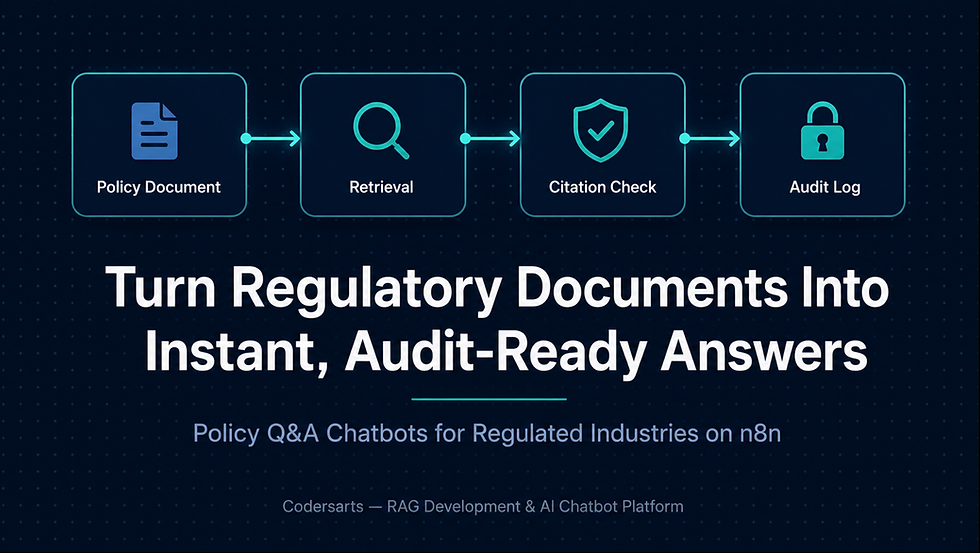
Picture a compliance officer at an insurance company, mid-audit, trying to confirm whether a specific disclosure requirement applies to a policy sold under a particular jurisdiction.
The answer exists — somewhere in a regulatory filing, an internal policy document, or a prior legal opinion — but finding it means searching across systems, checking with a specialist who may or may not be available, and hoping nothing's been updated since the last time someone looked. Multiply that by dozens of similar questions a week, across a team that's already stretched thin, and the cost isn't just time. It's risk. A slow answer delays an audit. A wrong one can trigger a finding, a fine, or worse.
This is exactly the kind of problem an AI chatbot seems built to solve — until you remember what's actually at stake. In HR or IT support, a chatbot that's occasionally a little off is an inconvenience. In compliance, an AI system that confidently answers a regulatory question incorrectly isn't a minor glitch. It's a liability with your organization's name on it. Which is why "chatbot" isn't really the right bar for this use case. The right bar is: can it point to exactly where that answer came from, and can you prove it did, months later, in front of an auditor?
That's what a properly built RAG — Retrieval-Augmented Generation — chatbot is designed to do. Instead of generating an answer from general training knowledge, it retrieves the actual regulatory text, internal policy, or prior ruling first, and grounds its response in that specific source — citing it, the way a compliance officer would if you asked them to show their work.
n8n has become one of the most widely used platforms for building these systems in production, and for compliance specifically, its core architecture happens to line up well with what regulated industries actually require. It's self-hostable, meaning sensitive policy and regulatory data doesn't have to leave your infrastructure to be processed. It's SOC2-aligned, which matters the moment your security or compliance team is part of the vendor evaluation. And it's node-based and visual, which means the resulting workflow — how a question gets answered, what it's grounded in, what gets logged — is something your own team can actually inspect, not a black box you're asked to trust.
But — and this is worth being upfront about — having the right platform is not the same as having a system your auditors will actually sign off on. Citation enforcement, audit logging, access control, human-in-the-loop escalation: these aren't features you get by default from any AI platform, n8n included. They're deliberate engineering decisions, and getting them right is the difference between a compliance chatbot that's a genuine asset and one that becomes its own audit finding.
In this blog, we'll walk through real, documented implementations of policy and compliance Q&A systems — including a verified n8n build — the specific technical requirements regulated industries impose that a general-purpose chatbot doesn't have to meet, what it actually takes to build one of these on n8n, and honest guidance on when n8n is the right foundation versus when a custom build makes more sense.
This is the kind of system we build at Codersarts for clients who can't afford to guess — so we'll be direct about what's genuinely achievable, and where the real engineering work lives.
Why Compliance Q&A Is a Different Problem Than a Normal Chatbot
It's worth being precise about what makes this use case different, because the difference isn't really about the technology — it's about what happens when the technology gets it wrong.
An internal FAQ bot that misfires on a benefits question creates a minor inconvenience: someone gets a slightly off answer, maybe follows up with HR, and the mistake is forgotten by the next day. A compliance chatbot that misfires doesn't get that same margin for error.
A wrong answer about a disclosure requirement, a licensing obligation, or a data-handling rule can lead to a missed filing, an inconsistent policy applied across customers, or a finding that shows up in the next audit cycle with your organization's name attached to it. The stakes aren't hypothetical — they're regulatory, financial, and in some industries, reputational in ways that are hard to walk back.
There's also a consistency problem that's specific to compliance. When five different employees ask five different specialists the same regulatory question, you can end up with five slightly different answers — not because anyone's wrong on purpose, but because interpretation drifts, people remember things differently, and institutional knowledge isn't always written down anywhere consistent. A well-built compliance chatbot doesn't just answer faster — it answers the same way every time, grounded in the same source document, which is itself a meaningful improvement over how most compliance teams currently operate.
This is why "sounding right" — the bar most people unconsciously apply to a chatbot — isn't the bar that matters here. The bar is closer to what you'd expect from a compliance officer being questioned in an audit: where did that answer come from, can you show me the source, and can you prove what you told this person and when. A generic AI chatbot has no mechanism for any of that. It generates an answer and moves on.
A compliance-grade Q&A system needs to be built around a different set of requirements from the ground up:
Every answer needs a citation — not a vague reference, but a pointer to the exact document, section, or clause the answer is grounded in
Every interaction needs a record — an audit trail showing what was asked, what was retrieved, what was answered, and when
Access needs to be scoped — not every employee should be able to retrieve every policy document, especially in industries where information is segmented by role or jurisdiction
Some answers need a human in the loop — when the system isn't confident, or the question touches something high-stakes, escalation to a person needs to be built in, not bolted on after the fact
The underlying data needs to stay under your control — self-hosting and data residency aren't nice-to-haves in finance, healthcare, or insurance; they're often the deciding factor in whether a solution is viable at all
None of these are exotic requirements — they're the same standards compliance teams already hold themselves to. The difference is that most off-the-shelf AI chatbot tools weren't built with them in mind. What follows is what it actually looks like when a system is.
Real Implementations — What's Already Working
Theory is easy. What matters is whether this actually works in production, for real organizations, under real regulatory pressure.
Here's what's genuinely documented — starting with a verified n8n build, followed by three additional implementations that prove the broader approach works, even though they weren't built on this platform.
K33 — Compliance Automation for a Regulated Crypto Broker, Built on n8n
K33 is a Norway-based crypto exchange and broker, owned by a company listed on Nasdaq First North Stockholm, operating under MiCA, DORA, and anti-money laundering regulations, while also handling customer data under GDPR. For a compliance team of around 10 people carrying the regulatory obligations of a publicly listed company, the workload was significant — by their own account, compliance consumed roughly 70% of the team's time.
Before automating, the process was manual in ways that created real risk: customer data arrived by email and had to be typed into their AML software by hand; risk classifications were sometimes written up and then never actually applied; and verifying that everything was recorded correctly meant someone downloading CSV files and manually cross-checking addresses, tags, and risk levels for every client. Every customer also has to be periodically re-verified — annually for high-risk clients, every two to three years for others — which meant this manual burden never really let up.
K33 built their system on self-hosted n8n, deliberately chosen so customer data would never pass through third-party cloud sub-processors — a direct response to their GDPR obligations. Access is restricted by IP, limited to company-issued devices, and protected by single sign-on. Their COO built a custom n8n node specifically to handle authentication with their AML platform, so non-technical staff could update client records and risk classifications without touching an API directly.
AI is used in two specific ways: fuzzy matching between a scanned passport and a manually confirmed name, flagged with a confidence score, and a daily automated job that compares every client profile against internal policy and flags inconsistencies for review.
It's worth being precise here: K33's system is compliance automation with embedded AI — not a conversational Q&A chatbot. But the underlying architecture is exactly what a policy Q&A chatbot in a regulated environment needs: self-hosted infrastructure, restricted access, a system built for auditors to inspect, and AI applied carefully rather than broadly.
That's the foundation the rest of this post builds on.
The results, in K33's own words: roughly one hour saved per client on compliance checks, with the compliance verification workflow alone saving the equivalent of more than a full-time employee. Daily consistency checks that used to consume entire workdays now run automatically on schedule.
"With n8n, everything stays in our server, we are in control," said Giuliano Ciccone, K33's Chief Operating Officer. "Self-hosting takes a lot off our plate in terms of compliance and complexity." On how the system holds up under scrutiny, he added: "When we show auditors that we're mitigating risk with this workflow, they love it."
PwC Germany — A Peer-Reviewed RAG Chatbot for Regulatory Assurance
Not built on n8n — included because it's one of the most rigorously documented compliance chatbots publicly available, and it proves the approach itself works at a level most vendor case studies never reach.
PwC's Risk & Quality assurance team in Germany, working with researchers from Fraunhofer IAIS, the University of Bonn, and the Lamarr Institute, built a RAG chatbot to handle the volume of nuanced regulatory interpretation questions their team fields daily — the kind of question that requires understanding, for example, the exact scope of an EU tax-advisory prohibition, not just a keyword match.
The architecture is genuinely instructive: documents are chunked with overlap and a boosting factor that favors internal source material, embedded and indexed in Azure AI Search, retrieved using a hybrid of vector and keyword search, and answered by GPT-4o at zero temperature — with the system prompt explicitly instructing it to cite every fact by document and chunk ID, and to say so rather than invent an answer when the source material doesn't contain one.
In peer-reviewed evaluation against 124 expert-annotated queries, judged by senior R&Q specialists, this configuration reached a G-Eval answer-correctness score of 3.79 out of 5 — meaningfully ahead of GPT-4-Turbo (3.69), GPT-4o-mini (3.63), and GPT-3.5-Turbo (3.27) on the same task. Hybrid search consistently outperformed vector-only or keyword-only retrieval across every configuration tested.
RBC "Arcane" — Investment Policy Search Inside One of Canada's Largest Banks
Not built on n8n — included as a named, executive-level example of the same problem this post is about, at real enterprise scale.
At Royal Bank of Canada, investment specialists — typically with five to ten years of specialized training — were losing meaningful time locating policy answers scattered across PDFs, spreadsheets, and internal platforms. As Dr. Ahsan Mujahid, RBC's Head of AI Solution Acceleration and Innovation, described it, every second of that delay carried "multiplicative productivity impacts, often translating to millions of dollars in bottom-line impact."
The team built a standard RAG architecture — heavy investment in parsing semi-structured source documents, a ChromaDB vector store, and a chat interface where every answer links directly back to its source. They evaluated it rigorously, using retrieval-precision and faithfulness metrics alongside human review, and documented a real risk worth noting for anyone building something similar: errors can compound across a multi-turn conversation, since each new answer depends on context carried from the last.
RBC completed this as a tested pilot before handing it to their enterprise AI team for further scaling — no published ROI figures exist yet, and we won't invent any here.
QueryNow — Cutting Pharma Compliance Review From Hours to Minutes
Not built on n8n — an agency-built system for an anonymized European pharmaceutical regulator, included for its clear before-and-after metrics.
A national medicines-advertising regulator in Europe faced a review bottleneck: every marketing claim had to be manually cross-referenced against regulations, prior approvals, and dossiers — two to three hours per asset, with inconsistent verdicts and no audit trail to fall back on.
The resulting system — built on GPT-4 and GPT-4 Vision, Azure AI Search, and a structured 11-rule validation process — reduced that review time to roughly two minutes per asset, with a complete audit trail behind every finding: the prompt used, the model parameters, the retrieved source documents, and a timestamp. In production, it's handled over 620 assets.
"We went from a process that took hours per asset and still produced inconsistent results, to a system where customers get structured compliance feedback in under two minutes," said the client's Head of Digital Operations. "The citation transparency changed everything. Every finding traces back to the exact regulation."
Four different organizations, four different regulatory environments — but the same underlying pattern. In every case, what actually delivered results wasn't "adding AI." It was building a system deliberately constrained to cite its sources, log its reasoning, and fail safely when it wasn't sure. That discipline is what the rest of this post is about.
Let's Look at More Chatbot Use Cases on n8n
The compliance-specific examples above prove the approach works — but if you're evaluating n8n as a platform, it's worth seeing what it's already achieved outside of regulatory use cases too. These are fully verified n8n implementations, and while they're not compliance-focused, they show the same underlying pattern: a chatbot built to retrieve and ground answers in real organizational knowledge, rather than generate from memory.
XIBIX Solutions — Cutting Repetitive HR Questions in Half
XIBIX Solutions, a Munich-based IT services company with around 120 employees, built an internal "Ask HR" chatbot to solve a problem every growing company eventually runs into: HR staff spending real time answering the same policy and benefits questions, over and over, that were already documented somewhere in Confluence.
The system retrieves directly from their Confluence knowledge base, with embeddings stored in a hosted vector database on Azure and retrieval logic orchestrated in n8n. It's accessible through Microsoft Teams and an internal chat interface, so employees can ask wherever they already work.
Result: repetitive HR inquiries dropped by more than 50%, with HR reclaiming at least that much time previously spent re-answering the same questions.
"n8n is one of the top three impact makers in the next 12 months for us," said Fabian Pagel, XIBIX's founder and acting CTO.
TUP — An Internal Knowledge Chatbot Employees Actually Rely On
TUP, a German warehouse-management software company with around 160 employees, faced a familiar problem: project knowledge scattered across Confluence spaces, with employees manually digging through pages instead of getting a direct answer.
They connected an internal chatbot, built on OpenWebUI, to their knowledge store, with n8n handling the retrieval logic behind it.
Result: 26 hours saved per month, and — notably for a tool people need to trust daily — a 0.94% failure rate across 1,282 executions in a 30-day period, meaning it succeeded more than 99% of the time.
"Until last year, many teams had little or no practical experience regarding what artificial intelligence and automated workflows can do and how they can help with day-to-day tasks," said Julian Stock, TUP's AI and Automation Lead. "n8n provided us with the opportunity to show them."
Fullscript — Automating Compliance Work in a Regulated Healthcare Business
Fullscript, a North American healthcare and telehealth platform, operates in a genuinely regulated industry, with obligations around personal-data handling and account security.
One of their n8n-built workflows automates the review process required after certain calls, replacing manual audio review that previously had to happen within 30 minutes of each call, across roughly 13,000 monthly calls.
A separate system, built during an internal hackathon, automates identity and security investigations — parsing account data, gathering relevant context, and generating a full report automatically.
Result: the investigation workflow is projected to save 3,600 engineering hours a year, cutting security investigations by 97% and reducing what used to take weeks down to about half an hour. It was built in two days.
"We've saved hundreds, if not thousands, of hours for the team," said Sahar Rahmani, Fullscript's Director of Internal AI. "Not only is it about reducing this manual workload, it's about ensuring security and compliance."
What these three have in common with K33, and with the compliance examples before them, is the same core principle applied to a different problem: ground the system in real, existing data, and let it do the retrieval and repetition so people can focus on judgment calls instead of searching. That principle doesn't change based on industry — what changes, when the stakes get higher, is how much discipline goes into building it correctly.
That's what the next section walks through.
How a Compliance Q&A Chatbot Actually Gets Built on n8n
The core mechanics of a RAG chatbot don't change much between a general knowledge bot and a compliance-grade one. What changes is what gets added at nearly every step — citation enforcement, access control, and an audit trail that has to hold up months later, not just work in a demo. Here's what that actually looks like, stage by stage.

1. Source and scope the regulatory and policy documents.
Before anything gets built, the specific documents in scope get identified — regulatory filings, internal policy manuals, prior compliance rulings, licensing requirements, whatever the chatbot needs to answer from. In a compliance context, scoping matters more than usual: including outdated or superseded documents in the knowledge base isn't just noise, it's a real risk of the system confidently citing something that's no longer accurate.
2. Ingest documents with version and source tracking built in.
As documents are pulled into the pipeline, they need to carry metadata that survives all the way to the final answer — which document, which version, which effective date. This is a compliance-specific requirement that a general knowledge chatbot can usually skip: if a regulation changes, you need to know exactly which version of a policy the system was answering from at any point in time.
3. Chunk the content with citation integrity in mind.
Documents get split into retrievable pieces, same as any RAG build — but for compliance, the chunking strategy also needs to preserve enough structure that a citation actually means something. A chunk that cuts a regulatory clause in half, or separates a rule from its exception, doesn't just hurt retrieval quality — it risks the system citing a source that, read in full, actually says something different.
4. Generate embeddings and store them in a self-hosted, access-controlled vector store.
This is where compliance builds diverge most clearly from a typical internal chatbot. The embeddings get stored in a vector database that lives inside infrastructure you control — self-hosted n8n, deployed on infrastructure the organization owns or contracts directly, the same approach K33 took to keep customer data from ever touching a third-party sub-processor.
5. Build the retrieval workflow with role-based access scoped in.
When a question comes in, the retrieval workflow doesn't just search the full knowledge base indiscriminately — it scopes the search based on who's asking. A junior compliance analyst and a general counsel may need access to different sets of documents, and the retrieval layer needs to enforce that boundary, not just the interface on top of it.
6. Add reranking for precision on nuanced regulatory language.
Regulatory text is dense, and multiple retrieved chunks can look similar on the surface while only one is actually correct for the specific question asked. A reranking step re-scores retrieved results for genuine relevance before they reach the generation step — the same technique covered in our broader RAG engineering work, applied here to language where precision matters even more.
7. Enforce citation-only answers at the generation step.
This is the single most important compliance-specific decision in the entire build. The system prompt has to instruct the model to answer only from retrieved content, cite the specific source for every fact, and explicitly decline to answer when the retrieved material doesn't contain a clear answer. PwC's own R&Q chatbot uses exactly this approach — instructing the model not to invent an answer, and to cite by document and section rather than paraphrasing without attribution.
8. Log every query and response pair immutably.
Every question, every retrieved chunk, every generated answer, and the timestamp of each gets written to an audit log that can't be altered after the fact. This is what turns "the chatbot gave an answer" into "we can show exactly what it was told, what it retrieved, and what it said, on this date, to this person" — which is the actual bar an auditor will hold the system to.
9. Build in human-in-the-loop escalation for low-confidence answers.
When the system's retrieval confidence is low, or a question touches something high-stakes, the workflow should escalate to a person rather than generate an answer anyway. This isn't a failure of the system — it's a deliberate design choice that keeps the chatbot from ever being the last word on something it genuinely doesn't have a confident answer for.
10. Connect the chatbot to where compliance teams actually work.
The finished system gets surfaced through Slack, Microsoft Teams, or an internal portal — wherever the compliance or policy team already operates, so using it doesn't require adopting a new tool on top of an already full workload.
11. Set up an ongoing evaluation loop.
Once live, the system needs to be tested against a set of known questions with verified correct answers on a recurring basis — both to validate accuracy before rollout and to catch drift as source documents and regulations change over time. This is the step that turns "we built a compliance chatbot" into "we can prove it's still accurate," which is often the actual question a skeptical stakeholder or auditor is asking.
None of these steps require custom-coding a system from scratch — every one of them is achievable with n8n's existing nodes and workflow logic. What they require is knowing, at each step, which decision is a compliance requirement and not just an optional refinement. That distinction is the difference between a chatbot that's genuinely audit-ready and one that only looks that way until someone asks it to prove its work.
The Non-Negotiables: What Regulated Industries Actually Require
The build process above touches on each of these requirements as they come up. It's worth pulling them together here as a standalone checklist — partly because it's useful for evaluating any compliance chatbot proposal, including ours, and partly because these are exactly the questions a security or compliance team will ask before signing off on anything.

Source citations, not summaries.
A compliance chatbot's answer is only as trustworthy as its ability to show its work. That means every factual claim in a response needs to trace back to a specific document and section — not a general "based on company policy" gesture, but an actual pointer someone could click through and verify. PwC's R&Q chatbot enforces this directly in its system prompt, requiring citations in a document-and-chunk-ID format and instructing the model to say so rather than guess when the source material doesn't cover the question. This single design decision does more for trust than almost anything else in the system.
Immutable audit logs.
Every query, every retrieved source, every generated answer, and the exact timestamp need to be logged in a way that can't be edited or deleted after the fact. This isn't just good practice — it's what makes the system defensible during an actual audit. If a regulator or internal auditor asks "what did this system tell an employee about X policy on this date," you need an exact, unaltered record, not a reconstruction based on memory or logs that could have been touched.
Role-based access control at the retrieval layer.
Access control can't just live in the interface — it has to be enforced where the actual retrieval happens. If a chatbot searches the full document set regardless of who's asking, and just decides what to display afterward, that's not real access control; the information has already been retrieved and processed. For organizations where information is segmented by role, jurisdiction, or client relationship, the retrieval step itself needs to respect those boundaries.
Data residency and self-hosting.
For finance, healthcare, insurance, and public sector organizations, where data physically lives — and who can access the infrastructure it sits on — is often a non-negotiable procurement requirement, not a preference. K33's decision to self-host n8n specifically to avoid sending customer data through third-party cloud sub-processors is a direct, practical example of this in action. It's also often the deciding factor between a platform that's viable for regulated use and one that isn't, regardless of how capable it is technically.
Human-in-the-loop for genuine edge cases.
No compliance chatbot should be positioned as the final word on a high-stakes question. When retrieval confidence is low, or a question touches something with real consequences, the system should escalate to a person — and that escalation, along with the eventual human decision, should also be part of the audit trail. This isn't a limitation of the technology; it's a deliberate design choice that keeps the system honest about what it does and doesn't know.
Why RAG, not fine-tuning, is the right architecture here.
It's worth addressing directly, since it's a common question: why not just fine-tune a model on your compliance documents instead? The answer is that fine-tuning bakes knowledge into a model's weights in a way that's difficult to trace, difficult to update as regulations change, and impossible to apply access control to after the fact — you can't selectively "forget" a document for one user but not another once it's part of the model itself. RAG keeps the knowledge external, retrievable, citable, updatable, and scoped by access rules — which is exactly what auditability requires.
The regulatory frameworks worth knowing.
Depending on your industry, the relevant frameworks will differ, but the ones that come up most often in this space are:
SOC 2 (a near-universal baseline expectation for any vendor handling sensitive data),
HIPAA (for U.S. healthcare-related data),
GDPR (for any organization handling EU personal data, which shapes both data residency and retrieval-access requirements),
the EU AI Act (which may classify certain compliance-facing AI systems as higher-risk, with added transparency and oversight obligations),
and ISO 42001 (an AI management-system standard that's increasingly showing up in enterprise AI procurement checklists). None of these are optional context — they directly shape decisions like where data is hosted, how access is scoped, and how much human oversight is built in.
Taken together, this isn't a list of nice-to-haves layered on top of a chatbot. It's the actual definition of what makes a compliance chatbot different from any other kind — and it's why building one well takes real engineering discipline, not just access to an LLM and a document folder.
What to Actually Expect: Efficiency, Cost, Time, Scaling & Privacy on n8n
Before committing to a build, most enterprise teams want honest answers to a few practical questions: how much time will this actually save, what will it cost, how long will it take, will it hold up as we grow, and can we trust it with sensitive data. Here's a straight answer to each, based on what's actually been demonstrated rather than optimistic projections.
Efficiency
The efficiency gains from a well-built compliance chatbot tend to compound in ways that aren't obvious at first glance. It's not just that answers come faster — it's that the need for a person to manually cross-reference documents disappears for a large share of routine questions. K33's compliance verification workflow saved the equivalent of more than a full-time employee's worth of work, on top of roughly an hour saved per client interaction.
QueryNow's pharma compliance system cut review time from 2–3 hours down to roughly 2 minutes per asset — a change in order of magnitude, not a marginal improvement. The pattern across every real implementation covered in this post is the same: the biggest efficiency win isn't answer speed, it's the elimination of a manual, repetitive verification step that used to require a specialist's time for every single instance.
Cost
There's no honest flat number to give here — cost genuinely depends on scope, and giving one would either underclaim or overclaim depending on your situation. What's more useful is understanding what actually drives cost on n8n: whether you self-host or use n8n's cloud offering, which vector store you choose (some have generous free tiers, others scale in cost with data volume), how much you're calling embedding and LLM APIs, and how many source systems need to be connected and maintained.
What's worth weighing against that cost is what it replaces — K33's framing is instructive here: eliminating the equivalent of a full-time role's worth of manual compliance work is a real, ongoing offset against the cost of building and maintaining the system. The right way to think about cost isn't "what does this cost in isolation" but "what does this cost against what we're currently spending in manual hours and audit risk."
Time to build
This also varies meaningfully by scope, but there are honest ranges worth knowing. A narrow, single-source policy chatbot — one department, one document set, straightforward access rules — moves considerably faster than a multi-department system pulling from several regulatory sources with full audit tooling and tiered access control. Looking back at the build process covered earlier, most of the time investment isn't in connecting nodes on the canvas — that part is genuinely fast.
It's in getting the chunking strategy right for your specific documents, tuning retrieval and reranking until answers are consistently accurate, and building out the evaluation loop that proves the system works before it goes anywhere near production use. Rushing past that stage is exactly how a promising pilot becomes a system nobody trusts six months in.
Scaling
n8n handles growth in document volume, concurrent users, and connected systems well, up to a real but genuine limit. As a compliance chatbot expands from one department to several, or from one regulatory framework to many, the workflow logic itself tends to scale cleanly — n8n's node-based structure makes it straightforward to add new source connections or new access rules without rebuilding what's already working. Where scaling starts to strain a no-code approach is at the extremes: very high query volume with strict latency requirements, deeply complex multi-step regulatory logic that goes beyond standard retrieval and reasoning, or a need for infrastructure-level optimization that a workflow canvas isn't designed to provide.
For the vast majority of compliance use cases, n8n scales comfortably well past the point most organizations will ever need. For the exceptions, that's precisely where a custom-built solution becomes the more efficient path — covered in the next section.
Privacy and data residency
This is where n8n's structural advantages matter most for regulated industries specifically. Self-hosting — the same approach K33 took — means sensitive policy and customer data never has to leave infrastructure you control, which sidesteps an entire category of vendor-risk questions that come up with third-party SaaS AI tools. n8n's SOC2 alignment gives your security team a baseline they can evaluate against.
And because access control can be built directly into the retrieval workflow, sensitive information can be scoped by role or jurisdiction at the point of retrieval, not just filtered afterward in the interface. For an internal HR chatbot, this level of control is a nice-to-have. For a compliance chatbot handling regulated data, it's usually the deciding factor in whether a system is viable at all.
When n8n Is the Right Call — and When Custom Development Makes Sense
Every example in this post — including K33, the clearest n8n proof point — shares something in common: the compliance problem being solved, however serious, was well-served by a platform that connects existing systems and enforces good retrieval discipline.
That covers the large majority of compliance Q&A use cases. But it's worth being honest about where that stops being true, because recommending the same approach for every situation would be a disservice, not a sales pitch.
n8n tends to be the stronger choice when:
The chatbot needs to pull from multiple existing systems — policy wikis, regulatory databases, internal document stores — where n8n's pre-built integrations save real development time over building each connection from scratch
Auditability and internal transparency matter as much as the AI itself — a visual, node-based workflow is something your compliance and security teams can actually review line by line, rather than trusting a codebase they can't inspect
Self-hosting and data residency are firm requirements, and you need that control without the overhead of building an entire custom infrastructure stack around it
The system needs to evolve over time — new document sources added, new access rules introduced, new departments onboarded — without a full rebuild each time requirements shift
Speed to a working, defensible system matters, and a long custom-development cycle would delay getting real audit-trail and citation protections in place
A custom-built solution tends to make more sense when:
The compliance logic itself is unusually complex — multi-jurisdictional rule interactions, conditional logic that goes well beyond retrieval-and-cite, or reasoning chains that standard RAG nodes aren't built to handle cleanly
Query volume and latency requirements are demanding enough that a fully optimized, purpose-built pipeline meaningfully outperforms a node-based orchestration layer
There's a need for extremely granular, low-level control over model behavior, infrastructure cost optimization, or performance tuning that a no-code layer adds friction to
The organization already has significant internal engineering capacity, and a custom build integrates more efficiently into existing infrastructure than a general-purpose platform would
In practice, most compliance Q&A use cases — including everything covered in this post — fall clearly into the first category. The core value in a compliance chatbot comes from disciplined retrieval, citation enforcement, and audit logging, not from bespoke infrastructure most organizations don't actually need. But this is a genuine assessment worth making honestly before committing to either path, rather than defaulting to whichever approach is easier to sell.
If your compliance use case does call for something beyond what a no-code platform is built to handle — highly complex regulatory logic, unusual scale, or deep integration with existing internal systems — that's exactly the kind of engagement our RAG development services are built for. We'll tell you honestly which path fits before recommending either one.
Common Pitfalls in Compliance Chatbot Projects
Not every compliance chatbot project succeeds, and the ones that don't tend to fail for the same handful of reasons. Naming them plainly is more useful than a polished pitch — knowing where the risk actually lives is most of what prevents it.
No citation enforcement.
A chatbot that generates fluent, confident-sounding answers without tracing each fact back to a specific source isn't a compliance tool — it's a liability wearing a compliance tool's interface. This is the single most common shortcut we see, usually because it's the fastest way to get a demo working. It's also the first thing that erodes trust the moment someone in compliance asks "where did that come from" and the system can't answer.
No real audit trail.
A system that works well but can't produce an unaltered record of exactly what was asked, retrieved, and answered on a given date doesn't pass an actual audit review — even if every answer it ever gave was correct. Logging that can be edited after the fact, or that only captures the final answer without the retrieved sources behind it, isn't an audit trail. It's a log that looks like one until someone needs to rely on it.
Missing human-in-the-loop for edge cases.
Treating a compliance chatbot as the final word on every question — rather than building in a clear point where low-confidence or high-stakes questions escalate to a person — creates exactly the failure mode compliance teams are most worried about: an AI system making a consequential call with no human checkpoint. This is usually skipped not out of carelessness, but because it adds complexity to the build. It's complexity worth keeping.
Treating it as "set and forget."
Regulations change. Policies get updated. A compliance chatbot's knowledge base needs a maintained ingestion pipeline that keeps pace with those changes — otherwise the system keeps answering confidently from information that's quietly gone stale, which is arguably a worse outcome than having no automated system at all, since staleness is invisible until someone acts on a wrong answer.
Using RAG when a simpler rules engine would be more defensible.
Not every compliance question needs a language model's flexibility. For narrow, deterministic questions — does this transaction exceed a specific threshold, does this jurisdiction require a specific disclosure — a structured rules engine can be more accurate, faster, and easier to audit than a RAG chatbot. We've seen organizations reach for RAG because it's the current default, when a simpler, more rigid system would have actually served the compliance goal better. Part of doing this work honestly is knowing when the more exciting technology isn't the right tool for the specific question being asked.
Every one of these is avoidable — but only if they're accounted for from the start of the build, not patched in after a pilot reveals the gap. That's the difference between a compliance chatbot that earns your team's trust and one that becomes the reason leadership stops trusting AI initiatives altogether.
Why n8n + Codersarts
Everything covered so far points to the same conclusion: n8n gives regulated organizations a genuinely strong foundation for compliance Q&A — self-hosting for data control, visual workflows your own team can inspect, native integrations into the systems you already use, and enough flexibility to enforce citations, logging, and access control the way this use case actually requires.
What n8n doesn't do is make those decisions for you. It doesn't know which chunking strategy preserves the legal meaning of your specific policy documents. It doesn't decide how granular your access control needs to be, or which questions are risky enough to require a human checkpoint before an answer goes out. It doesn't design an audit log that will actually satisfy your compliance team's auditors, as opposed to one that looks sufficient until it's tested. Those are engineering and judgment calls — and they're exactly where a compliance chatbot project succeeds or quietly fails.
That's the layer we work at. At Codersarts, we build AI chatbot systems for clients who can't treat "it seems to work" as good enough — where the system needs to hold up under real scrutiny from compliance officers, security teams, and auditors, not just impress in a demo.
We've made the calls this post has walked through: what citation enforcement actually needs to look like in a system prompt, how to structure audit logging so it's genuinely immutable and useful months later, where role-based access needs to live in the retrieval layer rather than just the interface, and when a use case has outgrown what a no-code platform can reasonably handle.
Our AI chatbot platform is built around exactly this kind of work — RAG-based chatbots engineered for organizations where accuracy, auditability, and data control aren't optional extras, but the entire point. Whether the right foundation for your use case is n8n, a custom build, or something in between, that's a conversation we'd rather have honestly with you upfront than after a rushed pilot reveals the gaps the hard way.
Ready to Build a Compliance Chatbot Your Auditors Will Trust?
Stop losing hours to compliance and policy teams manually cross-referencing regulations, chasing down specialists for answers that already exist somewhere in your documentation, or living with the quiet risk of an AI tool that sounds confident but can't show its work.
Partner with Codersarts to build a compliance Q&A chatbot engineered around citations, audit trails, and access control from day one — not bolted on after a pilot reveals the gaps.
Take the Next Step
Request an Enterprise AI Architecture Session: Work directly with our team to evaluate your regulatory documents, existing systems, and compliance requirements, and map out a realistic deployment roadmap — including whether n8n or a custom build is the right foundation for your specific case.
Explore Our RAG Development & AI Agent Services: See how Codersarts engineers audit-ready RAG chatbots and compliance automation systems — on n8n and beyond, built around what regulated industries actually require, not a generic chatbot template.
Direct Contact: contact@codersarts.com
Website: www.ai.codersarts.com
You may also be interested in the following blogs:
Build a Multi-Agent AI Banking Document Processing Platform with n8n
Planning Agents in n8n: Breaking Complex AI Workflows into Governed, Executable Steps
RAG & Deep Research for Internal Documents: Why n8n Is the Ultimate Enterprise Control Plane
How Codersarts Builds n8n Lead Qualification Workflows for B2B Sales Teams

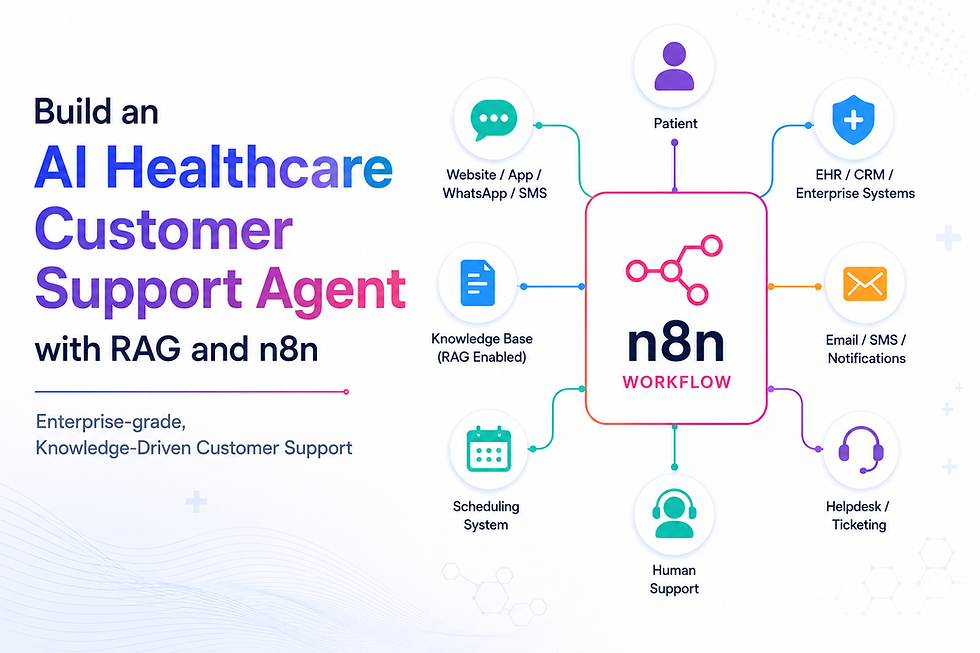


Comments