

Build an AI Healthcare Customer Support Agent with RAG and n8n | Enterprise-grade, Knowledge-Driven Customer Support

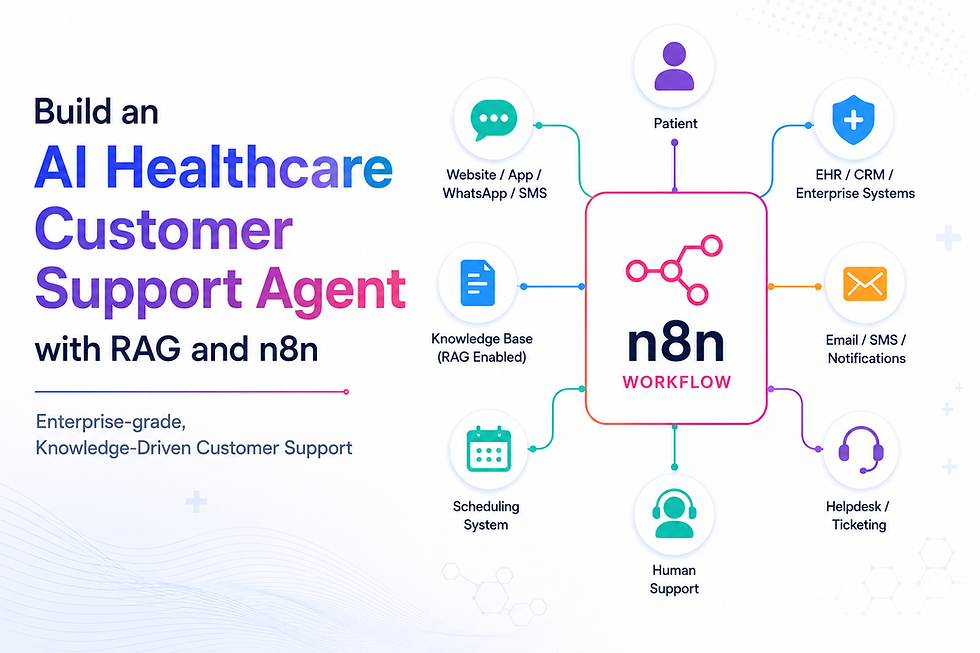
Healthcare customer support involves helping patients and caregivers with requests throughout their healthcare journey, including appointment scheduling, lab report updates, insurance questions, billing support, procedure instructions, and follow-up communication.
Unlike many industries, healthcare support requires access to information spread across multiple systems such as patient portals, scheduling platforms, electronic health record systems, CRM tools, billing systems, and internal knowledge repositories. The challenge is not only answering questions but connecting these systems to deliver accurate and timely responses.
AI can help understand patient requests, summarize information, and assist support teams. However, AI models alone do not have access to an organization’s latest policies, procedures, or internal documentation. This is where Retrieval-Augmented Generation (RAG) becomes valuable.
RAG enables AI systems to retrieve information from trusted sources such as healthcare policies, FAQs, and internal documentation before generating responses. This helps provide more accurate and context-aware answers based on an organization’s own knowledge.
However, patient support involves more than retrieving information. A complete workflow may require checking appointments, updating records, creating support tickets, sending notifications, and escalating requests to staff.
This is where n8n fits in.
n8n is a workflow automation and orchestration platform that connects applications, APIs, databases, and AI services through automated workflows. It allows healthcare organizations to coordinate AI agents, knowledge sources, patient systems, and human teams in one connected process.
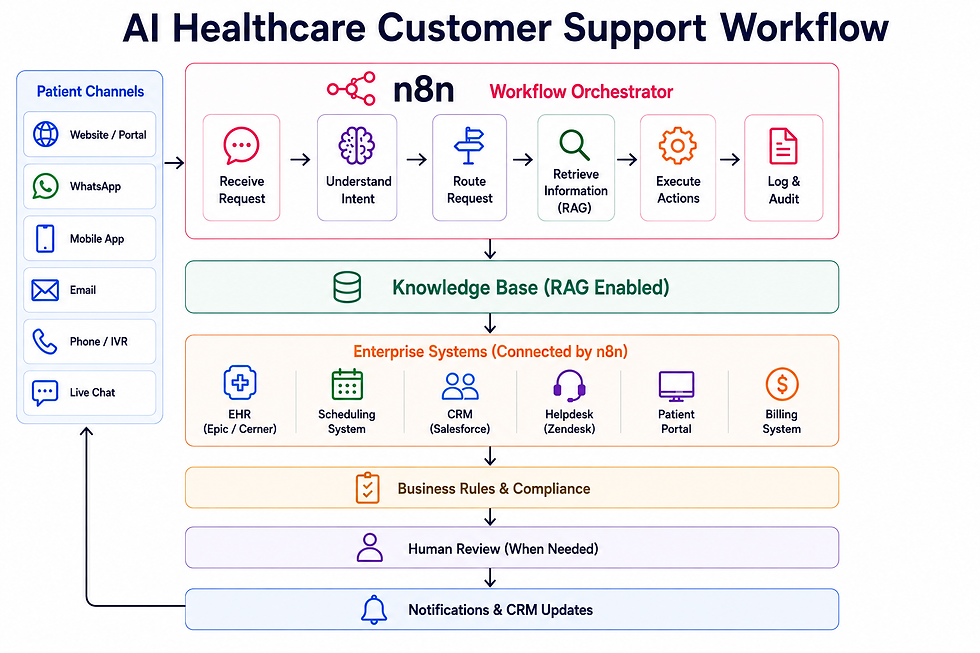
For example, when a patient requests an appointment change, n8n can receive the request, retrieve relevant policies using RAG, check scheduling availability, update systems, send confirmation messages, and route complex cases to support staff.
The value of n8n is not replacing healthcare systems or AI models. It is connecting them to create reliable, scalable, and adaptable customer support workflows.
Why Healthcare Organizations Are Choosing n8n for Workflow Automation
Healthcare organizations already rely on many digital systems, from patient portals and scheduling platforms to CRM tools, communication channels, and internal knowledge bases. The challenge is making these systems work together as one coordinated process.
This is where n8n provides value. It acts as a workflow orchestration layer that connects existing applications, automates repetitive processes, and coordinates AI-powered workflows without requiring organizations to replace their current technology stack.
Several capabilities make n8n suitable for healthcare automation:
Connecting Existing Healthcare Systems
Healthcare workflows often involve multiple platforms. n8n can connect applications through APIs, webhooks, databases, and built-in integrations, allowing systems such as scheduling software, CRM platforms, helpdesk tools, and knowledge repositories to exchange information automatically.
Flexible Deployment Options
Healthcare organizations often have strict requirements around infrastructure, security, and data handling. n8n supports self-hosted deployments, giving teams more control over where workflows run and how they are managed.
AI Workflow Orchestration
Instead of building standalone AI chatbots, organizations can use n8n to coordinate AI agents with real business processes. An AI agent can understand a patient request, while n8n manages the actions that follow, such as retrieving information, updating systems, creating tasks, or escalating cases.
Human Approval and Escalation Workflows
Healthcare support cannot be fully automated. Complex cases may require staff review, clinical input, or department involvement. n8n allows workflows to include human decision points, ensuring automation supports teams rather than removing necessary oversight.
Reducing Vendor Lock-In
Healthcare technology environments continue to evolve. n8n allows organizations to connect different AI providers, applications, and services within the same workflow, making it easier to adapt as requirements change.
The main advantage of n8n is not a single automation feature. It is the ability to bring together healthcare systems, AI capabilities, knowledge sources, and human teams into workflows that are easier to manage, monitor, and improve over time.
Why Healthcare Customer Support Is Really a Workflow Problem
Healthcare support is often viewed as a communication challenge, but in practice, it is a coordination challenge.
A patient asking a simple question may trigger multiple actions behind the scenes. A request to reschedule an appointment may require checking availability, validating scheduling rules, updating records, notifying the right department, and sending confirmation to the patient.
Similarly, a question about a procedure may require retrieving approved preparation instructions, while an insurance query may involve checking coverage information, creating a support ticket, and routing the request to the appropriate team.
These processes involve multiple systems and teams, including:
Patient portals
Scheduling platforms
Electronic health record systems
CRM and helpdesk platforms
Billing systems
Knowledge repositories
Email and messaging platforms
AI can help understand requests and provide relevant information, but it does not automatically manage the complete process. The real challenge is deciding what should happen next, which systems need to be accessed, and when human involvement is required.
This is where workflow orchestration becomes essential.
With n8n, healthcare organizations can create workflows that connect patient interactions, AI agents, healthcare applications, knowledge sources, and support teams. Instead of treating every request as a separate conversation, organizations can build repeatable processes that handle tasks from initial inquiry to final resolution.
The result is a support system that does more than answer questions. It coordinates actions across the healthcare ecosystem while keeping human teams involved where their expertise is needed.
How n8n Connects the Healthcare Customer Support Ecosystem
A modern healthcare support experience depends on many systems working together. Patients may interact through a website, mobile app, WhatsApp, or a patient portal, while support teams rely on scheduling platforms, CRMs, helpdesk tools, and internal knowledge systems to resolve requests.
The challenge is ensuring that information moves between these systems at the right time.
n8n acts as the orchestration layer that connects these components into a single workflow.
When a patient submits a request, n8n receives the event and determines the next steps. It can route the request to an AI agent, retrieve relevant information from approved knowledge sources, interact with healthcare systems, and trigger actions across multiple platforms.
For example, an appointment-related request may require retrieving scheduling information, checking available time slots, updating the appointment system, sending confirmation messages, and recording the interaction in the CRM. n8n coordinates these actions as one connected workflow.
The same approach can be applied to other support processes, such as:
Lab report notifications
Insurance inquiries
Prescription reminders
Procedure preparation guidance
Patient follow-ups
Support ticket management
The role of n8n is not to replace healthcare applications. It connects them.
By acting as the workflow layer between patient communication channels, AI capabilities, knowledge sources, and existing healthcare systems, n8n helps organizations build support experiences that are more consistent, automated, and easier to scale.
A Patient Support Journey Powered by n8n
Consider a patient who sends a message through the hospital's website:
"Can I reschedule my MRI appointment for next week?"
While the request appears simple, resolving it involves multiple systems and business processes. The workflow begins when n8n receives the request from the website, patient portal, or WhatsApp. It identifies the intent of the request and retrieves the patient's appointment details from the scheduling system.
Before suggesting a new appointment, n8n can use a RAG workflow to retrieve the hospital's latest scheduling and cancellation policies from approved knowledge sources. This ensures the AI agent responds using current organizational guidance rather than relying solely on model knowledge.
Next, n8n checks available appointment slots through the scheduling system. If suitable times are available, it presents the options to the patient and, once confirmed, updates the appointment automatically.
The workflow then continues by updating the CRM with the interaction, notifying the radiology department of the schedule change, sending a confirmation through the patient's preferred communication channel, and recording the workflow execution for operational tracking.
If the request cannot be completed automatically, such as when prior authorization is required or no appointments are available, n8n routes the conversation to the appropriate support team. The agent receives the conversation history and relevant patient context, allowing them to continue the interaction without asking the patient to repeat information.
From the patient's perspective, it is a simple conversation. Behind the scenes, n8n coordinates AI, knowledge retrieval, scheduling, notifications, business systems, and human support into a single workflow. This orchestration is what enables healthcare organizations to deliver faster, more consistent, and more efficient customer support while allowing staff to focus on cases that require human expertise.
Five Ways n8n Improves Healthcare Customer Support
Connects Disconnected Healthcare Systems
Healthcare support teams often work across multiple applications to answer a single patient query. Appointment scheduling software, electronic health record systems, CRM platforms, helpdesk tools, patient portals, and communication channels all contain different pieces of information.
n8n connects these systems through a single workflow, allowing information to flow automatically between them without requiring staff to switch between multiple applications.
Automates Repetitive Support Workflows
Many patient interactions follow the same sequence of steps. Appointment reminders, follow-up messages, prescription refill notifications, lab result updates, referral status notifications, and billing reminders can all be automated through workflows.
Instead of performing these tasks manually, support teams can focus on requests that require personal attention while patients receive faster and more consistent communication.
Connects AI to Trusted Knowledge with RAG
Providing accurate healthcare information requires more than a capable AI model. Responses should be based on approved organizational knowledge.
Using Retrieval-Augmented Generation (RAG), n8n can retrieve information from trusted sources such as SharePoint, Confluence, internal documentation, hospital policies, FAQs, and knowledge repositories before sending context to an AI model. This helps ensure responses are grounded in the organization's latest information.
Keeps Humans in Control
Not every patient request should be handled automatically. Clinical questions, billing disputes, insurance exceptions, and complex scheduling requests may require human review.
n8n supports workflows that can route requests to the appropriate department, pause automation until a decision is made, and continue the workflow once staff have completed their review. This allows automation and human expertise to work together.
Builds on Existing Healthcare Technology
Healthcare organizations have made significant investments in systems such as electronic health records, CRM platforms, Microsoft 365, helpdesk software, and patient portals. Replacing these systems is rarely practical.
n8n is designed to integrate with existing applications through APIs, databases, webhooks, and connectors, allowing organizations to modernize customer support without disrupting their current technology stack.
Rather than introducing another isolated support tool, n8n creates a connected workflow that brings together patient communication, AI, knowledge retrieval, healthcare applications, and human teams into a single support experience.
Why n8n Is More Than a Standalone AI Chatbot
Many organizations begin their automation journey by exploring AI chatbots. While chatbots can answer frequently asked questions, healthcare customer support often requires much more than generating responses.
A patient asking about an appointment, prescription, or billing issue typically needs actions to be performed across multiple systems, not just information returned in a chat window.
That is where n8n provides a different approach. Instead of acting as a chatbot, it orchestrates the entire workflow that follows a patient request.
Capability | Standalone AI Chatbot | n8n-Powered Workflow |
Answers patient questions | ✓ | ✓ |
Retrieves information using RAG | ✓ | ✓ |
Connects multiple healthcare systems | Limited | ✓ |
Updates scheduling systems | Limited | ✓ |
Creates helpdesk tickets | Limited | ✓ |
Sends email and SMS notifications | Limited | ✓ |
Routes requests to the right department | Limited | ✓ |
Supports human escalation | Limited | ✓ |
Coordinates end-to-end workflows | ✗ | ✓ |
Connects AI with business processes | Limited | ✓ |
This distinction becomes especially important as healthcare organizations scale their digital services. Patients expect more than quick answers. They expect appointments to be updated, requests to be routed correctly, notifications to be delivered promptly, and support teams to have the right information when manual intervention is needed.
n8n makes this possible by acting as the workflow orchestration layer between communication channels, AI agents, knowledge sources, healthcare applications, and support teams. Rather than adding another chatbot to the technology stack, organizations can build customer support experiences that automate both conversations and the business processes behind them.
Real Organizations Modernizing Healthcare Customer Support
Healthcare organizations around the world are investing in digital patient experiences that reduce administrative workload while making it easier for patients to access information and services. Although the technology stacks differ, many successful initiatives share a common pattern. They connect existing systems, automate routine workflows, and keep staff involved when human expertise is required.
Mayo Clinic
Mayo Clinic has expanded the use of digital tools to improve patient engagement, including online appointment management, secure patient messaging, and digital access to health information. These services help patients complete common tasks without relying solely on phone calls or in-person interactions.
Workflows like these require coordination between patient portals, scheduling systems, communication channels, and internal applications. This is the type of end-to-end process that n8n can orchestrate by connecting existing systems and automating the workflow between them.
Cleveland Clinic
Cleveland Clinic provides patients with digital services such as online scheduling, virtual care, appointment reminders, and secure communication through its patient portal. Behind these services are workflows that synchronize information across multiple systems to deliver a consistent patient experience.
Whether the underlying systems are commercial healthcare platforms or custom applications, n8n can serve as the orchestration layer that coordinates requests, notifications, approvals, and system integrations.
What Healthcare Organizations Can Learn
Modern patient support is not built around a single application or chatbot. It is built by connecting scheduling platforms, patient portals, knowledge repositories, communication tools, and healthcare applications into a unified workflow.
That is where n8n adds value. It enables organizations to automate the flow of information between systems while incorporating AI, RAG, and human support where they provide the greatest benefit. Instead of replacing existing healthcare technology, it helps those systems work together to deliver a faster and more consistent support experience.
Key Considerations Before Implementing n8n in Healthcare
Implementing workflow automation in healthcare involves more than selecting a platform. Success depends on how well the workflows fit existing systems, operational processes, and organizational requirements.
Deployment Strategy
Healthcare organizations have different infrastructure and data handling requirements. n8n supports both cloud and self-hosted deployments, allowing teams to choose the approach that best fits their operational and security needs.
Integration Planning
Before automating a workflow, it is important to identify how patient portals, scheduling platforms, electronic health record systems, CRM applications, helpdesk tools, and communication services will exchange information. A well-planned integration strategy reduces implementation complexity and supports long-term scalability.
Access Control and Human Oversight
Not every patient request should be resolved automatically. Workflows should clearly define when requests need to be routed to support staff, clinical teams, or other departments. Human review points help ensure that automation complements healthcare operations rather than replacing critical decision-making.
Monitoring and Reliability
Production workflows should be monitored continuously. Teams need visibility into workflow executions, failed integrations, processing delays, and retry attempts so that issues can be identified and resolved quickly before they affect patient support.
Maintainability
Healthcare policies, operational procedures, and support processes evolve over time. Designing modular workflows makes it easier to update integrations, knowledge sources, or AI components without rebuilding the entire automation.
When these considerations are addressed from the beginning, n8n becomes more than an automation tool. It becomes the workflow layer that connects healthcare systems, AI capabilities, and support teams into a solution that can evolve with the organization's needs.
Common Mistakes Organizations Make When Automating Healthcare Customer Support
Many healthcare organizations begin with the goal of improving patient support, but the focus is often placed on deploying a chatbot rather than improving the underlying workflow. As a result, automation may answer questions but still leave staff performing the same manual tasks behind the scenes.
Treating a Chatbot as the Complete Solution
A chatbot can answer common questions, but patient support often requires actions such as scheduling appointments, creating support tickets, sending notifications, or updating internal systems. Without workflow orchestration, these tasks remain manual.
Creating Another Knowledge Silo
If an AI system relies on static documents or manually updated content, it quickly becomes outdated. Connecting AI to trusted knowledge sources through RAG helps ensure responses are based on current policies, FAQs, and internal documentation.
Ignoring Existing Systems
Healthcare organizations already rely on patient portals, electronic health record systems, CRM platforms, scheduling software, and communication tools. Building automation that operates separately from these systems often creates more work instead of reducing it.
Overlooking Human Escalation
Not every request can or should be handled automatically. Clinical questions, complex billing issues, or exceptional cases may require human expertise. Workflows should include clear escalation paths so that staff can take over when necessary without losing the conversation history.
Not Monitoring Workflows
Automation should not stop at deployment. Without monitoring, failed integrations, delayed notifications, or workflow errors may go unnoticed, affecting both support teams and patients. Visibility into workflow execution helps teams identify issues early and maintain reliable operations.
The most successful healthcare automation projects do not focus solely on AI. They focus on building connected workflows where AI, healthcare systems, knowledge sources, and human teams work together. That is the role n8n is designed to fulfill.
Is Your Healthcare Customer Support Ready for Workflow Automation?
Healthcare organizations often recognize the need for automation when support teams spend more time coordinating systems than assisting patients. If routine requests still require manual effort across multiple applications, workflow automation can significantly improve both operational efficiency and the patient experience.
Your organization may benefit from an n8n-powered customer support platform if:
Support teams switch between multiple systems to resolve a single patient request.
Patients frequently ask the same questions about appointments, billing, prescriptions, or procedures.
Information is spread across scheduling platforms, patient portals, CRM systems, and internal documentation.
Staff spend significant time on repetitive tasks such as appointment reminders, follow-up messages, or ticket creation.
Knowledge and policies change regularly, making it difficult to keep responses consistent.
Requests often need to be transferred between departments before they are resolved.
There is limited visibility into how support requests move through the organization.
If several of these challenges sound familiar, the issue is likely not a lack of AI. It is a lack of workflow orchestration.
By using n8n as the orchestration layer, healthcare organizations can connect patient communication channels, AI agents, RAG-based knowledge retrieval, existing healthcare systems, and human support teams into a single workflow. The result is faster response times, fewer manual tasks, and a more consistent support experience without replacing the systems already in place.
When n8n Is the Right Choice and When a Custom AI Platform Makes More Sense
One of the questions we frequently receive from enterprise teams is whether every AI document intelligence platform should be built with n8n.
The short answer is no.
At Codersarts, we recommend the architecture that best fits the business and technical requirements. While n8n is an excellent orchestration platform for most enterprise AI workflows, there are scenarios where a fully custom solution is the better engineering decision.
n8n Is the Right Choice When
n8n is typically the best option when the project focuses on orchestrating enterprise systems, AI services, and business workflows rather than building custom infrastructure from scratch.
It works particularly well when:
Multiple enterprise systems need to be connected, such as SharePoint, Google Drive, Confluence, Salesforce, Jira, Slack, Microsoft Teams, databases, and internal APIs.
The organization wants to deploy production-ready AI workflows quickly without spending months building orchestration infrastructure.
Business workflows are expected to evolve over time, requiring new integrations, approval steps, AI models, or data sources without major redevelopment.
Internal IT teams want visual, auditable workflows that are easier to understand, maintain, and extend than large custom codebases.
Security, governance, approval workflows, and enterprise integrations are just as important as the AI model itself.
For the majority of enterprise RAG, document intelligence, and Deep Research platforms, these requirements represent most of the engineering effort, making n8n a natural fit.
A Custom Build Makes More Sense When
There are situations where building directly with frameworks such as LangGraph, custom Python services, or other orchestration platforms provides greater flexibility.
A custom implementation is often the better choice when:
The retrieval pipeline involves highly specialized ranking algorithms, graph traversal, probabilistic reasoning, or domain-specific logic that extends beyond standard workflow orchestration.
The platform must process extremely high volumes with ultra-low latency where every millisecond of overhead matters.
The organization requires fine-grained control over infrastructure, distributed execution, GPU scheduling, or custom inference pipelines.
Existing internal AI platforms already provide orchestration, authentication, monitoring, and deployment capabilities that make introducing another orchestration layer unnecessary.
The engineering team has dedicated AI platform engineers responsible for maintaining custom infrastructure over the long term.
Our Recommendation
In our experience, enterprise RAG platforms rarely struggle because of the orchestration technology itself. They struggle because retrieval quality, security, data freshness, evaluation, and system integration are not designed correctly from the beginning.
Common failure points include poor retrieval quality, weak security controls, inadequate evaluation, stale knowledge bases, missing governance, and poorly designed ingestion pipelines.
Whether the orchestration layer is n8n or a fully custom platform, success depends on solving the engineering problems discussed throughout this article:
Secure document-level access control and RBAC
Real-time document synchronization
Hybrid retrieval with citation verification
Intelligent model routing and cost optimization
Horizontally scalable workflow architecture
Continuous evaluation and monitoring
Together, these capabilities determine whether an enterprise RAG platform is secure, scalable, and truly ready for production deployment.
Frequently Asked Questions
Why use n8n for healthcare customer support?
Healthcare customer support involves more than answering patient questions. Requests often require checking appointment schedules, retrieving approved information, updating CRM records, creating support tickets, sending notifications, and routing cases to the appropriate department. n8n connects these actions into a single workflow, allowing organizations to automate processes across multiple systems rather than deploying a standalone chatbot.
Why combine n8n with Retrieval-Augmented Generation (RAG)?
RAG enables AI to retrieve information from trusted sources before generating a response. By combining RAG with n8n, healthcare organizations can build workflows where AI retrieves the latest policies, FAQs, or procedure guidelines and then automatically performs actions such as updating systems, notifying patients, or escalating requests when necessary.
Can n8n integrate with healthcare systems?
Yes. n8n can integrate with applications that expose APIs, webhooks, databases, or other supported interfaces. This allows it to connect patient portals, scheduling platforms, CRM systems, helpdesk software, Microsoft 365, communication services, and internal knowledge repositories into a unified workflow.
Can n8n work with electronic health record systems such as Epic or Oracle Health?
Many healthcare platforms, including Epic and Oracle Health (formerly Cerner), provide integration capabilities through APIs and industry standards such as HL7 or FHIR. The available integration options depend on the organization's implementation and access permissions. n8n can orchestrate workflows around these integrations without replacing the underlying healthcare systems.
Can n8n automate appointment scheduling workflows?
Yes. n8n can orchestrate workflows for appointment requests, confirmations, reminders, cancellations, and rescheduling by connecting scheduling systems with patient communication channels, CRM platforms, and notification services.
How does n8n work with AI agents?
n8n acts as the orchestration layer. AI agents can understand patient requests, summarize information, or generate responses, while n8n determines what happens next, such as retrieving knowledge with RAG, updating business systems, sending notifications, or routing the request to a support team.
Does n8n support human escalation?
Yes. Workflows can route requests to support staff or specific departments whenever manual review is required. This allows organizations to automate routine interactions while ensuring complex or sensitive requests receive appropriate human attention.
Can n8n be self-hosted?
Yes. n8n supports both cloud and self-hosted deployments. This gives organizations flexibility in choosing how workflows are deployed and managed based on their operational, security, and infrastructure requirements.
Is n8n suitable for healthcare organizations?
n8n is well suited for organizations that need to connect multiple systems, automate repetitive workflows, and integrate AI into existing business processes. Whether it is the right choice depends on factors such as integration requirements, deployment preferences, governance policies, and long-term workflow strategy.
How can CodersArts help with n8n implementation?
CodersArts helps organizations design, build, and deploy n8n workflows that integrate healthcare systems, AI agents, RAG-based knowledge retrieval, and patient communication channels. Our focus is on creating maintainable, scalable workflows that improve customer support while working with your existing technology stack.
Intelligent Cost Optimization & Enterprise-Scale Architecture
Enterprise AI platforms must optimize not only for accuracy but also for operational cost and scalability. At Codersarts, we build n8n workflows that intelligently reduce unnecessary LLM calls, minimize embedding costs, and scale horizontally as usage grows.
How CodersArts Helps Organizations Build with n8n
CodersArts helps organizations design and build n8n-powered automation solutions that connect AI agents, knowledge sources, and business systems into production-ready workflows.
Our approach includes:
Workflow architecture for orchestrating AI agents, processes, and integrations.
System integrations with applications, databases, SaaS platforms, and APIs.
Knowledge integration using RAG to connect AI with trusted data sources.
Deployment and monitoring with visibility, error handling, and workflow tracking.
From process automation to AI-powered workflows, we help organizations build scalable solutions that fit their existing technology stack.
Reach out at contact@codersarts.com or visit www.codersarts.com to get started.
Explore More AI Solutions from Codersarts
If you found this useful and want to learn how the same approach can be used to build production-ready AI systems across different domains, check out these posts from CodersArts:


Comments