

Building an Enterprise AI Deep Research Agent with n8n, Apify, and OpenAI o3: The Complete Architectural Playbook
.jfif/v1/fill/w_320,h_320/file.jpg)
For the past twenty years, enterprise intelligence has operated on a fundamental constraint: information acquisition is cheap, but cognitive synthesis is expensive.
When a strategy team evaluates an acquisition target, when a hedge fund analyzes supply chain bottlenecks, or when an enterprise procurement department benchmarks vendor risk, the bottleneck is almost never access to raw data. The bottleneck is the hundreds of human hours required to scrape disparate sources, cross-reference conflicting financial statements, filter out marketing noise, verify facts, and structure the output into an actionable executive brief.
Standard AI search engines and first-generation Retrieval-Augmented Generation (RAG) pipelines attempted to solve this. They failed for a predictable reason: they are linear. A traditional RAG system takes a user prompt, executes a single vector lookup, retrieves a few passages, and summarizes them.
Real executive research is not linear. It is recursive, iterative, and adversarial.
When a skilled senior analyst encounters a contradiction in a company’s quarterly filing, they do not stop. They pivot. They query regulatory databases, cross-examine press releases against court dockets, analyze executive sentiment, and run secondary searches to confirm or refute their emerging hypothesis.
In 2026, the convergence of three foundational technologies has made it possible to automate this entire cognitive loop at enterprise scale:
n8n: The open, extensible workflow orchestration platform that serves as the event-driven Control Plane and state manager for agentic workflows.
Apify: The scalable data extraction engine that acts as the agent’s Sovereign Web Sensors, dynamically harvesting structured and unstructured data from across the deep web without hitting anti-bot walls or rate limits.
OpenAI o3: The state-of-the-art Cognitive Engine equipped with deliberate, extended reasoning capabilities (Chain of Thought), designed specifically for multi-step planning, hypothesis generation, and rigorous synthesis.
This guide details the architectural blueprint for building a private, production-grade Enterprise AI Deep Research Agent. Written specifically for enterprise technology executives, strategy leaders, and product decision-makers, this playbook bypasses line-by-line code to focus on system mechanics, governance frameworks, token economics, and strategic ROI.
The Economics of Automated Intelligence: The $500,000 Analyst Bottleneck
Before evaluating the architecture, executive leaders must evaluate the economic baseline.
Consider a mid-sized enterprise strategy department, investment firm, or consulting practice with ten dedicated research analysts:
Average Analyst Fully-Loaded Cost: $150,000 – $220,000 / year
Average Time Spent per Comprehensive Brief: 25 – 40 hours
Annual Research Volume per Analyst: ~45 deep-dive reports
Team Total Output: ~450 reports / year at an aggregate cost of ~$1.8 Million
More critically, human-driven research suffers from three structural liabilities:
Latency: A strategic decision must wait 3 to 7 business days for a comprehensive report. In fast-moving M&A, procurement, or competitive intelligence scenarios, that latency destroys enterprise value.
Coverage Asymmetry: Human analysts, constrained by fatigue and time, evaluate a fraction of available data sources—typically stopping after reviewing top search results and internal databases.
Consistency & Recency Decay: Research methodologies vary wildly between analysts, and reports become static artifacts the moment they are exported to PDF.
The Agentic Alternative
An enterprise-grade Deep Research Agent powered by n8n, Apify, and OpenAI o3 fundamentally shifts this cost curve:
Dimension | Human Analyst Team | Basic RAG / Chatbot | Autonomous Deep Research Agent |
Time per Report | 25 – 40 Hours | 30 Seconds | 12 – 20 Minutes |
Direct Cost per Report | $3,500 – $5,000 | $0.05 | $3.50 – $12.00 (Token & Scraper compute) |
Depth of Search Graph | 10 – 30 Sources | 3 – 5 Chunks | 150 – 500 Structured Sources |
Reasoning Loop | High (Human) | Zero (Linear lookup) | Recursive extended reasoning (o3) |
Data Sovereignty | High (Internal staff) | Low (Third-party SaaS) | Complete (Private VPC & Self-Hosted) |
The goal is not to replace human strategic judgment. The goal is to elevate senior analysts from data gathers to decision reviewers—delivering a comprehensive, fully-cited 30-page research synthesis in 15 minutes, allowing leadership to act with conviction ahead of the market.
The 3-Pillar Technology Stack Explained
To build a research agent that is reliable enough for executive decision-making, you must avoid the trap of "all-in-one" proprietary SaaS platforms. Proprietary platforms lock your data into black boxes, obscure how conclusions are drawn, and limit your ability to integrate custom enterprise databases.
The sovereign enterprise approach relies on a decoupled, three-pillar architecture:
Architectural Layer | Core Platform | Capabilities & Responsibilities |
Enterprise Control Plane | n8n | Event Triggers • State Machine • Error Recovery • Audit Logging |
Data Harvesting Tier | Apify | Web Actors • Headless Crawlers • SERP Scrapers • Document Parsers |
Cognitive Engine | OpenAI o3 | Extended Reasoning • Sub-Planning • Hypothesis Testing • Synthesis |
1. The Control Plane: n8n Workflow Orchestration
An agent is only as good as its control system. In a complex research loop where dozens of asynchronous operations execute concurrently, standard linear scripts break down.
n8n provides the foundational orchestration fabric:
Event-Driven Execution: Listens for triggers from enterprise frontends (Slack, Microsoft Teams, Salesforce, internal portals, or webhooks).
State & Loop Management: Controls recursive execution. It manages the agent’s memory across iterative research cycles, preventing infinite loops while ensuring all sub-hypotheses are explored.
Asynchronous Resilience: Deep research takes minutes, not seconds. n8n natively orchestrates asynchronous webhooks, long-polling queues, and execution persistence, ensuring that network hiccups or API rate limits do not crash the research job.
Enterprise Security Integration: Hosts inside your own Cloud VPC (AWS, GCP, Azure), maintaining full compliance with internal SSO, OAuth2 credentials, and strict data residency policies.
2. The Sovereign Web Sensors: Apify
An AI reasoning model cannot analyze data it cannot see. Commercial search APIs often return superficial metadata snippets, while standard HTTP fetchers are blocked by modern web anti-bot protocols.
Apify serves as the specialized web data extraction layer:
Headless Browser Execution: Runs automated, anti-blocking web scrapers (Actors) capable of executing JavaScript, navigating complex web applications, and rendering dynamic content.
Targeted Extraction Actors: Utilizes purpose-built Actors for Google Search (SERP), SEC EDGAR filings, LinkedIn company profiles, industry news outlets, and custom enterprise portals.
Structured Data Formatting: Converts messy, unstructured HTML into clean, structured JSON formats optimized for token-efficient consumption by the cognitive engine.
Scalable Scraping Infrastructure: Manages IP rotation, residential proxies, and browser fingerprinting automatically, guaranteeing reliable data retrieval regardless of source protection.
3. The Cognitive Engine: OpenAI o3
Standard generative models (like GPT-4o) excel at rapid conversational responses, but they struggle with complex, multi-layered strategic synthesis. They tend to jump to conclusions based on top-level facts.
OpenAI o3 represents a shift to deliberate reasoning:
Chain-of-Thought Planning: Before generating an output, o3 spends internal compute cycles generating hidden reasoning steps—breaking complex research questions into structured execution trees.
Adversarial Self-Correction: Evaluates its own extracted evidence. If retrieved data contains conflicting figures (e.g., two different revenue metrics across press releases and SEC filings), o3 identifies the anomaly and schedules a clarifying investigation.
High-Density Synthesis: Capable of synthesizing hundreds of pages of unstructured data into precise, highly structured executive summaries without losing subtle contextual nuances.
The 6-Stage Autonomous Research Workflow (Deep Dive)
How does this stack actually operate in practice? Below is the detailed breakdown of the 6-stage autonomous research lifecycle executed by the n8n-Apify-o3 system.
Gaps Identified (Iterate)mData Sufficient (Proceed)
Stage 1: Intent Deconstruction & Search Graph Planning (OpenAI o3)
Stage 2: Asynchronous Multi-Source Harvesting (Apify + n8n)
Stage 3: Information Triangulation & Structuring (n8n + Vector Store)
Stage 4: Recursive Gap Analysis & Sufficiency Check (OpenAI o3)
Stage 5: Deep Synthesis & Counter-Factual Reasoning (OpenAI o3)
Stage 6: Multi-Format Executive Delivery & Citation Audit (n8n Output Pipeline)
Stage 1: Intent Deconstruction & Search Graph Planning
The process begins when an enterprise executive submits a high-level research prompt through an internal portal or communications channel:
"Evaluate the competitive posture, financial health, and potential vulnerabilities of [Target Enterprise] in the cloud infrastructure space over the past 24 months."
Rather than converting this prompt directly into a search query, n8n passes the request to OpenAI o3, configured with a specialized system instruction for research planning.
The Deconstruction Process
OpenAI o3 executes a deliberate reasoning pass, expanding the singular prompt into a Deconstructed Research Tree comprising four key dimensions:
Financial Performance & Accounting Signals: Revenue growth trajectory, margin compression, changes in deferred revenue, credit rating shifts, and recent capex allocations.
Product & Technological Positioning: Patent filings over the past 24 months, core platform updates, developer sentiment analysis, infrastructure outages, and key engineering leadership hires/fires.
Market & Competitive Dynamics: Win-loss signals against primary competitors, pricing model changes, key enterprise customer wins or churn events, and strategic channel partnerships.
Regulatory, Legal & Governance Risks: Pending litigation, regulatory compliance investigations (e.g., FTC, EU AI Act), executive turnover, and insider trading patterns.
For each dimension, o3 generates specific, targeted search queries alongside the required data types (e.g., PDF filings, news articles, official announcements). n8n captures this structured JSON plan and initializes the research state machine.

Stage 2: Asynchronous Multi-Source Harvesting
Once the research plan is finalized, n8n transitions from planning to execution. It dispatches a fleet of Apify Actors to harvest data across multiple web channels simultaneously.

Parallel Scraper Dispatching
To maximize speed and minimize rate-limiting issues, n8n utilizes parallel execution branches:
Branch A (Search Indexing): An Apify Google Search Actor queries the web for the generated targeted terms, extracting top URLs, titles, metadata snippets, and published timestamps.
Branch B (Document Ingestion): For specialized sources (such as SEC filings or investor presentations), dedicated Apify Web Scrapers target specific domain paths, automatically downloading relevant PDF and HTML assets.
Branch C (Market & Community Sentiment): Specialized scrapers harvest developer forums, tech publications, and specialized social channels to capture unstructured qualitative sentiment.
Asynchronous Queue & Callback Design
Because deep scraping across dozens of domains can take several minutes, n8n does not execute these tasks synchronously (which would lead to API timeouts). Instead:
n8n issues an asynchronous API request to Apify to start the specified Actor runs.
Apify processes the scraping workloads across its distributed proxy network.
Upon task completion, Apify triggers a secure n8n Webhook Endpoint, delivering the structured payload back into the active research workflow.
Stage 3: Information Triangulation & Structuring
Raw extracted web data is inherently dirty. HTML tags, navigation headers, cookie consent text, advertisement scripts, and duplicate syndicated articles consume valuable token context and introduce noise.
In Stage 3, n8n executes a multi-step data refining and structuring pipeline before passing data back to the cognitive layer.

1. Content Sanitization & Parsing
n8n passes raw document payloads through lightweight text-extraction utility modules. Non-essential elements—such as headers, footers, sidebars, and embedded tracking code—are stripped. What remains is clean, semantic markdown or structured text.
2. Deduplication & Cross-Referencing
If five different industry publications syndicated the exact same press release, passing all five to the LLM wastes money and biases the reasoning engine. n8n computes cryptographic or semantic similarity hashes across extracted passages, discarding duplicate text while preserving unique source references.
3. Ephemeral Vector Indexing
For large-scale research tasks where total extracted text exceeds 500,000 tokens, n8n dynamically indexes the cleaned data into an ephemeral vector database (such as pgvector, Qdrant, or Pinecone). This enables hybrid retrieval (keyword + vector search) in subsequent reasoning iterations.
Stage 4: Recursive Gap Analysis & Sufficiency Check
This is the exact point where basic AI research agents fail and true deep research agents excel.
Standard systems take whatever data was retrieved in the first pass and generate a report, regardless of quality. An enterprise deep research agent built with OpenAI o3 executes a Cognitive Quality Gate.

The Evaluation Mechanics
n8n passes the compiled research findings back to OpenAI o3 with a specific evaluation instruction:
"Review the accumulated evidence against the initial research objectives. Identify missing facts, unverified claims, missing historical periods, or unresolved contradictions between sources."
o3 analyzes the dataset and produces a Gap Analysis Assessment:
Scenario A (Data Insufficient): o3 identifies specific missing elements (e.g., "We have captured news reports of client churn, but we lack financial confirmation from Q3 SEC filings. Furthermore, developer feedback on platform latency is unverified.").
o3 generates Secondary Targeted Queries.
n8n captures these queries and triggers a Secondary Apify Harvesting Loop (returning to Stage 2).
The system limits maximum recursion depth (typically capped at 3 iterations) to ensure operational cost control.
Scenario B (Data Sufficient): The accumulated evidence covers all necessary dimensions with high confidence. The workflow advances to Stage 5.
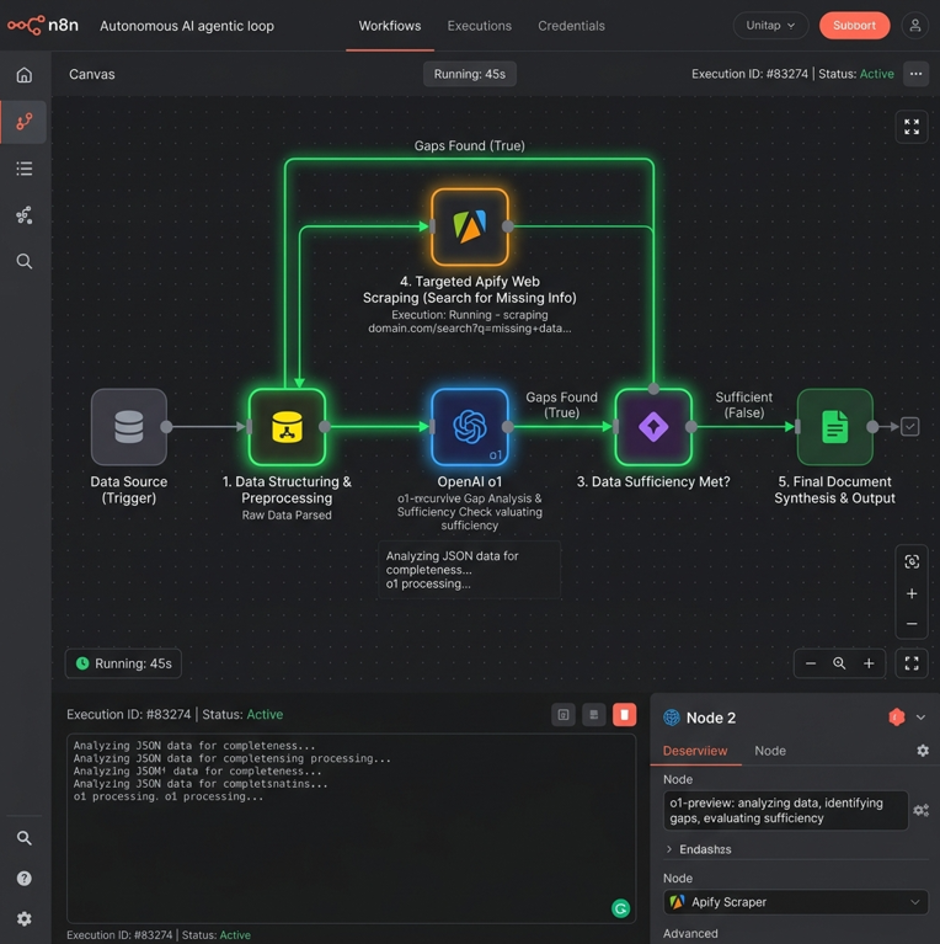
Stage 5: Deep Synthesis & Counter-Factual Reasoning
Once the data sufficiency gate is passed, OpenAI o3 enters its final, extended reasoning phase. This is not simple summarization; it is analytical synthesis.
The Cognitive Synthesis Framework
During Stage 5, o3 applies a structured analysis methodology across the entire validated dataset:
Fact Triangulation: Cross-verifies claims across independent sources. A claim made by an executive in a podcast is weighed against verified audited financials and technical benchmarks.
Temporal Alignment: Maps historical events chronologically to establish cause-and-effect relationships (e.g., correlating executive departures with subsequent product delays and market share shifts).
Adversarial Red-Teaming (Counter-Factual Analysis): o3 explicitly challenges its own primary conclusions. If the primary evidence suggests a company is expanding successfully, the model evaluates alternative hypotheses (e.g., "Is revenue growth masking unsustainable customer acquisition costs?").
Structured Executive Frameworking: Organizes insights into standard enterprise strategic frameworks:
Executive Summary & Investment/Strategy Thesis
Quantitative Metric Breakdown & Financial Health Table
Operational & Technical Capabilities Assessment
Risk Matrix (Categorized by Impact and Likelihood)
Strategic Recommendations & Key Unresolved Questions
Stage 6: Multi-Format Executive Delivery & Citation Audit
A research report without verifiable sources is a liability. The final stage of the workflow ensures complete data provenance, formatting excellence, and enterprise system distribution.
1. Precise Citation Mapping
Every factual assertion, metric, quote, or trend cited in the final report is tagged with an inline footprint referencing its explicit source URL, document section, and extraction timestamp.
"Cloud migration revenue grew by 24% year-over-year in Q3 [Source: Q3 10-Q Filing, Page 14], despite ongoing latency issues reported across developer infrastructure [Source: Technical Infrastructure Audit Report, Nov 2025]."
2. Multi-Channel Output Generation
n8n takes the structured markdown output from o3 and transforms it into required enterprise formats through automated distribution pipelines:
Executive PDF Report: Formatted with corporate branding, styled typography, data tables, and dynamic visual callout boxes. Automatically saved to corporate cloud storage (SharePoint, Google Drive, AWS S3).
Interactive Workspace Integration: Pushed directly into collaborative team spaces such as Notion, Confluence, or Coda.
Instant Executive Notification: Formats an executive summary digest delivered straight to Slack, Microsoft Teams, or Executive Email lists, complete with a link to the full document audit trail.


Enterprise Governance, Security & Cost Control
Deploying autonomous agents in an enterprise environment requires strict guardrails around security, data privacy, and operational costs.

1. Token Economics: The Model Routing Engine
OpenAI o3 is an extremely powerful reasoning model, but running extended reasoning chains across millions of tokens can become expensive if unmanaged.
To optimize operational spend, enterprise architectures implement Dynamic Model Routing:

By offloading routine text parsing to lighter models and reserving full o3 compute for strategic reasoning, enterprises reduce overall query costs by 60% to 75% without sacrificing report depth.
2. Data Sovereignty & Zero Data Retention
When processing sensitive competitive intelligence, M&A due diligence, or internal strategic queries, data privacy is non-negotiable.
Private Infrastructure Hosting: Host the n8n orchestration instance and vector storage within your own AWS/GCP Virtual Private Cloud (VPC), protected by enterprise firewalls.
Enterprise API Policies: Ensure all OpenAI API calls operate under Zero Data Retention (ZDR) enterprise agreements, guaranteeing that inputs and outputs are never used for model training.
Secrets Management: Credentials for Apify, OpenAI, and internal databases are stored in dedicated enterprise vaults (such as HashiCorp Vault or AWS Secrets Manager) rather than hardcoded in workflow configurations.
3. Human-in-the-Loop (HITL) Validation Gates
For high-stakes enterprise research (e.g., legal compliance or investment decisions), fully autonomous execution carries inherent risks.
n8n natively supports Human-in-the-Loop approval nodes:
Stage 1: Plan Generated ──> Human Review Gate: Manager Approves Scope via Slack ──> Stage 2: Scrape
If an agent proposes an extensive research plan estimated to exceed a pre-set budget threshold, n8n pauses execution, sends an interactive Slack/Teams notification to the project manager with the proposed scope, and waits for explicit human approval before triggering external scrapers.
Build vs. Buy vs. Partner: The Enterprise Decision Matrix
When enterprise leaders decide to deploy Deep Research capabilities, they face three strategic paths:

Option A: Buying Off-the-Shelf SaaS Solutions
Off-the-shelf "AI Research" tools offer quick setup, but they introduce severe enterprise limitations:
Black-Box Architecture: You cannot inspect how data was gathered, how sources were weighted, or why certain information was excluded.
Vendor Lock-In & Escalating Costs: Seats and per-query costs scale linearly. As research volume grows, subscription costs explode.
Zero Custom Integration: You cannot connect closed SaaS tools to your internal data lakes, private CRM notes, or proprietary research databases.
Security Barriers: Proprietary SaaS platforms rarely meet strict enterprise compliance standards (e.g., custom HIPAA, air-gapped VPCs, regional data residency).
Option B: Building Purely In-House from Scratch
Assigning an internal engineering team to build a custom research agent from scratch seems attractive, but often runs into operational headwinds:
High Opportunity Cost: Consumes months of valuable ML and DevOps engineering capacity better spent on core product development.
Maintenance Trap: Web scrapers break constantly as website schemas change. Maintaining scraping infrastructure, anti-bot bypass pipelines, and complex n8n state machines requires ongoing MLOps overhead.
The "PoC to Production" Gap: Internal teams quickly build impressive 80% demos, but struggle to bridge the final 20% required for enterprise-grade error handling, scale resilience, and token optimization.
Option C: Partnering with Specialized AI Engineering Experts (The Codersarts Model)
Partnering with an experienced AI engineering firm provides the optimal middle
ground: you own the entire IP and infrastructure but skip the trial-and-error learning curve.

Why Off-the-Shelf "Deep Research" Tools Fail in the Enterprise
Many technology leaders ask: "OpenAI, Google, and Perplexity are shipping 'Deep Research' features. Why shouldn't we just use those?"
The answer comes down to the difference between consumer research and enterprise intelligence.
1. The Internal Data Blindspot
Consumer AI research tools only see the public internet. But 80% of valuable enterprise research relies on combining public data with internal corporate knowledge:
Past internal M&A evaluation notes
Proprietary market research databases (Gartner, PitchBook, Bloomberg)
Internal customer churn logs and Salesforce CRM transcripts
Historical pricing models and internal legal opinion memos
A custom n8n-Apify-o3 pipeline bridges this gap. It queries both the live public web (via Apify) and your internal knowledge repositories (via enterprise RAG connections) simultaneously synthesizing public data in the context of your private corporate memory.
2. Lack of Custom Extraction Rules
An off-the-shelf research tool extracts general web summaries. It does not know that your procurement department specifically requires supplier compliance certificates, ESG metrics from annual PDF appendices, or specific ISO certification dates.
With a dedicated n8n + Apify architecture, you define explicit extraction schemas tailored to your exact industry requirements.
3. Compliance and Data Sovereignty Risks
When an employee types: "Analyze financial vulnerabilities for our upcoming acquisition of Target Corp" into a public, closed SaaS tool, that query and data context may be stored on third-party servers, creating significant legal and compliance vulnerabilities.
With a sovereign n8n deployment inside your AWS/Azure VPC, your queries, extracted data, and generated reports never leave your security perimeter.
How Codersarts Engineers & Deploys Enterprise Research Agents
At Codersarts, we specialize in designing, building, and deploying custom Agentic AI infrastructure for enterprises that cannot afford black-box limitations or security compromises.
We don't sell generic software subscriptions. We engineer production-grade AI systems that you own entirely.

What You Get with a Codersarts Enterprise Build
Sovereign, Air-Gapped Infrastructure: Deployed directly within your AWS, Azure, or GCP environment. You retain 100% ownership of the code, workflows, and data.
Custom Enterprise Scrapers & Connectors: Purpose-built Apify Actors designed to extract structured data from your target domains, paywalled databases, and specialized enterprise systems.
Advanced Reasoners & Guardrails: Customized OpenAI o3 prompt architecture equipped with specialized domain reasoning, strict factual grounding, and automated quality gates.
Cost Optimization Architecture: Built-in model routing engines that maximize research quality while minimizing API token overhead.
Production Reliability Guarantee: Built by senior AI/ML engineers with enterprise-grade error handling, execution persistence, and monitoring.
The Strategic Choice: Lag or Lead
Autonomous deep research is not a distant future capability. It is currently being deployed by forward-thinking hedge funds, enterprise strategy teams, M&A advisories, and procurement departments to outpace competitors.
The choice facing technology leadership is clear:
Wait for closed SaaS vendors to release rigid, black-box features that compromise data privacy and cost a fortune at scale.
Spend 12 months attempting to build, debug, and maintain complex agentic scraping infrastructure in-house.
Partner with Codersarts to deploy a production-grade, sovereign Deep Research Agent in weeks, giving your organization an enduring informational and operational advantage.
Ready to Build Your Sovereign AI Research Agent?
Stop wasting thousands of high-value engineering and analyst hours on manual data collection and linear search. Partner with Codersarts to architect a custom, sovereign Deep Research platform tailored to your exact enterprise requirements.
Take the Next Step
Request an Enterprise AI Architecture Session: Work directly with our Principal AI Architects to evaluate your research workflows and map out a custom deployment roadmap.
Explore Our AI & Agentic Development Services: Discover how Codersarts engineers custom RAG architectures, Autonomous Agents, and Enterprise AI infrastructure.
Direct Contact: contact@codersarts.com
Website: www.ai.codersarts.com
Also check out these other blogs from us you might find interesting:
Written by the Applied AI & Systems Engineering Team at Codersarts, specialists in enterprise AI model adaptation, agentic workflows, and production RAG infrastructure.


Comments