top of page


CODERSARTS AI · AGENT DEVELOPMENT
AI Quote Generation for Salesforce
Eliminate the friction of manual data entry and disconnected systems. Our agentic workflow does the coordination for you: retrieving governed product data, enforcing pricing rules, and handling approval routing automatically. Get the speed of AI-powered automation with the accuracy and control your enterprise requires.
Timeline:
2 - 4 Weeks
Industry:
Sales
Codersarts delivers an intelligent orchestration layer for Salesforce that bridges the gap between sales opportunities and closed deals. By combining agentic coordination with deterministic pricing and human-in-the-loop governance, we automate complex quote-to-proposal workflows—ensuring every quote is accurate, policy-compliant, and seamlessly synced with your existing sales process.
The operational problem
A quote is rarely just a document
For a simple deal, a sales representative may be able to create a quote directly from the CRM. The workflow becomes slower when the rep has to interpret requirements from calls or emails, find valid products, check the current price book, apply customer-specific terms, calculate a discount, locate the right approver, assemble a proposal, and update Salesforce.
The delays usually sit between systems:
product and packaging rules are maintained outside Salesforce;
pricing or availability comes from an ERP, catalogue, or internal service;
discount authority depends on role, margin, geography, or deal type;
approved case studies and legal language live in separate repositories;
deal-desk review happens in email or chat;
final documents and CRM fields are updated manually;
every revision creates another opportunity for stale values or version confusion.
Adding text generation to this process does not solve the coordination problem. The workflow needs governed retrieval, structured calculations, permissioned actions, approval state, and an audit trail.

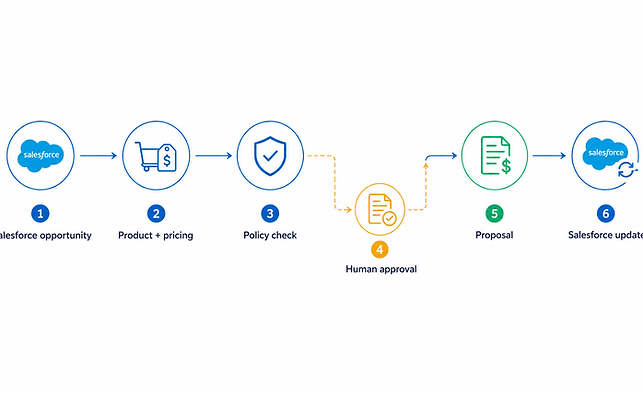
What the agent does: One controlled workflow from opportunity context to proposal
1. Understand the request
The workflow reads selected Salesforce opportunity fields, approved emails, call summaries, or a seller’s instructions. It identifies the products, quantities, term, geography, and commercial details that are still missing.
2. Retrieve governed product and pricing data
The agent calls approved catalogue, CPQ, ERP, or pricing interfaces. Product identifiers, list prices, eligibility, and availability come from structured systems rather than model memory.
3. Configure and calculate
Deterministic services calculate price, discount, margin, tax, and totals. The language model can explain the result and ask clarifying questions, but it does not invent SKUs or perform authoritative pricing arithmetic.
4. Apply approval policy
The workflow compares the proposed quote with the organisation’s discount and margin authority. Quotes inside policy can progress. Exceptions are packaged with the commercial context and routed to the correct approver.
5. Generate the controlled document
After approval, the system assembles a quote or proposal using locked templates, current values, approved product language, and permitted proof content. Each generated version is identifiable and reviewable.
6. Update Salesforce
The approved amount, quote status, next step, document reference, and activity history are written back through scoped Salesforce actions. The workflow does not need to create a parallel CRM.

Why an agent rather than a basic automation?
Use rules for the rules. Use an agent for coordination.
A Salesforce Flow is appropriate when the trigger, input, and action are already structured. A document-generation template is appropriate when the data is complete. A CPQ rules engine is appropriate for valid configuration and calculation.
An agent becomes useful when the workflow must interpret an incomplete request, retrieve context from several systems, decide which permitted tool to call, ask for missing information, maintain state while an approval is pending, recover from a failed integration, and record the completed outcome.
Codersarts combines these patterns instead of forcing an LLM into every step:
Workflow need | Preferred control |
Product eligibility and configuration | CPQ, catalogue rules, or deterministic service |
Price, margin, tax, and totals | Deterministic calculation |
Requirement interpretation | Language model with structured output |
Product and policy retrieval | Permissioned API calls and governed search |
Discount exception | Policy engine and human approval |
Proposal narrative | Controlled generation from approved sources |
Salesforce update | Validated, least-privilege action |
Retries and long-running approvals | Durable workflow orchestration |

Service scope: What Codersarts can implement
Quote-workflow discovery
We map the current process from opportunity stage to customer-ready document. This includes product and price sources, approval authority, exception paths, templates, Salesforce objects, and the places where employees still copy, investigate, or chase.
Salesforce and system integration
We connect the workflow to the customer’s Salesforce environment and the existing product, pricing, CPQ, ERP, document, email, or approval systems that are required for the selected use case.
Agent workflow and tool controls
We define the agent’s permitted tasks, structured inputs, tool schemas, failure paths, and escalation rules. High-impact actions are isolated behind policy checks rather than exposed as general-purpose tools.
Product and proposal knowledge
We prepare approved product descriptions, proof points, templates, and policy sources for retrieval. Content owners and expiry rules are part of the design so generated documents do not silently rely on stale material.
Deal-desk approval experience
We build a clear review interface showing the quote values, policy exception, supporting evidence, proposed changes, and approval history. Approvers can accept, reject, or request changes without reconstructing the deal.
Evaluation and monitoring
The workflow is tested against historical or synthetic quotes for product validity, pricing accuracy, approval routing, source use, Salesforce updates, and failure recovery. Production monitoring tracks corrections, retries, exceptions, and time saved.
Deployment and ongoing optimisation
Codersarts can deploy on AWS or Azure, implement role-based access and audit logging, and support controlled expansion to additional products, teams, or quote types after the pilot meets its acceptance criteria.

MVP: Start with one product family and one approval path
A practical pilot should be deliberately narrower than the final vision
Initial workflow: create an approval-ready draft for one product family with a limited set of valid configuration options.
Systems: Salesforce sandbox, one product/pricing interface or controlled fixture, approved proposal template, and an approval dashboard.
Agent permissions:
read the selected opportunity and account context;
retrieve allowed products and current pricing;
ask for missing commercial inputs;
call the deterministic pricing service;
create a draft quote and proposal;
propose Salesforce field updates.
Human approval required for:
discounts outside the representative’s authority;
nonstandard payment or contract terms;
low-margin configurations;
final document release;
consequential Salesforce stage changes during the pilot.
Pilot success criteria:
every line item maps to a valid product identifier;
authoritative totals match the pricing service;
approval routing follows the policy test set;
generated proposal content uses approved sources;
no quote is sent without the required approval;
Salesforce updates are correct and idempotent;
median quote-preparation time falls without increasing correction or reopen rates.
Designed as a layer around the systems you already trust
Experience layer
React and TypeScript seller or deal-desk interface
embedded Salesforce surface or standalone authenticated workspace
explicit review, approval, version, and error states
Application and orchestration
FastAPI or Django service
explicit state-machine or durable workflow orchestration
PostgreSQL for workflow, version, and audit state
background jobs for approvals, retries, and document generation
Agent and knowledge
OpenAI, Azure OpenAI, or Amazon Bedrock according to customer requirements
structured tool calls for Salesforce, catalogue, pricing, and documents
governed retrieval for product language, policy, and approved proof
evaluation sets and prompt/version controls
Enterprise integrations
Salesforce APIs and customer-approved Agentforce or Flow actions
existing CPQ, Revenue Cloud, ERP, catalogue, or pricing service
email, Slack, Microsoft Teams, or an internal approval channel
controlled document-generation templates and storage
Controls
role-based access and least-privilege service accounts
deterministic price and discount rules
human approval gates
source and action audit logs
idempotent writes and reconciliation
monitoring for stale data, tool errors, duplicate actions, and model drift
Fit the workflow to the customer’s Salesforce estate
The implementation can work with:
Salesforce Sales Cloud opportunity, account, product, and activity data;
Salesforce Revenue Cloud or an existing CPQ implementation;
Agentforce actions where the customer has adopted Agentforce;
Salesforce Flow for deterministic triggers and routing;
a separate ERP, product catalogue, pricing engine, or inventory service;
existing quote and proposal templates;
Slack, Microsoft Teams, or email approval;
AWS- or Azure-hosted integration services.
Availability depends on the customer’s Salesforce edition, licences, object model, security policy, and API access. These items should be validated during discovery rather than assumed in page copy or project estimates.
Commercial automation needs explicit boundaries
Incorrect product or configuration
Products and compatibility come from structured catalogue or CPQ tools. The model can interpret the request but cannot create an unsupported product record.
Wrong price, margin, or total
All authoritative arithmetic is performed by deterministic services. Tool outputs, timestamps, and price-book versions are stored with the quote.
Unauthorised discount
Approval thresholds are enforced outside the model. The workflow blocks document release until the required person approves.
Hallucinated capability or customer proof
Proposal generation is limited to approved, retrievable sources. Unsupported statements are blocked or flagged for review.
Stale data
Every product, pricing, and policy source has an owner, version, and freshness rule. The workflow can stop rather than produce a quote from expired data.
Duplicate Salesforce updates
Idempotency keys, before-and-after diffs, and reconciliation prevent repeated actions from creating conflicting records.
Prompt injection and over-permissioned tools
Opportunity notes, emails, and uploaded files are treated as untrusted content. Tool permissions are enforced by the application layer and customer identity, not by instructions embedded in text.
Has it worked for anyone?
Salesforce reports that its own sellers use Agentforce to qualify leads, answer product questions, create briefs, and generate quotes from live product and pricing data. Salesforce states that internal quote creation became 75% faster. This is a first-party result from the product provider, not an independent benchmark, and it should be presented with that attribution.
Frequently asked questions
Does this replace Salesforce CPQ or Revenue Cloud?
No. The workflow uses the customer’s existing Salesforce and pricing systems as systems of record. The service is most useful when the process needs additional context, custom tools, cross-system coordination, approval controls, document preparation, or evaluation.
Can the agent set prices?
The agent can retrieve and explain prices returned by an approved pricing or CPQ service. Authoritative calculations and approval thresholds should remain deterministic.
Can it send a quote automatically?
Technically, a validated low-risk workflow can progress toward automatic release. Codersarts recommends human approval for final send during the pilot and for every discount, term, or margin exception.
Does the customer need Agentforce?
Not necessarily. The same workflow pattern can be implemented with Salesforce APIs, Flow, and a customer-approved model platform. Discovery should determine whether native Agentforce actions, a custom integration service, or a hybrid is the most practical approach.
What data is required for a pilot?
The pilot needs a Salesforce test environment or representative fixtures, the valid product family, a price book or pricing API, discount authority, approved proposal content, example opportunities, and historical corrections or exception cases where available.
How is the workflow evaluated?
Evaluation should cover product and configuration validity, price agreement with the source system, approval routing, source-grounded proposal content, Salesforce write accuracy, duplicate-action prevention, recovery from tool failures, and the amount of human rework.
How long should the first pilot take?
Scope depends more on integration readiness and policy clarity than on the UI. Codersarts should estimate after confirming Salesforce access, product/pricing data, approval logic, and the target document. The page should not advertise a fixed timeline before discovery.
Our architecture is designed as a secure, durable layer that integrates with your existing enterprise systems rather than replacing them.
Component | Technology / Implementation |
Backend Services | Python (FastAPI or Django) for robust service-side logic. |
Persistence & State | PostgreSQL for maintaining workflow state, audit logs, and version history. |
AI Infrastructure | LLM orchestration via OpenAI, Azure OpenAI, or Amazon Bedrock. |
Agent Orchestration | Durable workflow engines/state machines for long-running processes (e.g., approvals, retries). |
Frontend / Interface | React and TypeScript for seller and deal-desk interfaces. |
Integration Layer | Salesforce APIs, RESTful integration with ERP/CPQ, and event-driven webhooks. |
Security & Controls | Role-based access control (RBAC), least-privilege service accounts, and source/action audit logging. |
Technical Philosophy:
Deterministic vs. Probabilistic: All authoritative calculations (price, margin, tax) and eligibility checks are performed by deterministic services (CPQ/ERP logic), never the LLM.
Governed Retrieval: The agent uses RAG-like retrieval for policy and product language, anchored by structured source identifiers to prevent hallucinations.
Idempotency: All writes back to Salesforce are reconciliation-safe, utilizing idempotency keys to prevent duplicate records or conflicting updates.
bottom of page