

CI/CD for Machine Learning: Automating Your ML Pipeline
.jfif/v1/fill/w_320,h_320/file.jpg)
A model can achieve excellent offline accuracy and still be unsafe to release.
Its training data may differ from production. A preprocessing change may exist only in a notebook. A dependency update may alter predictions. The container may pass software tests while the model fails on a critical customer segment. A retraining job may create a statistically stronger model that violates latency, fairness, cost, or explainability requirements. Even a technically successful deployment can fail when nobody can identify which data, code, and configuration produced the endpoint now serving traffic.
Traditional CI/CD solves only part of this problem. Machine learning introduces mutable data, probabilistic behavior, expensive training, delayed ground truth, multiple interacting artifacts, and quality that can degrade without a code change.
The objective is therefore not to deploy models as frequently as possible. It is to create a release system that can answer, for every production change:
What changed, what evidence justified the change, who approved it, what is serving now, how is it performing, and how quickly can we return to a known-safe state?
This guide explains how to design that system.
Executive Summary
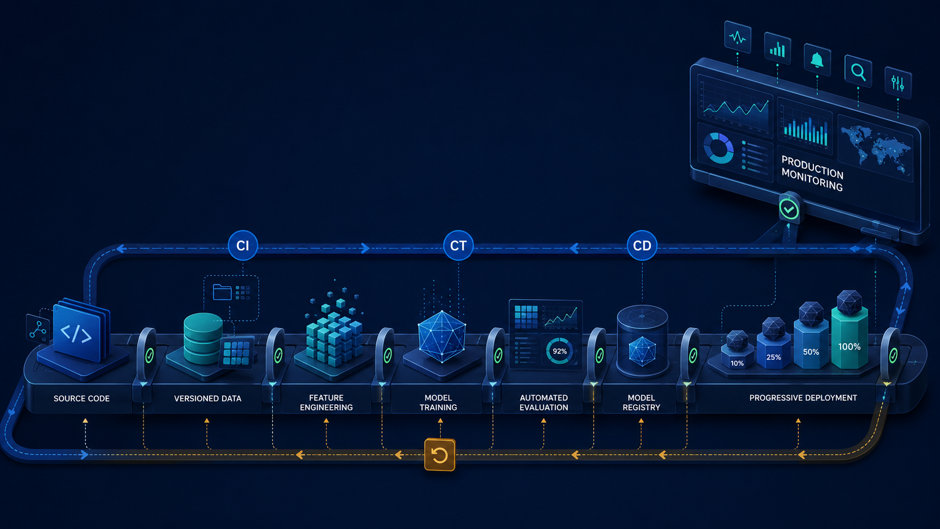
CI/CD for machine learning is the automation of testing, building, evaluating, approving, deploying, and monitoring the code, data-dependent pipelines, models, and infrastructure that form an ML system.
The strongest enterprise pattern separates three related pipelines:
Continuous integration (CI) validates source code, pipeline components, data contracts, infrastructure definitions, and security controls whenever an implementation changes.
Continuous training (CT) creates a candidate model from an identified code revision, immutable data snapshot, feature definition, configuration, and runtime environment.
Continuous delivery/deployment (CD) promotes an approved, immutable model-service release through environments, progressively exposes it to production, evaluates live behavior, and preserves rollback.
The pipelines share one control plane for identity, lineage, approvals, registry state, policy, secrets, observability, and audit evidence.
The most important design rules are:
● Version code, data references, feature definitions, models, environments, and deployment configuration together.
● Build once and promote the same immutable artifact; do not retrain independently in each environment.
● Treat model evaluation as a release gate, not as an experiment dashboard screenshot.
● Keep retraining separate from production promotion. A new candidate should not automatically become the champion merely because training completed.
● Test data behavior, model behavior, software behavior, infrastructure, security, and business constraints.
● Deploy progressively through shadow, canary, champion-challenger, or blue-green patterns appropriate to the inference mode.
● Monitor the complete decision system: data, features, service, model, users, business outcomes, and cost.
● Design rollback for code, model, feature logic, and data—not only the container image.
● Measure delivery throughput and instability alongside model and business performance.
The Minimum Viable Enterprise Pipeline
Stage | Minimum automated evidence |
Pull request | Unit tests, component tests, data-contract tests, security scans, pipeline compilation |
Candidate training | Code SHA, data snapshot, feature version, environment digest, parameters, metrics, lineage |
Model approval | Baseline comparison, segment metrics, robustness, latency/cost, limitations, approver |
Release build | Immutable image/model digest, SBOM, provenance, vulnerability result, deployment manifest |
Pre-production | Integration, load, smoke, access-control, observability, and rollback tests |
Production rollout | Progressive exposure, live guardrails, approval/abort rules, current champion pointer |
Ongoing operation | Data/model/service/business monitoring, incident ownership, retraining decision, audit history |
Contents
What CI/CD Means for Machine Learning
In conventional software, continuous integration checks whether code changes combine correctly, and continuous delivery keeps a tested release ready for deployment. Machine learning expands the unit of change.
An ML prediction is produced by a system containing:
● Application and pipeline code.
● Training and validation data.
● Labels and label-generation rules.
● Feature definitions and transformations.
● Model architecture and hyperparameters.
● Third-party packages, base images, and hardware/runtime behavior.
● Training, evaluation, and inference configuration.
● Business thresholds and post-processing rules.
● Deployment and infrastructure configuration.
● Online or batch input data.
A trustworthy release must identify and test the relevant versions of all these inputs.
A Direct Definition
CI/CD for machine learning is a policy-controlled system that converts changes in code, data, configuration, or approved model state into reproducible evidence and a recoverable production release.
This definition matters because an ML team can have automated jobs without having CI/CD. A scheduled notebook that retrains and overwrites model.pkl is automation, but it lacks immutable identity, gates, promotion, provenance, and rollback.
The ML Release Evidence Chain
Every deployed version should connect:
Business objective and risk tier
→ source commit and reviewed change
→ data snapshot and label definition
→ feature and pipeline versions
→ training run and environment
→ evaluation report and limitations
→ approval decision
→ immutable model and image digests
→ deployment configuration
→ production observations and incidents
We call this the ML Release Evidence Chain. It is the article's central framework. If one link is missing, the organization may still deploy, but it cannot fully reproduce, audit, or safely reverse the release.
CI, CD, CT, and MLOps Are Related but Not Identical
Term | Primary purpose | Typical trigger | Output |
CI | Validate implementation changes | Pull request or merge | Tested pipeline/application revision |
CT | Generate and evaluate a candidate model | Approved code, schedule, new data, drift, or manual request | Registered candidate plus evidence |
CD | Promote a release through environments | Approved candidate or release change | Deployed, observable, recoverable release |
MLOps | Govern and operate the full ML lifecycle | Continuous organizational practice | Repeatable delivery and reliable operation |
Google Cloud's MLOps architecture guidance similarly distinguishes CI, CD, and continuous training and describes increasing automation maturity from manual processes through automated pipelines and CI/CD. See MLOps: continuous delivery and automation pipelines in machine learning.
Why Ordinary Software CI/CD Is Insufficient
Standard DevOps principles remain necessary. ML simply adds failure modes they were not designed to detect on their own.
Data Can Change Behavior Without a Code Change
A model retrained from the same source revision may behave differently because records, labels, time windows, sampling, joins, or feature distributions changed. The pipeline must validate data and record its identity.
Correct Code Can Produce an Unacceptable Model
Unit tests may pass while accuracy falls below the champion, calibration deteriorates, a priority segment becomes biased, inference cost doubles, or predictions violate a business constraint.
Tests Are Statistical, Not Only Deterministic
Exact output equality is often inappropriate for training. Teams need tolerances, confidence intervals, repeated-seed policies, minimum effect sizes, and stable acceptance datasets.
Training and Serving Can Skew
The offline pipeline may calculate a feature differently from the online service. Training may use information unavailable at inference time. Missing-value behavior may differ. A single feature contract should define semantics across both paths.
Ground Truth May Arrive Late
Fraud, churn, default, demand, and maintenance outcomes may take days or months to become observable. Production gates therefore need immediate service and data signals plus delayed model-quality measurement.
A Model Release Is Often Expensive
Full training may consume significant compute and time. Running it on every pull request is wasteful. CI should use fast representative tests; CT should run expensive training only when justified.
Rollback Is Multidimensional
Rolling back a container does not help if the feature table has changed incompatibly or a batch job has already written millions of predictions. Recovery must cover models, feature logic, schemas, state, outputs, and downstream decisions.
Risk Depends on the Decision, Not the Algorithm
An image classifier organizing internal documents and a model denying transactions may use similar technology but require different approvals, monitoring, and human controls. Assign the risk tier from the consequence and reversibility of the decision.
The Three-Pipeline Operating Model: CI, CT, and CD
Treat CI, CT, and CD as independently triggered pipelines joined by immutable artifacts and policy gates.
Pipeline 1: Continuous Integration
CI answers: Is this implementation safe to merge and capable of producing a valid candidate?
It checks code, component interfaces, data contracts, pipeline definitions, feature transformations, infrastructure, dependencies, and security. It should be fast enough to provide useful pull-request feedback.
Pipeline 2: Continuous Training
CT answers: Can this approved implementation and data snapshot produce a candidate that meets offline release criteria?
It resolves immutable inputs, builds features, trains candidates, evaluates them against baselines and the current champion, records lineage, and registers—not deploys—the successful candidate.
Pipeline 3: Continuous Delivery or Deployment
CD answers: Can this approved candidate operate safely in the target environment, and should it receive more production exposure?
It assembles or resolves the release artifact, verifies provenance and security evidence, deploys to a pre-production or shadow environment, runs integration and performance checks, progressively releases, watches live guardrails, and promotes or rolls back.
The Shared Control Plane
All three pipelines depend on:
● Identity and least-privilege access.
● Source, package, container, data, and model registries.
● Metadata, lineage, and experiment tracking.
● Policy-as-code and approval workflows.
● Secrets and key management.
● Observability and alerting.
● Environment and infrastructure definitions.
● Cost attribution and quotas.
● Audit and retention controls.

Trigger Map: Do Not Run Everything for Every Change
Change or event | CI | CT | CD | Typical approval |
Documentation only | Lightweight | No | No | Code owner |
Training code or feature logic | Full | Candidate run | If approved | Model owner |
Inference code or dependency | Full | Compatibility/selected retraining | Yes | Service owner |
Pipeline component | Full | Integration candidate | If approved | Platform + model owner |
New data snapshot on schedule | No code build | Yes | Only after evaluation | Automated gate or model owner |
Data drift alert | Diagnostic | Possibly | Not automatically | Model/business owner |
Decision threshold change | Policy and tests | Re-evaluate | Yes | Business owner |
Infrastructure configuration | IaC/security tests | Smoke if relevant | Yes | Platform/security owner |
Emergency rollback | Minimal verification | No | Restore known release | Incident commander |
The trigger map keeps feedback fast and costs controlled while ensuring that changes reach the right evidence path.
Enterprise Reference Architecture for ML Delivery
A production architecture should make artifact identity and promotion visible.
The Eight Architectural Zones
Developer zone: local environments, notebooks, feature code, model code, tests, and reproducible project configuration.
Source-control zone: protected branches, reviewed pull requests, reusable workflow definitions, infrastructure code, and ownership rules.
CI execution zone: ephemeral runners that test, scan, compile, and publish candidate pipeline/application artifacts.
Training zone: isolated jobs with controlled data access, compute, tracked parameters, and reproducible environments.
Artifact and metadata zone: datasets or snapshot references, feature definitions, experiment runs, model registry, packages, images, SBOMs, and provenance.
Delivery zone: environment-specific configuration, policy gates, deployment controller, approval workflow, and rollout analysis.
Serving zone: batch, online, streaming, or edge inference with stable contracts and rollback capacity.
Operations zone: logs, metrics, traces, data/model monitoring, business outcomes, alerts, incident records, and cost telemetry.
Microsoft's MLOps v2 reference patterns similarly separate the data estate, administration/setup, model-development inner loop, and model-deployment outer loop. AWS SageMaker Pipelines and Model Registry, Kubeflow Pipelines, and other platforms implement comparable lifecycle components with different operational boundaries. See Microsoft's MLOps v2 architecture, Amazon SageMaker AI Workflows, and Kubeflow Pipelines concepts.
Repository Strategy
There is no universal requirement for a monorepo or multiple repositories. Choose the boundary that makes change ownership and release coupling clear.
ml-system/
├── src/
│ ├── features/
│ ├── training/
│ ├── evaluation/
│ └── serving/
├── pipelines/
│ ├── components/
│ └── definitions/
├── tests/
│ ├── unit/
│ ├── contracts/
│ ├── integration/
│ └── model_quality/
├── infrastructure/
├── deployment/
├── policies/
├── monitoring/
├── docs/
│ ├── model_card.md
│ ├── runbook.md
│ └── rollback.md
├── pyproject.toml
└── README.md
A monorepo works well when features, training, serving, and infrastructure normally change together. Separate repositories can reduce access and release coupling for a shared ML platform, but require versioned interfaces and cross-repository integration tests.
Build Once, Promote the Same Artifact
Do not rebuild or retrain the production release independently in each environment. A candidate approved in staging should be referenced by immutable digest in production. Environment-specific values—endpoint size, autoscaling limits, network identifiers, alert routing—belong in controlled deployment configuration, not in a newly built model artifact.
A Release Manifest
The deployment system should resolve a manifest similar to:
release_id: equipment-failure-2026-08-03.4
source_commit: 91c3...e72
pipeline_definition_digest: sha256:...
training_data_snapshot: warehouse://maintenance/events@2026-07-31
label_definition_version: failure-within-14d/v3
feature_set_version: equipment-risk/v12
training_run_id: run_01K...
model_registry_uri: models:/equipment-risk/42
model_digest: sha256:...
serving_image_digest: sha256:...
evaluation_report_digest: sha256:...
sbom_digest: sha256:...
provenance_attestation: registry://attestations/...
approval_record: change-8421
deployment_config_revision: 3a0b...c19
The exact format matters less than immutability, access control, and bidirectional traceability from production back to source and evidence.
Select Tools by Capability, Not by Logo Count
Capability | Examples | Enterprise selection questions |
Source and CI | GitHub Actions, GitLab CI/CD, Azure DevOps, Jenkins | Identity, reusable workflows, protected environments, runners, approvals, audit |
Pipeline orchestration | Kubeflow Pipelines, Airflow, Argo Workflows, managed cloud pipelines | Typed artifacts, retries, caching, lineage, isolation, scheduling, backfills |
Tracking and registry | MLflow, managed cloud registries, enterprise catalogs | Model identity, aliases, approvals, access, lineage, replication, retention |
Packaging and serving | Containers, managed endpoints, Kubernetes, batch platforms | Immutable digests, autoscaling, GPU/CPU support, rollback, network controls |
Infrastructure | Terraform, Pulumi, Bicep, CloudFormation | Review, drift detection, state protection, policy, environment separation |
Observability | OpenTelemetry-compatible tools, Prometheus, Grafana, managed monitoring | Metrics/logs/traces, model and data signals, SLOs, alert ownership, retention |
Avoid assembling a platform from many tools unless the organization can operate their identity, upgrades, interoperability, backup, and support boundaries.
Continuous Integration: What to Test Before Training
CI should reject implementation defects quickly without running the most expensive training job. Organize gates from fastest and most deterministic to slower integration checks.
Gate 1: Source and Review Controls
Require protected branches, peer review, code ownership for sensitive paths, signed or attributable commits where policy requires them, issue/change linkage, and a clear definition of done. Prevent direct production changes outside the emergency process.
Gate 2: Static Quality and Security
Run formatting, linting, type checking, dependency and license policy, secret scanning, static application security testing, infrastructure-policy checks, container-file linting, and workflow security checks.
Gate 3: Unit Tests
Unit-test transformations, encoders, label rules, threshold logic, post-processing, metric functions, serialization helpers, and input validation. Use small deterministic fixtures.
Gate 4: Data-Contract Tests
Validate:
● Required fields and types.
● Null, range, and category constraints.
● Primary-key and uniqueness expectations.
● Event-time and freshness rules.
● Join cardinality.
● Label availability and delay.
● Personally identifiable or restricted fields.
● Feature availability at prediction time.
● Backward and forward schema compatibility.
A schema passing does not prove data are statistically suitable. Add bounded distribution checks where a sudden shift indicates a pipeline defect rather than a legitimate business change.
Gate 5: Feature and Training-Serving Parity
Execute the same feature logic on representative offline and serving fixtures. Assert semantics, ordering, defaults, time-window boundaries, timezone handling, vocabulary versions, and numerical tolerances. Explicitly test leakage by reconstructing features as they would have existed at historical prediction time.
Gate 6: Component and Pipeline Tests
Compile the pipeline definition and execute a reduced end-to-end run using a small versioned dataset. Confirm component interfaces, typed artifacts, cache behavior, failure paths, retry safety, idempotency, and metadata emission.
Kubeflow describes components as packaged units with inputs, outputs, dependencies, and runtime requirements that form repeatable pipeline graphs. This component boundary is useful even when another orchestrator is used. See Kubeflow pipeline components.
Gate 7: Model Contract Tests
These tests do not prove final quality. They catch broken implementations:
● The model trains on the small fixture.
● Output schema, shapes, units, and classes are correct.
● Predictions are finite and within allowed domains.
● Serialization and reload preserve predictions within tolerance.
● Required metadata and signatures are present.
● Inference is deterministic where promised or variability is bounded.
● A simple signal can be learned from a synthetic dataset.
● A deliberately shuffled target does not produce suspiciously high performance.
Gate 8: Infrastructure and Serving Contract Tests
Validate infrastructure plans, least-privilege access, resource limits, network policy, health endpoints, readiness behavior, input/output schemas, timeout and retry contracts, logging redaction, and graceful failure. A minimal container smoke test should load the exact candidate format used in production.
The ML Testing Pyramid
Layer | Runs | Purpose |
Static and unit | Every change | Fast implementation feedback |
Contract and component | Every relevant pull request | Interfaces, data assumptions, reduced pipeline |
Integration and security | Merge or release candidate | External systems, identity, image, infrastructure |
Full offline model evaluation | CT trigger | Statistical and business acceptance |
Pre-production load and shadow | Approved release | Production-like behavior without full exposure |
Canary/champion-challenger | Controlled production | Live system and outcome evidence |

Illustrative CI Workflow
This platform-neutral pseudocode shows the sequence, not copy-paste configuration:
on: pull_request
permissions:
source: read
jobs:
fast-feedback:
steps:
- checkout immutable revision
- restore verified dependency cache
- lint, type-check, and unit-test
- scan secrets, dependencies, workflows, and IaC
- validate data and feature contracts on fixtures
pipeline-integration:
needs: fast-feedback
steps:
- build candidate component image
- generate SBOM and provenance metadata
- compile pipeline definition
- execute reduced pipeline in isolated test environment
- verify model serialization and serving contract
- publish test and lineage evidence
Use short-lived cloud credentials, restrict permissions per job, pin external workflow dependencies according to enterprise policy, and prevent untrusted pull-request code from accessing production secrets or data.
Continuous Training: How to Create a Defensible Candidate
Continuous training does not necessarily mean constant retraining. It means training is reproducible and can be initiated by controlled triggers when the expected value justifies it.
Choose Retraining Triggers Deliberately
Trigger | Appropriate when | Primary risk |
Schedule | Data and behavior change on a known cadence | Wasteful training or silent bad-data ingestion |
New labeled data | Ground truth arrives in meaningful batches | Label delay and biased feedback |
Data drift | Input distribution changes beyond a threshold | Drift may not imply performance loss |
Performance degradation | Reliable labels show quality loss | Detection arrives too late |
Business event | Product, policy, market, or process changes | Trigger may be subjective or poorly scoped |
Code/feature improvement | Reviewed implementation changes | Repeated experiments and compute cost |
Manual incident response | Investigation identifies retraining as corrective action | Urgency can bypass evidence controls |
Retraining is not remediation by default. If a source field is corrupted, the right response is to stop the pipeline and fix the data path—not train the model to accommodate the defect.
Resolve Immutable Inputs
At the beginning of CT, capture:
● Source commit and pipeline definition.
● Data snapshot or query plus immutable table/version semantics.
● Label definition and observation window.
● Feature-set version.
● Training, validation, and test split definition.
● Parameters and random seeds.
● Dependency lock and container digest.
● Compute type and relevant accelerator/runtime details.
● Trigger, initiator, and purpose.
If copying the full dataset is impractical, preserve an immutable table snapshot, object-version identifiers, or a manifest of partition/file hashes plus the code required to resolve it.
Prevent Time and Entity Leakage
Random splits often overstate performance for temporal, customer, patient, machine, or account data. Split using the production decision boundary. Keep related entities together where leakage is possible. Ensure features are calculated only from information available at the forecast or prediction timestamp.
Train Baselines and Challengers Under the Same Protocol
Every run should include a meaningful baseline: current champion, simple heuristic, previous production version, or non-ML decision rule. Compare candidates on the same data cutoff, slices, metrics, and confidence policy.
Use Multidimensional Model Gates
Gate category | Example acceptance evidence |
Predictive quality | Primary metric meets minimum and does not regress versus champion beyond tolerance |
Segment performance | Priority, protected, geographic, and low-volume slices remain within approved limits |
Calibration/uncertainty | Probability calibration or interval coverage meets the decision requirement |
Robustness | Missing, delayed, extreme, or shifted inputs produce bounded behavior |
Business rules | Predictions and thresholds respect mandatory constraints |
Explainability | Required explanations are stable, available, and meaningful to reviewers |
Performance | Training duration, model size, batch window, latency, throughput, and memory fit budgets |
Cost | Estimated training and inference spend stays within threshold |
Security/privacy | Data use, artifact scanning, access, and privacy tests pass |
Reproducibility | Rerun or documented tolerance confirms the result is reproducible enough for its risk tier |
Do not collapse all evidence into one weighted score if a category is a hard requirement. A small average accuracy gain cannot compensate for an unacceptable failure in a legally, financially, or operationally critical segment.
Account for Statistical Uncertainty
Avoid promoting a challenger because it wins by a negligible amount on one holdout sample. Use repeated backtests, bootstrap intervals, paired comparisons, or other methods appropriate to the task. Define a practical minimum improvement and a non-inferiority policy for secondary metrics.
Register the Candidate and Its Evidence
The model registry should store or link:
● Immutable model identity and digest.
● Source, data, feature, environment, and run lineage.
● Model signature and input/output contract.
● Metrics, slices, plots, evaluation dataset, and test protocol.
● Intended use, limitations, and excluded uses.
● Reviewer comments and approval status.
● License and dependency information.
● Deployment compatibility and resource requirements.
Modern MLflow registry guidance uses model versions, tags, and aliases such as champion rather than relying solely on fixed lifecycle stages. An alias can decouple the serving reference from a particular numeric version, but alias changes must remain controlled and auditable. See MLflow Model Registry workflows.
Never Treat Registration as Production Approval
Registration means the artifact is known. Validation means evidence passed. Approval means an authorized policy or person accepted it for a specific deployment scope. Deployment means it is running. Promotion means it receives greater authority or traffic. These states should not be conflated.
Continuous Delivery: How to Release a Model Safely
CD begins with an approved candidate and ends with a production release whose exposure and health are controlled.
Assemble and Verify the Release
Before deployment:
Resolve model and serving-image digests.
Verify source and build provenance.
Verify the software bill of materials and vulnerability policy.
Confirm model, feature, and request/response schema compatibility.
Confirm environment configuration and infrastructure plan.
Attach evaluation and approval records.
Confirm monitoring, dashboards, alerts, ownership, and runbook.
Confirm previous safe release and rollback procedure.
Estimate production capacity and cost.
Promote Through Isolated Environments
Development, staging, and production should have distinct access controls and data policies. Promotion moves an immutable artifact reference and validated configuration through these boundaries. Production credentials should not be available to routine development jobs.
Match Rollout Strategy to Inference Mode
Pattern | How it works | Best fit | Key limitation |
Shadow | New model sees copied production inputs; outputs do not drive decisions | High-risk online models and initial validation | Requires duplicate compute and careful output handling |
Champion-challenger | Candidate and champion produce comparable outputs | Model-quality comparison with delayed labels | Needs unbiased routing and outcome attribution |
Canary | Candidate receives a small share of live traffic | Online services with fast guardrail signals | Early traffic may not represent all segments |
Blue-green | New full environment is validated before traffic switch | Fast technical rollback and environment changes | Doubles capacity temporarily; data/state rollback remains separate |
A/B experiment | Users or entities are assigned to variants | Measuring causal product/business impact | Requires experiment design and interference control |
Partitioned batch | Candidate scores a bounded partition, date, region, or entity set | Batch inference | Downstream writes and reprocessing must be reversible |
Edge ring deployment | Release moves through device/site cohorts | Edge and offline inference | Slow fleet convergence and telemetry gaps |
Argo Rollouts documents canary traffic weighting and blue-green pre/post-promotion analysis, including aborting a rollout when analysis fails. Kubernetes also retains deployment revisions for workload rollback. These mechanisms help with application delivery, but ML teams must add model, feature, data, and business guardrails. See Argo canary strategy, Argo blue-green strategy, and Kubernetes deployment rollback.

Define Live Promotion and Abort Gates
Immediate gates can use:
● Availability, error rate, latency, saturation, and timeout.
● Input-schema validity and missing-feature rate.
● Prediction volume, score distribution, and fallback rate.
● Safety or business-rule violations.
● Cost per prediction or batch.
● Difference from champion outputs.
● User or operator override signals.
Delayed gates can use:
● Accuracy, precision/recall, calibration, ranking, forecast error, or task-specific quality.
● Segment and fairness outcomes.
● Conversion, fraud loss, service level, downtime, or other business outcomes.
● Human review quality and escalation rate.
Define how the system behaves while delayed truth is unavailable. A model can pass service health while producing poor decisions.
Rollback Must Restore a Known Decision Path
A complete rollback record identifies:
● Previous model and serving image.
● Compatible feature and schema version.
● Previous decision threshold and business rules.
● Infrastructure and routing configuration.
● Batch outputs requiring invalidation or recomputation.
● Downstream transactions that cannot be undone automatically.
● Owner authorized to invoke rollback.
● Communication and incident steps.
Test rollback before the first production release and periodically afterward. If restoration depends on an artifact that has been deleted, an undocumented database state, or one engineer's memory, rollback is only theoretical.
Separate Three Types of Promotion
Artifact promotion: candidate evidence is accepted for a target environment.
Deployment promotion: the release is installed and healthy in that environment.
Decision promotion: the release is authorized to influence a larger share or more consequential set of decisions.
This separation allows an organization to deploy a candidate in shadow mode without granting decision authority.
Secure and Govern the ML Delivery Chain
ML CI/CD expands the software supply chain to include datasets, pretrained models, training jobs, notebooks, feature pipelines, registries, and third-party actions. Security must cover both malicious change and accidental loss of evidence.
Threats to Address
● Unreviewed code or pipeline changes.
● Poisoned or unauthorized training data.
● Label manipulation and leakage.
● Dependency, base-image, or CI action compromise.
● Long-lived cloud credentials in repositories or runners.
● Artifact replacement under a mutable tag.
● Unauthorized registry alias or threshold changes.
● Exfiltration through logs, artifacts, caches, or experiment tracking.
● Overprivileged training and deployment identities.
● Model theft or extraction.
● Cross-environment contamination.
● Missing or alterable audit evidence.
Use Workload Identity Instead of Long-Lived Deployment Secrets
Where supported, CI jobs should exchange an OpenID Connect identity for short-lived, scoped cloud credentials. Trust policy should restrict repository/workflow identity, branch or environment, audience, and other claims supported by the platform. GitHub's official guidance describes OIDC-based cloud authentication and immutable subject claims for qualifying repositories created or transferred after July 15, 2026. Verify the exact subject format before changing cloud trust policies. See GitHub Actions OIDC reference.
Generate and Verify Provenance
Provenance should identify how an image, package, or other artifact was built. GitHub artifact attestations can establish build provenance and can associate an SBOM, while GitHub explicitly notes that an attestation does not prove the artifact is secure; policy must still verify and evaluate it. SLSA v1.2 defines build levels with increasing provenance and build-platform guarantees. See GitHub artifact attestations and the SLSA v1.2 specification.
For ML, extend the evidence graph beyond the software build. Record data, label, feature, training, and evaluation lineage even when those artifacts do not use the same attestation format.
Apply Least Privilege by Pipeline Stage
Identity | Should typically access | Should not automatically access |
Pull-request CI | Test fixtures, package cache, test registry | Production data, production registry mutation, deployment credentials |
Training job | Approved data snapshot, feature store, experiment store, candidate registry write | Production deployment or alias promotion |
Evaluation job | Candidate artifact, locked evaluation data, metrics store | Training-data mutation |
Delivery job | Approved release, target environment, deployment controller | Raw training data or arbitrary model creation |
Monitoring job | Production telemetry and approved labels | Source-control write or artifact replacement |
Emergency rollback | Known release history and routing/deployment control | Training and broad administrative access |
Policy as Code and Human Approval
Automate objective requirements: test results, metric thresholds, signatures, vulnerability severity, required metadata, environment constraints, cost limits, and artifact identity. Retain human approval where consequence, ambiguity, policy exception, or business accountability requires judgment.
High-risk decisions may need independent validation rather than approval by the model's author. Record who approved what scope, on which evidence, for how long, and with which conditions.
Map Controls to Recognized Frameworks
The NIST Secure Software Development Framework provides secure development practices that can be integrated into the SDLC. The NIST AI Risk Management Framework adds AI-specific governance around intended use, measurement, and risk response. ISO/IEC 42001 can inform an AI management system, and ISO/IEC 27001 can inform the surrounding information-security management system.
Do not claim compliance merely because a pipeline contains security scanners or approvals. Control design, implementation, evidence, scope, and organizational accountability determine whether a requirement is actually met.
RACI for ML Releases
Responsibility | Accountable | Responsible/consulted |
Business objective and acceptable decision risk | Product or business owner | Domain expert, risk, finance |
Data rights, quality, and retention | Data owner | Data engineering, privacy/legal, security |
Model methodology and limitations | Model owner | Data science, domain expert, validator |
CI/CT/CD platform reliability | ML platform owner | DevOps/MLOps, cloud/platform engineering |
Service SLO and incident response | Service owner | SRE/operations, model owner |
Security policy and exceptions | Security owner | Platform, data, risk, vendor |
Production model approval | Designated approver by risk tier | Independent validation, model and business owners |
Release execution and rollback | Release/service owner | Platform operations, incident commander |
Business outcome monitoring | Product/business owner | Analytics, model owner, operations |
The pipeline can automate evidence collection and enforcement. It cannot remove accountability.
Operate the System After Deployment
Deployment completes a release, not the ML lifecycle. Production signals must feed investigation, retraining decisions, backlog priorities, and governance reviews.
Monitor Seven Layers
Layer | Representative signals |
Data | Freshness, completeness, schema, category growth, outliers, missing features, consent/retention violations |
Feature | Online/offline parity, distribution, null/default use, computation latency, feature-store availability |
Service | Availability, latency, throughput, saturation, error, timeout, queue, fallback |
Model | Score distribution, concept/model drift, calibration, quality, segment performance, uncertainty, explanation availability |
Decision | Threshold outcomes, abstentions, overrides, escalations, action rate, policy violations |
Business | Revenue, loss, service level, downtime, customer impact, productivity, risk exposure |
Cost | Training spend, inference cost, accelerator use, storage, observability volume, idle resources |
Codersarts' guide to AI model maintenance and monitoring covers drift detection, performance tracking, retraining, and ongoing model operations in more detail.
Define SLOs and Error Budgets
An online model service might have availability and latency SLOs. A daily batch model needs completion time, data cutoff, successful-write, and reconciliation SLOs. Model-quality objectives may use delayed windows and therefore should not be confused with immediate service-level indicators.
Example:
Service SLO: 99.9% valid responses within 200 ms over 28 days
Data SLO: required features complete for 99.5% of requests
Batch SLO: approved predictions published by 05:30 local time
Model objective: recall ≥ agreed floor at fixed review capacity
Business guardrail: no priority segment exceeds approved false-negative limit
Cost guardrail: p95 cost per 1,000 predictions stays below budget
Design Alerts Around Action
Every alert needs an owner, severity, diagnostic context, first response, safe fallback, and escalation timer. Avoid paging on slow-moving drift that requires analysis rather than immediate interruption. Page on conditions where timely action reduces harm.
Retraining Does Not Equal Automatic Promotion
A monitor can trigger diagnosis or a CT run. The resulting candidate still must pass the appropriate gates. Fully automatic promotion may be reasonable for low-risk, high-volume systems with mature controls and a safe rollback path. It is inappropriate when labels are unreliable, outcomes are consequential, or model changes require accountable review.
Incident Response for ML Systems
Classify at least four incident types:
Service incident: endpoint or batch process unavailable or slow.
Data incident: source, schema, feature, label, or lineage failure.
Model incident: predictions degrade, drift, bias, or violate constraints.
Decision incident: technically valid predictions cause harmful downstream behavior because policy, threshold, workflow, or human use is wrong.
The runbook should distinguish rollback, traffic removal, heuristic fallback, feature disabling, threshold change, data quarantine, and suspension of automated action.
Measure Delivery Performance and ML Outcomes Together
DORA's current delivery metrics include change lead time, deployment frequency, failed deployment recovery time, change fail rate, and deployment rework rate. ML teams can extend them:
Delivery measure | ML-specific extension |
Change lead time | Commit-to-tested pipeline; approved-candidate-to-production time |
Deployment frequency | Model-service and model-decision promotions, separated |
Failed deployment recovery | Time to restore a safe model/feature/decision path |
Change fail rate | Releases requiring rollback, pause, hotfix, or model withdrawal |
Deployment rework rate | Unplanned ML releases caused by defects or incidents |
Reproducibility rate | Percentage of production releases with complete evidence chains |
Gate escape rate | Defects first detected after the gate intended to catch them |
Model freshness | Time since data cutoff or last valid evaluation, where meaningful |
See DORA's software delivery performance metrics. Do not optimize deployment frequency in isolation; a stable, infrequently changing high-risk model may be entirely appropriate.
Worked Example: Automating a Predictive Maintenance Model
An industrial company runs a daily batch model that estimates whether critical equipment will fail within 14 days. Maintenance planners use the output to prioritize inspections. The existing process is a monthly notebook run performed by one data scientist. Data come from sensor summaries, maintenance work orders, asset attributes, and operating hours.
The Initial Risks
● The notebook environment is not reproducible.
● Label logic has changed without version history.
● Training and production feature queries differ.
● The latest model file is stored in a shared bucket under a mutable name.
● There is no segment test by equipment family or site.
● Batch write-back can partially fail without reconciliation.
● Rollback means asking the original data scientist to find an older file.
Target Release Contract
The team defines a release as code + data snapshot + label version + feature set + model + evaluation + batch image + threshold policy. The production table records the release ID with every prediction.
CI Design
Pull requests run transformation unit tests, temporal leakage fixtures, schema contracts, label-window tests, reduced pipeline execution, image scanning, batch idempotency tests, and infrastructure-plan checks. Changes to label logic require review from the maintenance analytics owner.
CT Design
A weekly trigger starts only after source-data freshness gates pass. The pipeline snapshots eligible partitions, builds point-in-time features, trains the current algorithm and challengers, and compares them with the champion on rolling time splits.
Hard gates include:
● Recall at the planner's fixed weekly review capacity.
● Non-inferiority for each critical equipment family.
● Calibration within the approved range.
● No feature using events after the scoring timestamp.
● Daily scoring completing inside the batch window.
● Expected inspection volume staying within capacity.
A passing candidate is registered with evidence but requires the model owner and maintenance operations owner to approve decision promotion.
CD Design
The candidate first scores the previous 30 days in a production-like environment. It then runs in shadow for one live cycle. A partitioned rollout sends candidate recommendations to two sites while the champion remains active elsewhere. Both outputs are retained for outcome attribution. The release expands only if batch, model, planner-capacity, and operational guardrails pass.
Rollback reassigns the champion release, restores the compatible feature/threshold configuration, invalidates incomplete candidate output, and reruns the affected partition. The batch design is idempotent, so reprocessing does not duplicate work orders.
Illustrative Three-Year Economics
Assume the manual process consumes:
Annual manual cost driver | Hours |
Preparing and validating 24 releases | 720 |
Diagnosing and recovering from release/data failures | 360 |
Reproducing runs for audit and analysis | 240 |
Annual total | 1,320 |
At an illustrative blended engineering cost of $110 per hour, that is $145,200 per year or $435,600 across three years before infrastructure and business impact.
Assume the automated system requires 800 engineering hours to establish, 360 hours per year to operate and improve, and $48,000 per year of incremental platform/observability cost:
Initial engineering: 800 × $110 = $88,000
Three-year operating labor: 360 × $110 × 3 = $118,800
Three-year platform cost: $48,000 × 3 = $144,000
Illustrative automated three-year cost = $350,800
Direct three-year difference = $84,800
This calculation does not prove the investment is worthwhile. It omits transition cost, existing platform commitments, and the economic value of earlier or safer maintenance decisions. It also shows that automation is not free: the organization exchanges repeated manual effort and recovery risk for platform engineering and operations.
Use a finance-approved model:
Net value = labor avoided
+ incident loss avoided
+ earlier model-value realization
+ audit/reproducibility value
− implementation cost
− recurring platform and operating cost
− expected transition and failure cost
Sensitivity-test release frequency, engineering time, compute, incident frequency, approval delay, and business value. A rarely changed low-impact model may not justify a sophisticated platform. A portfolio of dozens of consequential models may justify reusable paved-road capabilities even if one model does not.

A Practical 180-Day Implementation Roadmap
Do not begin by automating every model. Choose one representative, valuable system and build reusable controls around its actual release path.
Days 1–30: Establish Identity and Reproducibility
● Select the pilot model and assign business, data, model, service, and platform owners.
● Document the current path, failure history, risk tier, and safe fallback.
● Put code, pipeline definitions, configuration, and infrastructure under reviewable version control.
● Define data snapshots, label semantics, feature identity, and model registry records.
● Capture a complete release manifest manually for the current champion.
● Baseline lead time, manual effort, failed changes, recovery time, and production quality.
Exit gate: the current production model can be traced and reproduced within the documented tolerance.
Days 31–60: Build Fast CI and a Reduced Pipeline
● Add static checks, unit tests, data/feature contracts, model contract tests, and security scans.
● Package reusable components with explicit inputs and outputs.
● Compile and run a reduced end-to-end pipeline in an isolated environment.
● Create short-lived CI identity and remove unnecessary secrets.
● Generate test reports, SBOM, and initial provenance evidence.
Exit gate: relevant pull requests receive reliable feedback without production access or full-scale training.
Days 61–90: Automate CT and Offline Approval
● Resolve immutable inputs and execute the full training workflow.
● Add champion and simple baselines.
● Define quality, segment, robustness, latency, cost, and reproducibility gates.
● Register candidates with lineage, model card, and approval state.
● Establish compute budgets, retry policy, cache policy, and failure quarantine.
Exit gate: a candidate can be recreated, evaluated, rejected, or approved from recorded evidence.
Days 91–120: Automate Pre-Production Delivery
● Build once and promote by digest.
● Create isolated staging/pre-production configuration.
● Automate integration, load, security, smoke, and rollback tests.
● Connect approvals to protected environments.
● Publish dashboards, alerts, runbooks, and release records.
Exit gate: an approved candidate can be deployed and removed from pre-production without manual artifact handling.
Days 121–150: Introduce Progressive Production Delivery
● Choose shadow, canary, champion-challenger, blue-green, or batch partitioning.
● Define immediate and delayed promotion/abort gates.
● Exercise rollback for model, feature/configuration, and downstream output.
● Run the first controlled production release with an incident commander assigned.
Exit gate: the enterprise can prove which release is serving, limit exposure, and return to a known-safe decision path.
Days 151–180: Operate and Productize the Paved Road
● Review alert quality, false gates, manual exceptions, cost, and developer experience.
● Measure delivery and model outcomes against the baseline.
● Convert reusable pipeline steps, policies, manifests, and dashboards into templates.
● Define onboarding criteria for the next model.
● Schedule disaster-recovery, evidence-retention, access, and rollback reviews.
Exit gate: a second team can adopt the path without copying undocumented knowledge from the pilot team.
The ML Delivery Reliability Ladder
Level | Capability | Evidence of completion |
0 - Manual | Notebook/script release | Named owner and documented current process |
1 - Reproducible | Versioned release inputs and manifest | Prior champion can be rebuilt or resolved |
2 - Tested | CI and reduced pipeline | Fast automated evidence on relevant changes |
3 - Governed candidate | CT, registry, multidimensional gates | Candidate is traceable, comparable, approvable |
4 - Recoverable delivery | Immutable promotion and progressive rollout | Rollback and safe fallback are rehearsed |
5 - Continuously operated | Layered monitoring, incidents, measured improvement | Delivery, model, business, and cost feedback close the loop |

Executive Readiness Scorecard
Score each item 0 (absent), 1 (partial), or 2 (operational and evidenced).
Area | Question | Score |
Ownership | Are business, data, model, service, platform, security, and approval owners named? | 0–2 |
Reproducibility | Can production be traced to code, data, features, environment, model, and configuration? | 0–2 |
CI | Do relevant changes receive fast software, data, feature, pipeline, and security tests? | 0–2 |
CT | Can training run from immutable inputs with controlled triggers and cost? | 0–2 |
Evaluation | Are champion, baseline, segment, robustness, performance, and business gates explicit? | 0–2 |
Registry | Are model identity, evidence, state, approval, and aliases controlled? | 0–2 |
CD | Is one immutable release promoted through isolated environments? | 0–2 |
Rollout | Can exposure be limited, measured, paused, and rolled back? | 0–2 |
Security | Are identity, secrets, provenance, dependencies, artifacts, and environments controlled? | 0–2 |
Monitoring | Are data, service, model, decision, business, and cost signals owned? | 0–2 |
Recovery | Is the safe fallback complete, current, and rehearsed? | 0–2 |
Measurement | Are delivery performance, quality, incidents, cost, and value reviewed? | 0–2 |
Interpretation:
● 0–8: automate identity, reproducibility, and recovery before continuous deployment.
● 9–16: establish consistent CI, CT evidence, registry state, and monitoring.
● 17–21: strengthen progressive delivery, security provenance, and portfolio reuse.
● 22–24: optimize developer experience, policy precision, cost, and cross-team adoption.
The score is a discussion aid, not certification. A zero on rollback or production identity can be a release blocker even if the total is high.
Production-Readiness Checklist
Release identity and evidence
Source, data, label, feature, environment, model, and deployment versions are traceable.
The model and serving artifact use immutable identifiers/digests.
Evaluation protocol, results, limitations, and approval are retained.
SBOM, vulnerability result, and provenance evidence meet policy.
Testing and quality
Unit, data-contract, feature-parity, pipeline, integration, and security tests pass.
Candidate is compared with the champion and a meaningful baseline.
Critical segments, robustness, calibration, latency, throughput, and cost pass.
Statistical uncertainty and practical improvement thresholds are considered.
Deployment and recovery
Release is promoted rather than rebuilt.
Production access uses scoped, short-lived identity where supported.
Rollout exposure, promotion, pause, and abort rules are explicit.
Model, feature/configuration, and downstream-output rollback are tested.
A safe fallback exists if the model service or data path is unavailable.
Operations and governance
SLOs, model objectives, business guardrails, and cost limits are defined.
Alerts have owners, actions, and escalation paths.
Retraining triggers and approval policy are documented.
Incident types, runbook, retention, access review, and audit evidence are current.
Business owners review outcomes, not only model metrics.
Common ML CI/CD Mistakes
Automating a Broken Notebook Workflow
Moving notebook cells into a scheduler does not create component contracts, tests, lineage, or recovery. First make the process reproducible; then automate it.
Running Full Training on Every Pull Request
This slows feedback and wastes compute. Use reduced deterministic fixtures in CI and reserve full training for justified CT triggers.
Promoting Any Model That Beats One Metric
A candidate can improve average accuracy while worsening calibration, a critical segment, latency, cost, or business capacity. Use multidimensional hard gates.
Letting Retraining Automatically Overwrite Production
New data can be late, corrupt, biased, or reflect a temporary event. Training completion creates a candidate, not a production entitlement.
Versioning the Model but Not the Data or Features
A model binary without the data and transformation lineage that produced it cannot be adequately reproduced or investigated.
Using Mutable Tags as Release Identity
Names such as latest or an ungoverned champion pointer are convenient references, not immutable evidence. Record the resolved digest and control pointer changes.
Checking Drift Without Knowing the Response
Drift is a diagnostic signal. Define whether it triggers investigation, data repair, threshold review, retraining, or no action.
Rolling Back Only the Container
Feature schemas, threshold policy, batch outputs, and downstream actions may also need restoration or reconciliation.
Building a Platform Before Selecting a Representative Model
A theoretical platform often misses real label delays, data permissions, batch behavior, approval needs, and team workflows. Build a paved road from a real production path, then generalize it.
Measuring Pipeline Activity Instead of Value
More runs, models, or deployments do not prove improvement. Track lead time, instability, reproducibility, model outcomes, business impact, and lifecycle cost.
Frequently Asked Questions
What is the difference between CI/CD and MLOps?
CI/CD is the automated integration, testing, promotion, and deployment mechanism. MLOps is the broader practice covering data, experimentation, training, evaluation, governance, deployment, monitoring, retraining, incidents, teams, and platform operations. CI/CD is a critical part of MLOps, not a synonym for the entire discipline.
What is continuous training in machine learning?
Continuous training is a controlled, reproducible pipeline that generates model candidates when triggered by approved code, new data, a schedule, drift, degraded performance, or a business event. It does not require uninterrupted training and should not automatically promote every candidate.
Should every model have automatic retraining?
No. Rarely changing models, models with delayed or manually reviewed labels, and high-risk systems may be better served by monitored, manually initiated retraining. Automate the reproducible process and evidence even when the trigger or approval remains human.
How often should an ML model be deployed?
Deploy when a change produces sufficient expected value and passes the required evidence gates. Some recommendation systems may change frequently; a regulated risk model may change infrequently. Deployment frequency is not a goal independent of quality, risk, and recovery.
Can GitHub Actions, GitLab CI, Jenkins, or Azure DevOps train ML models?
They can orchestrate or trigger training, but expensive jobs commonly run on a separate managed ML, batch, or Kubernetes compute plane. The CI platform should pass an immutable revision and scoped identity, then collect status and evidence rather than hold broad data and production credentials.
Do we need Kubernetes for ML CI/CD?
No. Managed ML platforms, serverless batch services, VMs, and specialized serving systems can support the lifecycle. Kubernetes is useful when the organization already operates it well and needs its portability or control. It also introduces cluster, networking, security, upgrade, and reliability responsibilities.
What belongs in a model registry?
At minimum: immutable model identity, signature, source/data/feature/run lineage, evaluation evidence, intended use, limitations, approval state, relevant dependencies/licenses, and deployment compatibility. A shared folder containing files named final is not a model registry.
What is the safest model deployment strategy?
There is no universal safest pattern. Shadow mode limits decision exposure; canary limits traffic exposure; blue-green supports fast technical switching; champion-challenger supports comparison; partitioned batch limits operational scope. Choose based on inference mode, signal delay, consequence, capacity, and rollback needs.
How do we test model quality in CI if training is expensive?
Use small deterministic fixtures, synthetic learnability tests, serialization checks, pipeline compilation, feature-parity tests, and reduced integration runs in CI. Run full training and statistical evaluation in CT. The same code paths should be exercised at different scale.
How long does it take to implement enterprise ML CI/CD?
A first reproducible CI/CT/CD path can often be established in three to six months when the model, data access, owners, and target environment already exist. Portfolio-wide adoption takes longer because shared identity, governance, templates, observability, support, and migration must mature. Scope by evidence and exit gates rather than promising a calendar alone.
How much does an MLOps pipeline cost?
Cost depends on model count, training frequency, accelerators, data volume, environments, serving mode, availability, observability retention, security controls, and internal platform capacity. Compare the proposed three-year lifecycle cost with manual release labor, incident exposure, delayed value, duplicated tooling, and audit/reproduction effort.
Does this architecture apply to generative AI and LLM applications?
The evidence-chain, security, release, rollout, and monitoring principles apply, but LLM systems add prompt versions, retrieval indexes, tool permissions, model/provider changes, nondeterministic evaluation, safety and red-team tests, and conversation-level observability. Codersarts' LLM evaluation and benchmark engineering service describes evaluation concerns specific to those systems.
What This Means for Your Organization
Do not buy an MLOps platform or write deployment YAML before defining the release contract.
Choose one production model and trace its current evidence chain. Identify every manual handoff, mutable artifact, untested assumption, privileged identity, missing owner, delayed signal, and unexercised recovery step. Then automate the smallest set of controls that makes the release reproducible and recoverable.
The executive decision is not whether every team must use the same tool. It is which capabilities should become a shared paved road:
● Identity and environment boundaries.
● Release manifest and lineage requirements.
● Reusable testing and pipeline templates.
● Registry and approval semantics.
● Security, provenance, and artifact policy.
● Progressive-delivery and rollback patterns.
● Monitoring, incident, and evidence-retention standards.
Allow model teams to vary algorithms and domain evaluation while keeping the enterprise release contract consistent.
How Codersarts Can Help
Codersarts can support the path from a manually deployed model to a controlled ML delivery system without requiring the enterprise to replace every existing tool. Our MLOps services cover production ML architecture, pipeline automation, deployment, monitoring, governance, and ongoing model operations.
ML Delivery Assessment
We map the current code, data, feature, training, registry, deployment, monitoring, security, and ownership path. The output identifies release risks, missing evidence, automation priorities, and the right pilot model.
Reference Architecture and Toolchain Design
We define the CI, CT, and CD boundaries; artifact and registry contracts; environment topology; cloud/Kubernetes or managed-service integration; identity model; evaluation gates; and operating responsibilities.
Pipeline Engineering
We can implement source workflows, reusable pipeline components, data and model tests, experiment and registry integration, infrastructure as code, model packaging, environment promotion, and progressive delivery.
Evaluation, Monitoring, and Recovery
We establish champion baselines, segment and robustness gates, production observability, drift and outcome monitoring, incident runbooks, and tested rollback. Our AI model maintenance and monitoring guide explains the post-deployment layer.
Handover or Managed Operations
The engagement can end in an enterprise-owned handover, ongoing managed support, or a staged transition. Repositories, infrastructure boundaries, access, documentation, pre-existing components, intellectual property, and operating responsibility should be explicit before implementation.
A decision-stage engagement can produce:
Deliverable | Enterprise use |
Current-state release map and risk register | Prioritize the highest-impact control gaps |
Target CI/CT/CD architecture | Align data, ML, platform, security, and enterprise architecture |
Release manifest and evidence schema | Standardize traceability across models |
Test and model-gate specification | Convert quality expectations into enforceable acceptance |
Pilot pipeline and progressive rollout | Prove the architecture on one production path |
Monitoring, SLO, incident, and rollback package | Establish accountable operations |
Paved-road templates and onboarding guide | Scale the pattern to additional teams |
Three-year cost and operating model | Support investment and ownership decisions |
Codersarts' AI product development services cover the lifecycle from discovery through deployment and monitoring. Teams needing broader model engineering can also review our machine learning solutions, AI product development offering, and contract AI/ML engineering support.
Build a Release System You Can Defend and Recover
The best ML CI/CD pipeline is not the one with the most stages or the greatest number of tools. It is the one that makes good changes easier, unsafe changes harder, evidence automatic, and recovery routine.
Bring Codersarts one production model, its current release process, and the systems it touches. We can help you identify the missing evidence links, design the CI/CT/CD boundary, and define a pilot that proves reproducibility, safe promotion, monitoring, and rollback.
If your team is not ready for a call, copy the readiness scorecard and production checklist into your next architecture review. The gaps will show whether your next investment should be in testing, lineage, registry controls, deployment safety, observability, or platform reuse.
Related Codersarts Resources
Research and Official Documentation
Editorial note: Product features and security behavior can change. Verify current official documentation, edition, deployment model, and service tier before making architecture or compliance decisions.


Comments