

AI Content Creation with RAG in n8n: Turn Marketing Knowledge into On-Brand Content Ideas
.jfif/v1/fill/w_320,h_320/file.jpg)
Executive summary
Most enterprise content teams do not have an idea shortage. They have a context problem. Market research is stored in presentations, successful campaign evidence is spread across analytics platforms, brand rules live in documents, customer language is buried in calls and tickets, and competitive observations sit in disconnected spreadsheets.
A generic language model cannot reliably use that organizational history. It may produce fluent copy, but the output often repeats familiar internet patterns, misses current positioning, invents product claims, or ignores what previous campaigns already proved.
Retrieval-augmented generation addresses this problem by retrieving approved evidence before content is planned or drafted. A production RAG development approach for marketing should do more than place documents in a vector database. It must control source quality, access, freshness, retrieval scope, brand compliance, review, and feedback.
In n8n, this can be implemented as two connected systems:
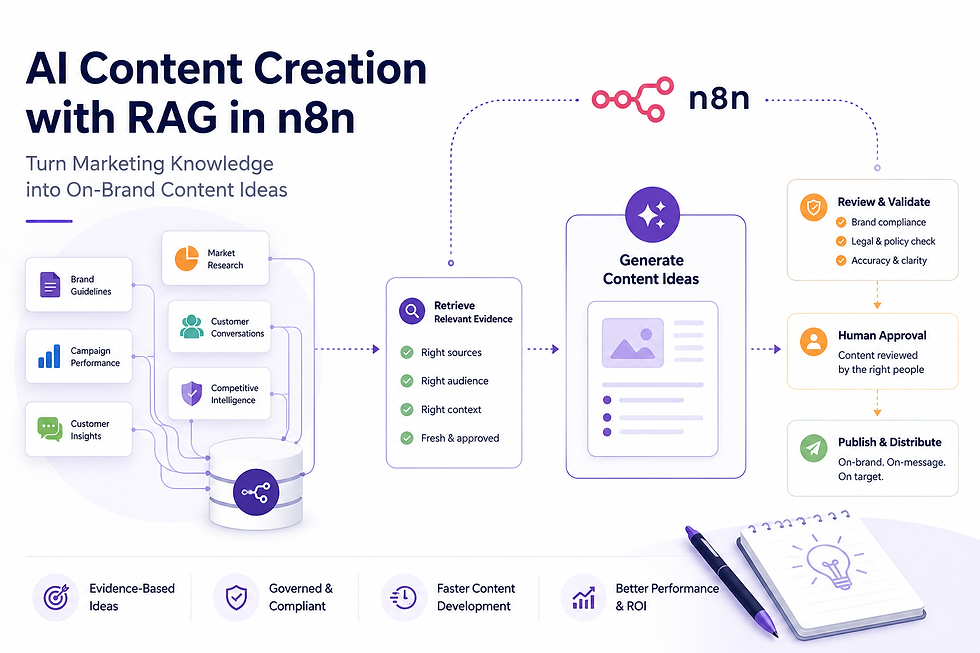
A knowledge-ingestion workflow that continuously processes brand guidance, market research, campaign assets, performance data, customer evidence, and permitted competitive material.
A content-intelligence workflow that interprets a marketing request, retrieves the right evidence, generates traceable ideas or briefs, validates them against policy, and routes them for human approval.
The objective is not autonomous publishing. It is faster, better-informed content development with evidence, governance, and a clear boundary between inspiration and approved brand communication.
The business problem: marketing knowledge is fragmented
Consider a B2B software company preparing a campaign for a new compliance product. The content team needs to answer several questions:
- Which customer problems appear most often in research and sales calls?
- Which value propositions performed well in previous campaigns?
- Which claims are legally approved?
- How does the product differ from named competitors?
- Which messages are appropriate for financial-services buyers in the UK?
- Which topics have already been overused?
- What evidence supports each proposed angle?
The answers may exist, but not in one system. The brand guide might be in Google Drive, win-loss analysis in a slide deck, campaign metrics in a warehouse, customer language in call transcripts, product claims in an approved database, and competitor observations in a research repository.
Writers compensate by searching manually, asking colleagues, reusing familiar ideas, or prompting a public model with incomplete context. That process is slow and inconsistent. It also makes it difficult to explain why an idea was recommended or whether the source was current.
The real requirement is a governed marketing knowledge system: one that can retrieve the right evidence for a particular audience, product, region, channel, and campaign objective.
Why common AI content approaches fail
A generic prompt has no organizational memory
“Write five campaign ideas for our product” contains almost none of the information needed to produce differentiated work. The model does not know the approved positioning, customer objections, previous experiments, regional restrictions, or current campaign strategy.
Adding a long brand description to every prompt helps only marginally. It does not solve source freshness, campaign retrieval, access control, or traceability.
Copying every document into a long prompt does not scale
Long-context models can process substantial input, but sending the entire marketing archive for every request is expensive and imprecise. Irrelevant evidence competes with the useful material. Older messaging may contradict current positioning, and sensitive documents may be exposed to users who should not see them.
Fine-tuning is not a live knowledge layer
Fine-tuning may help a model follow a stable style or output pattern. It is not the right mechanism for frequently changing campaign evidence, pricing, positioning, competitor observations, or performance metrics. Updating those facts should not require retraining a model.
A vector database alone is not a content strategy system
Semantic similarity can return text that sounds related without being appropriate. A high-performing consumer campaign may be irrelevant to an enterprise audience. A competitor page from two years ago may no longer represent the market. Marketing retrieval requires metadata filters, source authority, freshness rules, performance context, and sometimes keyword or SQL retrieval alongside vector search.
Draft generation without approval increases brand risk
Content can be grammatically correct and still be unusable. It may make an unapproved claim, imitate a competitor too closely, expose confidential results, use the wrong regional terminology, or publish before legal review. Generation and publication must remain separate workflow stages.
What is RAG for content creation and marketing insights?
Retrieval-augmented generation, or RAG, retrieves information from approved sources and provides that evidence to a language model when it generates an answer or asset.
For marketing, the useful unit is not simply “a document.” The system should retrieve evidence that answers a specific planning question:
- Customer language supporting a pain point.
- Campaign results supporting a channel or message choice.
- Brand guidance controlling tone and terminology.
- Product documentation validating a claim.
- Competitive evidence identifying a market gap.
- Regional policy controlling what can be stated.
The workflow then uses that evidence to create outputs such as:
- Campaign themes.
- Content briefs.
- SEO topic clusters.
- Webinar concepts.
- Email or landing-page variants.
- Social content angles.
- Sales-enablement narratives.
- Competitive-response messaging for internal review.
RAG grounds the work, but it does not guarantee correctness or originality. Retrieved evidence can be outdated, biased, incomplete, or incorrectly ranked. A production design must evaluate retrieval and generation separately.
The workflow shown in the n8n example
The attached screenshot is drawn from n8n's RAG use-case page, where “Content creation & marketing insights” is presented as a way to query market research, previous campaigns, and competitive analysis.
The visible workflow illustrates two reusable patterns:
A chat-triggered agent connected to a model, memory, and a processing tool.
A media-processing sub-workflow that accepts workflow variables, obtains YouTube video details and a transcript, splits the transcript into segments, recombines structured results, and returns them to the calling workflow.
That media workflow is useful for competitive webinars, product demonstrations, interviews, podcasts published as video, and customer-facing thought leadership. In a complete marketing RAG system, the returned transcript still needs classification, metadata, permission checks, chunking, embedding, storage, and retrieval controls. The screenshot is therefore an ingestion and agent-orchestration pattern, not a complete production architecture by itself.
Reference architecture for a marketing content intelligence system
A robust implementation has six layers.
1. Source layer
The source layer contains approved evidence:
- Brand guidelines and messaging frameworks.
- Product documentation and approved claim libraries.
- Personas, market research, and analyst reports.
- Past campaign assets and structured performance data.
- CRM notes, survey results, and anonymized customer language.
- Sales-call or webinar transcripts with appropriate consent.
- Content calendars and editorial decisions.
- Public competitor pages, announcements, videos, and campaign observations.
Each source needs an owner, classification, permitted purpose, and retention policy. Public availability does not automatically permit unrestricted copying or derivative use.
2. Ingestion and enrichment layer
n8n detects new or changed content through schedules, webhooks, storage triggers, APIs, database queries, or approved crawling services. The workflow extracts text and structured fields, detects language, removes duplicates, assigns metadata, and sends restricted or low-quality items to review.
Media requires an additional path. A video workflow can retrieve permitted metadata and transcripts, preserve timestamps, and connect each segment to the original source. Audio may require an approved transcription provider. Scanned documents may require OCR.
3. Knowledge layer
The knowledge layer normally combines:
- Object storage for original files.
- A relational store for source records, ownership, versions, and permissions.
- A vector store for semantic retrieval.
- Optional keyword or full-text search for exact terms.
- A warehouse or analytics database for numerical campaign results.
Do not convert every data type into prose. Campaign spend, conversions, pipeline, and cost per acquisition are better queried as structured data. Vector retrieval is appropriate for qualitative evidence such as messaging, feedback, research, and transcripts.
4. Retrieval layer
The retrieval workflow interprets the request, applies authorization and metadata filters, searches the appropriate stores, reranks results, removes near-duplicates, and builds a compact evidence package.
For example, a request for UK financial-services webinar ideas might apply:
- product = compliance_platform
- region = UK
- industry = financial_services
- channel = webinar
- approval_status = approved
- valid_to > current_date
It may then retrieve customer pain points, approved claims, relevant campaign results, current brand rules, and recent competitive themes.
5. Generation and control layer
The model receives the brief, constraints, and evidence package. It should produce structured output rather than an unconstrained essay. Deterministic checks then verify required fields, citations, prohibited claims, similarity to previous content, and approval requirements.
An AI agent development pattern becomes useful when the system must decide between several governed tools—for example, retrieving campaign performance from SQL, searching qualitative evidence in a vector store, checking an approved-claims service, or requesting clarification. A fixed chain remains preferable when every request follows the same retrieval sequence.
6. Review, publication, and learning layer
Human reviewers edit and approve the brief or draft. Only a separate, permissioned workflow may create a CMS draft, schedule a campaign, or distribute content. Publication should never be an accidental consequence of successful text generation.
After launch, the workflow can attach performance data to the campaign record. Those results inform future retrieval, but they should not automatically redefine brand strategy. A human owner decides whether an outcome represents a repeatable insight, a channel effect, a seasonal anomaly, or an experiment that should not be generalized.
Architecture diagram brief

n8n orchestrates the evidence lifecycle; the model generates only within the context and permissions supplied by the workflow.
Design the marketing knowledge model before building the workflow
RAG quality depends heavily on metadata. A chunk that contains excellent customer language is still difficult to use correctly if the system does not know its audience, product, date, source, and permission boundary.
A practical source record might include:
{
"source_id": "src_campaign_2026_014",
"source_type": "past_campaign",
"title": "UK Compliance Webinar Q2",
"business_owner": "demand_generation",
"brand": "primary",
"product": "compliance_platform",
"region": ["UK"],
"industry": ["financial_services"],
"audience": ["CISO", "Compliance Director"],
"channel": "webinar",
"content_stage": "published",
"approval_status": "approved",
"confidentiality": "internal",
"valid_from": "2026-04-01",
"valid_to": "2027-03-31",
"source_uri": "s3://marketing-evidence/campaigns/2026/014/",
"checksum": "sha256:...",
"version": 3
}
Campaign performance should have a related structured record:
{
"campaign_id": "campaign_2026_014",
"source_id": "src_campaign_2026_014",
"spend": 18000,
"registrations": 742,
"attendance_rate": 0.43,
"opportunities_influenced": 18,
"reporting_window_days": 90,
"metric_definition_version": "marketing_metrics_v4"
}
This separation prevents an LLM from trying to calculate or compare business metrics from narrative text.
How to build the workflow in n8n
Node availability and configuration vary by n8n version, deployment type, and connected services. The following workflow describes platform concepts rather than prescribing one vendor stack.
Step 1: Create a governed source registry
Create a table containing the source owner, connector, refresh schedule, confidentiality, permitted audiences, retention period, and processing status. Treat this registry as the allowlist for ingestion.
Do not let a content agent submit an arbitrary URL for indexing. Competitive sources should come from domains and acquisition methods approved by legal and security teams.
Step 2: Build separate ingestion workflows by source type
Use source-specific triggers and parsers:
- Storage triggers for brand and research documents.
- Database or warehouse queries for campaign performance.
- CRM or survey APIs for approved customer evidence.
- Webhooks for new research records.
- Schedule-triggered checks for permitted public sources.
- A media-processing sub-workflow for video details, transcripts, and timestamped segments.
Separate workflows make failures and permissions easier to manage. A transcript-processing error should not prevent campaign metrics from updating.
Step 3: Normalize and classify the material
Map each source into the common metadata contract. Detect missing ownership, approval state, region, product, and validity dates. Quarantine items that fail required checks rather than indexing them with guessed metadata.
Classify the material by purpose. A legal claim library is authoritative for permitted product claims. A past campaign is evidence of prior execution, not automatic approval to repeat its wording.
Step 4: Deduplicate and version content
Calculate a content checksum and compare it with existing versions. If a source changes, create a new version and retire or supersede the old one. Remove its previous chunks from the active index through a controlled update.
Semantic deduplication is also useful. The same press release may appear on a website, in a PDF, and in a sales deck. Without deduplication, retrieval can incorrectly make one claim appear well-supported because several copies rank highly.
Step 5: Chunk according to information structure
Chunking should preserve meaning:
- Keep a brand rule with its exceptions.
- Keep a campaign result with its audience, channel, and reporting window.
- Keep a transcript segment with the speaker and timestamp.
- Keep a competitor claim with the source date and URL.
- Keep an approved product claim with its required disclaimer.
Fixed token windows are simple, but they can separate a claim from its qualifier. Prefer structure-aware chunking where document formats permit it. Test chunk size and overlap against realistic marketing questions rather than copying generic defaults.
Step 6: Generate embeddings and index the chunks
Choose an embedding model that supports the organization's languages and expected query vocabulary. Store the embedding together with source metadata, permissions, version, and a stable chunk identifier.
Use separate indexes or strong metadata partitions when business units, clients, or regions must not share evidence. Application-side filtering after retrieval is too late if unauthorized text has already reached the model.
Step 7: Normalize the content request
A content request should capture more than a topic:
{
"request_id": "brief_2026_071",
"requester_id": "usr_482",
"objective": "Generate three webinar concepts",
"product": "compliance_platform",
"audience": ["CISO", "Compliance Director"],
"industry": "financial_services",
"region": "UK",
"funnel_stage": "consideration",
"channel": "webinar",
"constraints": {
"exclude_campaign_ids": ["campaign_2026_014"],
"claims_must_be_approved": true,
"competitive_comparison": "internal_only",
"maximum_ideas": 3
}
}
If the audience, product, or intended channel is missing, ask for clarification before retrieval. An invented assumption can cause the system to retrieve the wrong evidence while still producing convincing copy.
Step 8: Route the request to the right retrieval methods
Use deterministic routing where possible:
- Vector search for research, customer language, brand guidance, and transcripts.
- SQL for campaign metrics and ranked performance.
- Exact or keyword search for product names, regulated phrases, and competitor terminology.
- An approved claim service for statements allowed in external content.
Hybrid retrieval often performs better than semantic search alone because marketing queries contain both concepts and exact entities.
Step 9: Filter, rerank, and assemble evidence
Apply permissions and metadata filters before retrieval. Retrieve a broader candidate set, rerank it for the specific request, remove near-duplicates, and enforce evidence diversity.
The evidence package should represent distinct needs:
- Two or three customer-problem sources.
- Relevant campaign evidence with comparable audience and channel.
- Current brand and product guidance.
- Approved claims.
- Recent competitive evidence where requested.
Returning ten similar campaign chunks is less useful than returning a balanced set of evidence.
Step 10: Generate a content brief before generating final copy
Ask the model to produce a structured brief:
{
"idea_title": "Operational Proof, Not Policy Theatre",
"audience_problem": "Compliance leaders cannot demonstrate that controls operate continuously",
"proposed_angle": "Show how continuous evidence changes audit preparation",
"why_now": "New research and recent sales calls show increased audit-readiness pressure",
"supporting_evidence": [
{
"chunk_id": "chunk_research_184",
"source_id": "src_research_041",
"use": "market pressure"
},
{
"chunk_id": "chunk_voc_992",
"source_id": "src_sales_calls_2026_q2",
"use": "customer language"
}
],
"approved_claim_ids": ["claim_204", "claim_219"],
"differentiation": "Focuses on continuous proof rather than generic compliance automation",
"risks": ["Requires legal review of audit-efficiency wording"],
"recommended_channels": ["webinar", "executive article"]
}
A brief is easier to review than a complete campaign. Once the angle and evidence are approved, a second workflow can generate channel-specific drafts.
Step 11: Validate the output deterministically
Before human review, verify:
- All cited chunk and claim IDs exist.
- The requester may access the sources.
- Every material product claim maps to an approved claim.
- The output contains no prohibited terms.
- The proposed idea is not too similar to an existing campaign.
- Competitive references are allowed for the intended audience.
- Required regional disclaimers are present.
- The requested number and format of ideas are respected.
An LLM may assist with subjective brand scoring, but it should not replace exact policy checks.
Step 12: Route human approval and downstream actions
Send the brief to the correct content owner. Add legal, compliance, product, or regional reviewers according to the detected claims and risk level. Record the exact version reviewed, the decision, edits, reviewer identity, and timestamp.
After approval, a separate workflow may create a draft in the CMS or project-management system. Keep automatic external publishing disabled until the organization has a strong reason, tested controls, and explicit authorization.
Step 13: Capture outcomes without corrupting the knowledge base
Connect published content to analytics and campaign systems. Record channel, audience, spend, attribution window, conversions, pipeline influence, and editorial assessment.
Do not label every high-traffic asset a brand best practice. Performance can be driven by paid distribution, seasonality, subject-matter authority, or an existing audience. Marketing owners should approve which lessons become reusable guidance.
End-to-end example: generating a product-launch content plan
Assume a global cybersecurity company is launching a new third-party risk product for UK financial-services firms.
The request
The demand-generation lead requests five campaign concepts for CISOs and compliance directors. Ideas must use current UK terminology, avoid claims about guaranteed compliance, and differentiate the product without naming competitors in public copy.
Evidence retrieval
n8n retrieves:
- The current brand voice and regulated-claims policy.
- Approved product positioning and proof points.
- Recent UK market research.
- Anonymized language from sales calls and win-loss interviews.
- Performance from comparable webinars and executive reports.
- Recent public competitor webinars and product pages.
- The current campaign calendar to avoid duplication.
SQL identifies which prior formats performed well for a comparable audience. Vector and keyword retrieval surface recurring customer concerns and competitor themes. The reranker prioritizes current, region-appropriate sources.
Idea generation
The model creates five structured briefs. Each brief identifies the customer problem, angle, evidence, approved claims, differentiation, channel, and risks. One idea is rejected automatically because it closely matches a campaign launched three months earlier. Another is routed to legal because the wording could imply a regulatory guarantee.
Human review
The content strategist selects two ideas and edits the narrative. Product marketing validates positioning, and legal approves the claims. n8n records the final evidence set and creates CMS drafts without publishing them.
Learning
After the campaign, n8n associates performance with each approved concept. The team can later ask:
Which content angles produced qualified financial-services opportunities, and what customer evidence supported them?
The answer combines structured performance results with qualitative campaign and customer evidence. It does not infer causation from conversion data alone.
Retrieval strategies for different marketing questions
Marketing question | Best retrieval pattern | Why |
“What language do customers use for this problem?” | Vector search over approved call, survey, and ticket excerpts | Semantic retrieval finds similar expressions even when vocabulary varies |
“Which webinar themes produced pipeline?” | SQL filter and aggregation over campaign metrics | Numerical comparison requires structured queries |
“May we use this product claim in Germany?” | Exact lookup in a versioned claims and policy store | Authorization and regional policy should be deterministic |
“What topics are competitors emphasizing this quarter?” | Time-filtered hybrid search over permitted public evidence | Exact entities and semantic themes both matter |
“Have we already published this idea?” | Hybrid search plus semantic similarity over the content archive | Detects both exact reuse and concept-level overlap |
“Generate an executive brief for healthcare buyers” | Multi-source retrieval with product, audience, region, and approval filters | The brief requires several distinct evidence types |
Brand voice is more than a style prompt
A brand prompt containing adjectives such as “confident, clear, and practical” is too ambiguous for consistent enforcement. Translate brand guidance into testable rules:
- Required and prohibited terminology.
- Sentence and paragraph preferences.
- Reading-level range by audience.
- Voice examples with explanations.
- Claims requiring evidence.
- Competitor-reference policy.
- Regional spelling and disclaimer requirements.
- Channel-specific constraints.
- Examples explicitly marked as outdated or disallowed.
Use positive and negative examples during evaluation. A model may imitate surface style while violating positioning, using an unapproved promise, or addressing the wrong buyer concern.
Competitive intelligence without unsafe imitation
Competitive analysis should identify market patterns, not copy competitors.
Store the source URL, observation date, market, product, and acquisition method with every competitor record. Separate facts, direct claims, analyst interpretation, and internal conclusions. Mark public evidence differently from licensed research.
The generation prompt should prohibit reproducing distinctive competitor wording. Use competitive evidence to answer questions such as:
- Which themes are saturated?
- Which customer problem is underrepresented?
- Which proof types do competitors rely on?
- Where does approved product evidence support a credible contrast?
Legal and brand teams should define how competitors may be named in internal briefs, sales enablement, and public content.
Want to dive deeper into enterprise AI automation? Here are a few related guides that complement the concepts discussed in this article:
Build Intelligent Lead Qualification Workflows with n8n — Design AI-powered workflows that score, enrich, and route leads automatically.
Automate End-to-End Lead Generation with n8n — Build scalable lead generation pipelines using AI, web scraping, CRM integrations, and automation.
Planning Agents in n8n: Breaking Complex AI Workflows into Governed Executable Steps — Learn how planning agents decompose complex tasks into reliable, production-ready execution plans.
Building an Enterprise AI Deep Research Agent with n8n, Apify & OpenAI o3 — Explore the architecture behind autonomous AI research systems that collect, verify, and synthesize information.
Build a Multi-Agent AI Banking Document Processing Platform with n8n — See how multiple AI agents collaborate to process complex banking documents with enterprise-grade reliability.
Security, privacy, and governance
Source-level authorization
Access control must apply before retrieval. A regional contractor should not receive confidential global campaign results merely because they are semantically relevant. Store tenant, business unit, region, confidentiality, and permitted-role metadata with each source.
Customer and employee data
Call transcripts, CRM notes, tickets, and surveys may contain personal or commercially sensitive information. Apply consent, minimization, anonymization, retention, and model-provider rules before indexing. Preserve the source reference without exposing unnecessary identity data to the model.
Competitive and licensed content
Public content is not automatically free of contractual or copyright restrictions. Record permitted uses and avoid indexing licensed analyst material beyond the organization's agreement. Do not design the workflow to bypass access controls or website restrictions.
Prompt injection
External pages and documents are untrusted data. A competitor page containing instructions for an AI system must not change workflow behavior. Keep system instructions separate, sanitize inputs, allowlist tools, restrict network access, and validate all tool parameters.
Secrets and credentials
Use n8n credentials or an approved external secrets system. Do not place API keys, database passwords, or CMS credentials in prompts, vector metadata, logs, or generated drafts. Use separate least-privilege credentials for ingestion, retrieval, analytics, and CMS-draft creation.
Auditability
Record the request, requester, source and chunk IDs, model and prompt versions, generated output, validation results, reviewer edits, approvals, and downstream record IDs. This lineage is essential when a claim is challenged or a campaign must be corrected.
Evaluation: measure retrieval and content quality separately
A polished output can hide poor retrieval. Evaluate the pipeline in stages.
Retrieval measures
- Recall at K: whether expected evidence appeared in the candidate set.
- Precision at K: how much retrieved evidence was relevant.
- Ranking quality: whether the most useful evidence appeared first.
- Metadata accuracy: whether region, audience, product, and permission filters worked.
- Freshness compliance: whether expired or superseded sources were excluded.
- Evidence diversity: whether results covered different required source types.
Generation measures
- Groundedness: whether material statements follow from the evidence.
- Citation correctness: whether cited records actually support the statement.
- Brand compliance: terminology, tone, positioning, and claim rules.
- Audience relevance: whether the idea addresses the selected buyer.
- Novelty: whether it avoids near-duplication of past campaigns.
- Actionability: whether the result can become a usable content brief.
- Safety: whether confidential information or restricted comparisons appear.
Business measures
- Time from request to approved brief.
- Reviewer acceptance and edit distance.
- Percentage of ideas rejected for unsupported claims.
- Reuse of approved evidence.
- Campaign production cycle time.
- Qualified engagement and pipeline contribution, interpreted with appropriate attribution limits.
Use representative test cases before release: missing metadata, conflicting brand rules, expired claims, adversarial competitor text, multilingual requests, permission boundaries, and campaigns with misleading performance correlations. n8n provides AI evaluation workflows that can support regression testing, but business owners must still define what a good marketing outcome means.
Observability and failure recovery
Monitor both workflow health and knowledge quality:
Failure or signal | Required response |
Source connector fails | Retry with backoff, alert the source owner, and report index freshness |
Transcript is unavailable | Mark the source incomplete; do not invent or silently substitute content |
Metadata is missing | Quarantine the item for review |
Embedding fails | Keep the previous valid version active and retry the new version |
Vector update partially succeeds | Reconcile chunk IDs before activating the source version |
Retrieval returns insufficient evidence | Ask for clarification or return an evidence-gap response |
Model output lacks valid citations | Reject and regenerate within a fixed attempt limit |
Approval expires | Keep the CMS action blocked and notify the owner |
CMS creation times out | Check the idempotency key before retrying |
Track request_id, source_id, source_version, chunk_id, workflow_version, embedding_model, generation_model, prompt_version, retrieval_strategy, and approval status. Do not log unrestricted source content when correlation identifiers are sufficient.
Performance, scalability, and cost
The major cost drivers are ingestion volume, re-embedding, retrieval complexity, reranking, model context size, and generation frequency.
Control them by:
- Processing only changed sources.
- Versioning and deleting stale chunks deterministically.
- Using content hashes to prevent duplicate embedding.
- Keeping numerical data in SQL instead of embedding it.
- Applying metadata filters before expensive reranking.
- Caching stable retrieval results with source-version keys.
- Using smaller evaluated models for classification and extraction.
- Generating briefs before full channel variants.
- Limiting retrieved evidence by relevance and diversity.
- Archiving workflow execution data under a retention policy.
Scale ingestion independently from interactive retrieval. A large quarterly research import should not degrade response times for active content teams. For high-volume deployments, separate worker capacity, rate-limit model and source APIs, and capacity-plan the vector database and metadata store.
Common implementation mistakes
Indexing everything without ownership. Low-quality or unauthorized content becomes model context.
Mixing current and obsolete brand guidance. The retriever can return conflicting instructions.
Embedding campaign metrics as prose. The model may compare numbers incorrectly.
Using semantic search without metadata filters. Results may match the topic but not the region, audience, or channel.
Treating a high-performing campaign as causal proof. Distribution and timing may explain the result.
Retrieving competitor content without provenance. The team cannot assess freshness, rights, or accuracy.
Generating final copy before agreeing on the brief. Reviewers spend time correcting strategy rather than improving execution.
Letting the model approve its own claims. Policy enforcement must use authoritative records.
Publishing directly from the generation workflow. A text-quality error becomes an external brand incident.
Evaluating only fluency. Fluent content may be unsupported, repetitive, or strategically wrong.
Re-embedding the entire corpus for every change. Cost and freshness degrade as the knowledge base grows.
Using chat memory as the campaign system of record. It cannot replace durable source, approval, and performance records.
Production best practices
- Begin with one product, region, audience, and content format.
- Define authoritative source types before selecting a vector database.
- Keep original evidence, metadata, and embeddings independently traceable.
- Separate structured performance analytics from semantic retrieval.
- Require citations for claims and strategic recommendations.
- Use content briefs as the approval boundary before draft generation.
- Enforce permissions before retrieval and again before downstream actions.
- Version brand rules, claims, prompts, models, and retrieval settings.
- Build regression tests from rejected briefs and real editorial corrections.
- Treat performance feedback as evidence requiring interpretation, not automatic truth.
RAG versus alternative approaches
Approach | Appropriate use | Limitation for marketing intelligence |
Generic LLM prompt | Early brainstorming with no proprietary context | Cannot reliably use current organizational evidence |
Prompt with manually attached files | Small, infrequent tasks with a known evidence set | Manual, difficult to govern, and hard to keep current |
Long-context generation | Deep analysis of a bounded collection | Costly and noisy for large, changing archives |
Fine-tuning | Stable style or output behavior | Does not provide live campaign or market knowledge |
Deterministic templates | Highly standardized channel assets | Limited ability to synthesize new evidence |
Governed RAG workflow | Repeated content planning across changing sources | Requires data ownership, retrieval evaluation, and operations |
Agentic RAG | Variable requests requiring several retrieval tools | Adds nondeterminism, latency, and a larger security surface |
When not to use RAG for content creation
Do not build a RAG system when:
- The team has only a small, stable set of documents that can be attached manually.
- Brand and product sources have no clear owners.
- Campaign performance definitions are inconsistent.
- The organization cannot lawfully or contractually reuse the proposed data.
- The output is simple templating with no need for evidence synthesis.
- Human review and incident ownership are undefined.
- The expected request volume cannot justify operating the knowledge pipeline.
Fix knowledge governance before automating retrieval. RAG amplifies the quality and disorder of the system connected to it.
Decision framework
Before implementation, answer:
Which marketing decisions should the system support?
Which sources are authoritative for brand, claims, market evidence, and performance?
Who owns each source and its freshness?
Which data must remain in structured systems rather than a vector store?
Which metadata controls audience, region, product, time, and permissions?
How will the system distinguish public, licensed, internal, and confidential content?
What evidence must accompany every proposed idea?
Which outputs require product, legal, compliance, or regional approval?
How will retrieval and generation be evaluated independently?
What happens when the system cannot retrieve enough reliable evidence?
How will published outcomes become governed learning?
Who responds if the workflow produces an unsupported or unsafe claim?
Frequently asked questions
How does RAG help create on-brand marketing content?
RAG retrieves current brand rules, approved claims, customer evidence, campaign history, and other relevant sources before generation. The model receives organization-specific context instead of relying only on its training data. Deterministic validation and human review are still necessary.
Can RAG generate completely new content ideas?
It can synthesize new combinations and identify gaps across retrieved evidence. Novelty is not guaranteed. Compare proposed ideas with the existing content archive and require strategists to judge whether the angle is meaningfully different.
Should past campaign performance be stored in a vector database?
Store qualitative assets and observations in a vector index. Keep spend, conversion, pipeline, dates, and comparable metrics in a relational database or warehouse. The workflow can retrieve from both.
How should competitor content be used?
Use permitted competitive evidence to understand market themes, proof patterns, and gaps. Preserve provenance and freshness, respect licenses and access restrictions, and prohibit copying distinctive wording.
Does RAG eliminate hallucinations?
No. RAG supplies evidence, but retrieval can return irrelevant or outdated material and the model can misinterpret it. Evaluate retrieval, require citations, validate claims, and route material content through human review.
Is an AI agent required?
No. A deterministic retrieval-and-generation chain is easier to test when every request uses the same sources. Use an agent only when the request genuinely requires dynamic selection among several governed retrieval or analysis tools.
How often should the marketing knowledge base update?
Update according to source volatility and business risk. Brand rules and approved claims should update immediately after a controlled change. Campaign metrics may update daily or after an agreed attribution window. Competitive evidence needs an explicit observation date and expiry policy.
Can n8n publish generated content automatically?
n8n can orchestrate downstream CMS and campaign-platform actions when the relevant integrations or APIs are configured. For enterprise marketing, a safer default is to create a draft only after recorded human approval.
What should a pilot include?
Choose one high-value request such as webinar briefs for one product and region. Use a small set of governed sources, create an evaluation dataset, measure editorial acceptance and time saved, and test permission and failure paths before expanding.
How Codersarts approaches marketing content intelligence
Codersarts begins with the marketing decision and evidence model, not the chatbot interface. The engagement identifies authoritative sources, campaign metric definitions, access boundaries, approval policies, and measurable editorial outcomes before selecting models or databases.
The implementation then separates ingestion, metadata, structured analytics, semantic retrieval, generation, validation, approval, and publishing. This makes it possible to test each layer, replace individual vendors, and explain how an idea was produced. For n8n deployments, the work can include source connectors, media-processing workflows, vector and SQL retrieval, evaluation datasets, least-privilege integrations, human-review paths, deployment controls, and operational monitoring.
The appropriate objective is not to remove marketers from content development. It is to give them faster access to organizational evidence and a controlled system for turning that evidence into differentiated, reviewable work.
Conclusion
On-brand AI content creation is primarily a knowledge-engineering problem. A model cannot use research, campaign history, customer language, and brand policy that remain fragmented or poorly governed.
n8n can orchestrate the complete lifecycle: ingest sources, process transcripts, classify and version evidence, update vector and structured stores, retrieve context, generate briefs, enforce policy, route approvals, create downstream drafts, and capture performance.
The implementation should proceed in this order:
Define the marketing decision and authoritative evidence.
Establish source ownership, permissions, and metadata.
Build incremental ingestion and versioning.
Separate semantic content from structured metrics.
Filter and rerank evidence for each request.
Generate a cited brief before final content.
Validate claims, brand rules, and originality.
Require approval before downstream action.
Evaluate retrieval, generation, and business outcomes.
Feed performance back only through governed interpretation.
The result is not a generic content generator. It is a marketing intelligence workflow that helps teams produce ideas faster while preserving brand judgment, evidence, and accountability.


Comments