

The AI Engineering Curriculum Nobody Else Is Teaching (Free Download)

Most AI courses teach you tools. This one teaches you decisions.
There's a specific moment every AI engineer hits — usually in an interview, sometimes in a production incident — where knowing what a component does stops being enough. Someone asks why it connects there. What breaks if you move it. What you gain and lose either way.
That's the gap this curriculum is built to close.
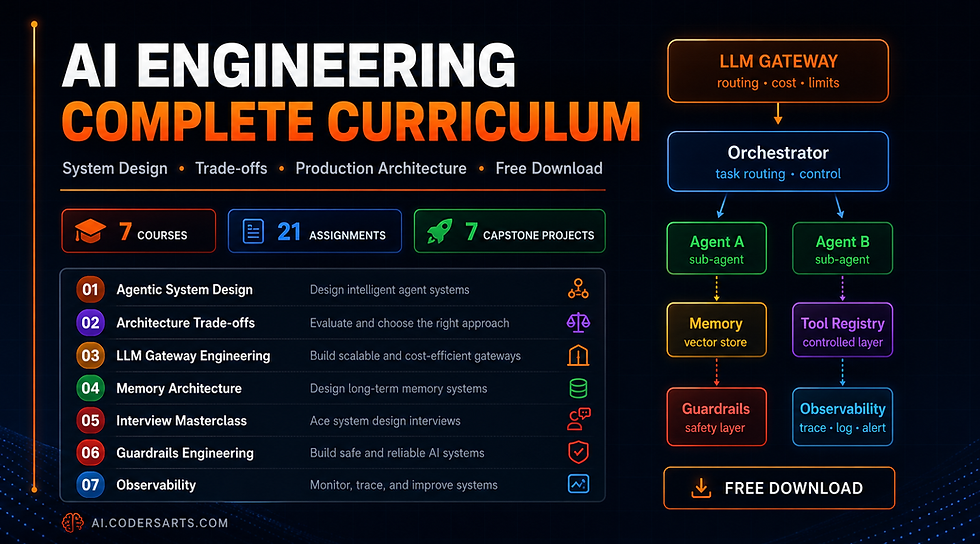
We put together a complete, structured curriculum covering everything from agentic system design to LLM gateway engineering, memory architecture, guardrails, and production observability. Seven courses. Twenty-one assignments. Seven capstone projects. All of it in one free PDF.
⬇ Download the AI Engineering Complete Curriculum — Free PDF
What's Inside the Curriculum
This is not a beginner's guide to AI. It assumes you already know the components. The entire curriculum is about what happens when you have to connect them, defend them, and ship them.
Course 1 — Agentic System Design for AI Engineers
Learn the 8 core components of every production agentic system and, more importantly, why each one connects where it does. Covers orchestrator design, sub-agent patterns, tool registries, LLM gateways, and the trade-off most engineers get asked about in interviews: centralised vs. distributed memory.
Capstone: Design a production agentic system from a blank canvas, write an Architecture Decision Record defending every connection, and record a 5-minute mock interview presentation.
Course 2 — AI Architecture Trade-offs: Defend Your Decisions
The missing layer between knowing components and passing system design interviews. You'll work through every major architectural decision — not just which option to pick, but what breaks if you move a component, and how to articulate your reasoning under pushback.
Capstone: Receive a senior engineer's "correct" architecture. Find three decisions where an alternative would be equally valid. Build the comparison matrix. Defend both.
Course 3 — LLM Gateway Engineering
The component everything flows through — and most engineers underdesign. Covers routing logic (cost-based, latency-based, capability-based), rate limiting for multi-agent workloads, cost attribution, fallback chains, and observability hooks.
Capstone: Build a working LLM gateway with LiteLLM — routing, rate limiting, SQLite cost tracking, a /statsendpoint, fallback chains, and structured JSON logging.
Course 4 — Memory Architecture in Multi-Agent Systems
Where memory lives changes everything: latency, consistency, cost, and correctness. Covers orchestrator-level vs. agent-level memory, episodic/semantic/procedural patterns, vector store retrieval strategies, concurrent write conflicts, and memory eviction at scale.
Capstone: Build the same research agent three times with different memory architectures. Benchmark all three. Write a production recommendation backed by data.
Course 5 — AI System Design Interview Masterclass
From blank canvas to confident defense in 45 minutes. Covers the anchor-first diagramming method, how to narrate your thinking while drawing, how to handle pushback without collapsing, and the traps interviewers use to separate candidates who understand trade-offs from those who've memorised components.
Capstone: Three full mock interviews — timed, recorded, self-evaluated — across three different system scenarios.
Course 6 — Guardrails Engineering for Production AI
Safety is not a checkbox. It is an architectural decision. Covers input vs. output guardrails, gateway-level vs. agent-level placement, prompt injection detection, PII redaction in multi-agent pipelines, tool-call validation, and guardrail latency budgeting.
Capstone: Add a complete guardrails layer to a provided system. Constraint: total overhead must stay under 150ms.
Course 7 — Observability for Agentic AI Systems
You can't debug what you can't see — and agents fail in ways monoliths don't. Covers multi-hop tracing, structured logging schemas, LangSmith and Langfuse integration, detecting agent loops and silent failures, and alerting on token spend and latency spikes.
Capstone: Instrument a broken agentic system. Diagnose three bugs using only traces and logs. Write an incident report and runbook.
Who This Is For
Mid-level engineers (3–6 years of experience) preparing for AI/ML engineering roles
Backend engineers transitioning into AI engineering who know the tools but not the systems
Engineers who have failed a system design round and know exactly what went wrong
Developers who can build with LangChain or LiteLLM but can't yet defend their architecture under pressure
What You Get After Completing All 7 Courses
By the time you finish all seven capstones, you will have a real portfolio:
7 architecture diagrams with written ADRs defending every connection
A working LLM gateway with routing, rate limiting, and cost tracking
Three memory architecture implementations with benchmark data
A complete guardrails layer with measured latency impact
A fully instrumented agentic system with Langfuse tracing
Three recorded mock interview sessions with self-evaluations
The ability to sit in front of a blank canvas and explain every box you draw
⬇ Download the Free Curriculum PDF
Need Help Going Further?
The curriculum gives you the roadmap. If you want expert hands helping you build, we offer a range of services at ai.codersarts.com — each one directly mapped to what this curriculum covers.
🛠 Assignment Help
Stuck on one of the assignments? We will work through it with you — not by giving you the answer, but by making sure you genuinely understand the decision you are making so you can defend it in any interview.
Component mapping and ADR writing
Trade-off analysis and diagram reviews
Pushback response coaching
Mock interview transcript reviews
💻 Code Implementation Help
The capstone projects involve real code: LLM gateways, memory benchmarks, guardrails layers, instrumented systems. If you hit a wall, we build it with you.
LiteLLM gateway setup and custom routing logic
Vector store integration (Pinecone, Weaviate, Chroma)
LangSmith / Langfuse observability integration
Guardrails implementation (NeMo Guardrails, custom layers)
Multi-agent orchestration with LangGraph or AutoGen
📁 Portfolio-Ready Project Help
Want a capstone that stands out in a job application? We help you take any project from functional to interview-ready — clean code, a professional README, an architecture diagram, and a written explanation any hiring manager can follow.
Complete project audit and cleanup
Architecture diagram creation and annotation
README and documentation writing
ADR writing and trade-off documentation
GitHub portfolio setup
🚀 Build a SaaS on Top of This Curriculum
The systems in this curriculum are not just interview prep — they are the foundation of real products. If you have an idea for an AI-powered SaaS and want help turning the architecture you have learned into a working product, we build it with you from whiteboard to deployment.
Recent examples we have helped build:
AI document review pipelines with agentic orchestration
Multi-agent customer support systems with memory and guardrails
LLM-powered internal tools with full observability layers
AI coding assistants with vector-based memory and cost tracking
🎓 1-on-1 Interview Preparation
For engineers with an interview in the next 2–6 weeks, we offer focused 1-on-1 sessions: a live blank-canvas design exercise, real-time pushback, and a full debrief. You leave with a scored diagram and a clear list of what to work on.
45-minute live system design session
Real interviewer-style pushback on every decision
Scored against a rubric across 5 dimensions
Written debrief with specific improvements
🏢 Corporate Training
If you are an engineering manager or CTO upskilling your team into AI engineering, we run the full curriculum as a private workshop — 2 days, your team, live diagramming exercises, and real systems your engineers will recognise from their own stack.
2-day intensive system design workshop
Custom scenarios built around your product and stack
Architecture review of your existing AI systems
Ongoing coaching and diagram review for 30 days post-workshop
Download the Free Curriculum Now
The PDF covers all 7 courses in full — learning objectives, all 21 assignments with sub-tasks, all 7 capstone projects with requirements and deliverables, a recommended learning sequence, and a completion portfolio checklist.
No signup required. No email wall. Just download it, use it, and reach out when you want help going further.
⬇ Download the AI Engineering Complete Curriculum — Free PDF
Have a specific project in mind or want to discuss your situation before reaching out formally?
Email us at contact@codersarts.com or visit ai.codersarts.com — we respond to every message.


Comments