

n8n Research Assistant Workflow for Sales and Strategy

Updated: Jul 31

Good sales and strategy decisions depend on research that most teams don't have time to do properly. A rep prepping for a call, a founder sizing up a market, or a strategist tracking competitors all end up doing the same manual work — opening a dozen tabs, skimming, and summarizing by hand. At Codersarts, we build n8n research assistant workflows that pull from multiple sources automatically and deliver a structured summary before anyone has to open a browser.
Quick answer: Codersarts builds n8n research assistant workflows that pull company, market, and competitor data from multiple sources, summarize it with AI, and deliver structured briefs to reps or strategists automatically — before a call, meeting, or planning session. Projects are typically delivered as a fixed-price engagement within a few weeks.
Why Research Automation Matters
Research quality and research speed are usually in tension. Doing it properly — checking recent news, funding, hiring trends, competitor moves — takes real time, so it either gets skipped under pressure or done shallowly. Neither outcome helps a rep walk into a call prepared, or a strategist make a well-informed call.
Automating the research step removes that trade-off. The same depth of research happens every time, in minutes, regardless of how busy the team is.
The Cost of Manual Research
Without this kind of automation, research work tends to fall into familiar patterns:
Reps prep inconsistently — some do deep research, others skip it under time pressure
Competitive intelligence goes stale because no one has time to check it regularly
The same account gets researched from scratch by different people on different calls
Research findings live in scattered notes instead of a shared, structured format
Strategic decisions get made on incomplete or outdated information
n8n removes these gaps by pulling and structuring research automatically, on a schedule or on demand, from sources your team already trusts.
What Codersarts Automates
We build n8n research assistant workflows that typically handle:
Pulling company data — funding, headcount, recent news, hiring trends
Monitoring competitor activity — pricing changes, product launches, messaging shifts
Summarizing market or industry trends from news and public sources
Structuring findings into a consistent brief format automatically
Delivering briefs to reps ahead of scheduled calls or meetings
Refreshing competitor and market briefs on a recurring schedule
Flagging significant changes — a competitor's pricing update, a target account's funding round
Logging research history so it's reusable instead of redone from scratch
Example Workflow
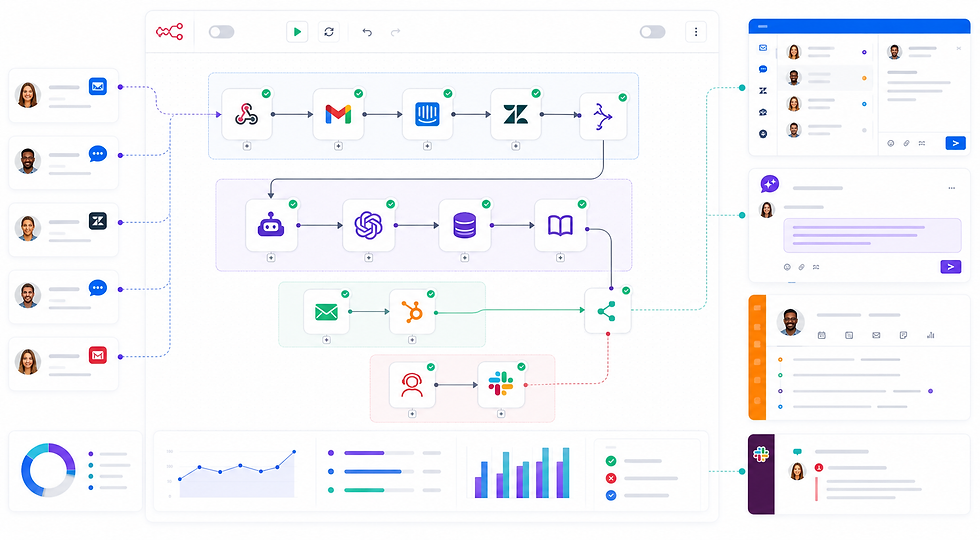
A typical n8n research assistant workflow looks like this:
A trigger fires — a calendar event, a new CRM record, or a scheduled interval
n8n pulls data from company, news, and competitor sources relevant to the trigger
AI summarizes the raw data into a structured, readable brief
The brief is formatted consistently — company overview, recent signals, key talking points
The brief is delivered to the rep or strategist via email, Slack, or directly into the CRM
For recurring research, the workflow re-runs on a schedule and flags meaningful changes
All research output is logged for future reference

Who This Is For
This automation is a strong fit for:
Sales teams that want consistent account research before every call
Founders and strategists tracking competitors or market shifts
Agencies producing research-backed proposals for prospective clients
Product teams monitoring competitor positioning and feature releases
If research quality currently depends on who has time that week, this makes it consistent regardless of workload.
Why Codersarts
We don't build a single-source news scraper. We design the research workflow around the specific questions your team actually needs answered — deal-relevant signals for sales, competitive moves for strategy — so the output is a usable brief, not a raw data dump.
Where useful, we also build in change-detection, so the workflow only surfaces what's actually new or significant instead of repeating the same summary every time.
n8n vs. Generic AI Research Tools
Generic AI research assistants exist, but n8n offers advantages for teams that want the output tied directly into their process:
Custom source combinations — n8n can pull from news, CRM data, and competitor sites together, rather than being limited to one data source.
Direct delivery into existing tools — briefs land in Slack, email, or the CRM automatically, instead of living in a separate app reps have to check.
Scheduled and triggered runs — n8n can research on a recurring schedule or fire automatically off a calendar event or CRM change.
Data ownership — self-hosted n8n keeps research data and findings inside your own infrastructure.
How Codersarts Delivers These Projects
Discovery — mapping the research questions your team actually needs answered and the sources that answer them.
Workflow design — building the data pull, summarization, and formatting logic with change detection where useful.
Integration and testing — connecting your CRM, calendar, and delivery channel, then testing output quality across different account types.
Handover and support — documenting the workflow and supporting it as research needs evolve.
Most research assistant projects are delivered as a fixed-scope engagement, so cost and timeline are clear upfront.
Common Integrations
Depending on your stack, a research assistant workflow can connect with:
HubSpot, Salesforce, or other CRMs for trigger data
News APIs, Google Alerts, or industry-specific data sources
Company data providers like Clearbit or Apollo
Slack, email, or Notion for brief delivery
AI models for summarization and brief formatting
Built for Production
A production-ready research assistant should include:
Clear source prioritization so the most reliable data is weighted correctly
Consistent brief formatting so output is easy to scan under time pressure
Change detection to avoid repeating the same information
Error handling for sources that fail or return no data
A logging system so past research is searchable, not lost
Frequently Asked Questions
What is an n8n research assistant workflow?
It's an automation that pulls company, market, or competitor data from multiple sources, summarizes it with AI, and delivers a structured brief to a rep or strategist automatically, without manual research.
Can this replace manual research entirely?
For most repeatable research tasks, yes. It's best suited to the research that happens repeatedly — pre-call briefs, competitor monitoring — rather than one-off, highly specialized deep dives.
How current is the research data?
Data currency depends on the sources connected and how often the workflow runs. Recurring workflows can refresh on a schedule so briefs stay current between meetings or planning cycles.
Can it monitor competitors automatically?
Yes. The workflow can track competitor pricing pages, product announcements, and public messaging on a recurring schedule, and flag changes as they happen.
Where do the research briefs get delivered?
Briefs can be delivered wherever your team already works — Slack, email, directly into a CRM record, or a shared Notion page.
How long does it take to build a research assistant workflow?
Most fixed-scope research assistant projects are scoped and delivered within a few weeks, depending on the number of sources and the complexity of the brief format.

Need This Built?
If you want a custom research assistant workflow in n8n, Codersarts can help. We build data-pull, summarization, and delivery workflows that put research directly in front of reps and strategists — before they need to ask for it.
Or email us directly at contact@codersarts.com


Comments