

How to Evaluate an Agentic AI Development Company: A Buyer's Decision Guide
.jfif/v1/fill/w_320,h_320/file.jpg)

By the time most businesses start seriously evaluating agentic AI, they've usually already read the pitch decks, seen a few demos, and have a rough sense that it could help. What's often missing isn't information — it's a clear framework for actually making the decision: whether agentic AI is the right fit at all, whether to build it internally or bring in outside help, how to evaluate the companies competing for the work, and what to look for in a proposal before signing anything.
This guide is built around that decision process specifically, structured the way it actually unfolds — starting with whether agentic AI genuinely fits your business need, moving through build-vs-outsource decisions, vendor evaluation criteria, PoC assessment, and proposal comparison, before landing on how to choose a partner for the long term. It's meant to be worked through, not just read — a checklist for a decision that's easy to get wrong by rushing past the early questions to get to vendor comparisons too quickly.
If you want to see what a company that holds up well against these criteria actually looks like in practice, Codersarts' agentic AI development page is a reasonable reference point as you work through the questions below — but the framework itself is designed to help you evaluate anyone, not just us.
Do You Actually Need Agentic AI? (Readiness Questions)
Before evaluating any vendor, it's worth answering a more basic question honestly: does your use case actually need agentic AI, or would something simpler serve it just as well? Getting this wrong — building an agent for a problem that didn't need one — is one of the more expensive mistakes to walk back later.
How do I know if my business actually needs Agentic AI?
A useful test: does the task require multi-step reasoning, decision-making across several possible paths, or the ability to take actions across systems (not just answer questions)? If a task is genuinely a single lookup-and-respond pattern, agentic AI is likely more than the problem needs.
Which business processes are best suited for Agentic AI?
Processes involving judgment calls, multi-step workflows, or coordination across several systems tend to be the strongest fit — think claims processing, multi-step customer resolution, or sales qualification, rather than simple FAQ answering.
A few comparisons worth working through explicitly:
Question | Points Toward Agentic AI | Points Toward a Simpler Solution |
Agentic AI vs. traditional chatbot | Task requires reasoning across steps, taking real actions, or handling ambiguity | Task is answering known questions from a fixed knowledge base |
Agentic AI vs. RAG solution | Task needs to act on retrieved information (update a record, trigger a workflow), not just answer with it | Task is purely informational — retrieve and present relevant content |
Custom agent vs. existing AI platform | Workflow is specific enough that off-the-shelf platforms can't handle it without significant workarounds | A general-purpose platform already covers the workflow reasonably well out of the box |
When should we use Agentic AI instead of a traditional chatbot?
When the interaction needs to go beyond answering — resolving a ticket end-to-end, updating a CRM record, coordinating a multi-step process — rather than just responding conversationally.
When should we use Agentic AI instead of a RAG solution?
When the value isn't just in retrieving the right information, but in acting on it — RAG is about answering well; agentic AI is about answering and doing.
When should we build custom AI agents instead of using existing AI platforms?
When your workflow has enough specificity — proprietary systems, non-standard business logic, compliance requirements — that a general platform would require so much customization it stops being meaningfully "off-the-shelf" anyway.
How many AI agents does my business need? Should we build a single agent or a multi-agent system?
Start with the number of genuinely distinct decision-making roles in the workflow. If one agent can reasonably handle the reasoning end-to-end, a single agent is usually the right starting point — multi-agent systems add real coordination complexity and should be reserved for workflows that genuinely require specialized agents working together, not applied by default because it sounds more sophisticated.
The honest goal of this section isn't to talk you into agentic AI — it's to make sure that if you move forward, it's because the use case genuinely calls for it, not because it's the current trend. A good vendor should be willing to tell you if a simpler solution fits better, even if it means a smaller engagement.
Build In-House, Hire Engineers, or Outsource?
Once you've confirmed agentic AI is the right fit, the next decision is who builds it. This is a genuinely different question from which vendor to hire — it's about which delivery model fits your situation at all.
Should I hire Agentic AI engineers or outsource Agentic AI development?
This largely comes down to whether agentic AI will be a one-off project or an ongoing capability. A single, well-scoped project usually favors outsourcing — hiring dedicated engineers for a project that ends in a few months rarely makes economic sense. Recurring, evolving agentic AI needs shift the calculation toward either dedicated hires or a longer-term outsourced/dedicated-team arrangement.
Should I build an internal Agentic AI team or work with an external company?
An internal team makes sense when agentic AI will be a permanent, core part of the business — not a single deliverable but an ongoing capability spanning multiple systems and use cases over years. For most businesses evaluating their first agentic AI project, an external company is the lower-risk starting point, with the option to build internal capability later once there's a proven use case and a clearer sense of what that team should look like.
When should a company hire an Agentic AI development partner?
Typically when the technical expertise required (orchestration frameworks, evaluation practices, production hardening) doesn't already exist in-house, and building it from scratch would take longer or cost more than the value the project itself is meant to deliver.
When should we use a dedicated Agentic AI development team?
When the need is ongoing rather than a single project — multiple agents planned, a product that will keep evolving, or work spanning several months where a consistent team (rather than shifting engagement-by-engagement) meaningfully improves quality and continuity.
Should we start with an Agentic AI PoC?
In most cases, yes — a scoped proof-of-concept is the lowest-risk way to validate that agentic AI genuinely solves the problem before committing to a larger build. The exception is when the use case is already well-understood and low-risk enough that skipping straight to a small production build doesn't meaningfully increase risk.
A simple way to frame the decision:
Situation | Likely Best Fit |
Single, well-scoped project; first agentic AI initiative | Outsource to an external company |
Ongoing need, multiple agents planned, evolving scope | Dedicated team or long-term partner |
Agentic AI is becoming a core, permanent business capability | Internal team, possibly built alongside an external partner initially |
Use case unproven, meaningful uncertainty about fit | Start with a PoC before committing to any larger model |
If you want the fuller breakdown of build-vs-outsource trade-offs and what to look for once you've decided to bring in outside help, our guide on how to hire an agentic AI development company goes deeper into that specific decision — the next section here picks up from that point, on evaluating specific companies.
What to Look For in an Agentic AI Development Company
Once you've decided to bring in outside help, the question becomes which company. A handful of criteria consistently separate companies genuinely capable of delivering from ones repackaging a chatbot as "agentic AI."
How do I choose an Agentic AI development company?
Start with the fundamentals: relevant technical expertise, real production experience (not just demos), and a development process that's transparent enough for you to actually evaluate rather than take on faith.
How do I evaluate an Agentic AI company's technical expertise? What technologies should an Agentic AI development partner specialize in?
Ask specifically what they build with — orchestration frameworks like LangGraph, CrewAI, or AutoGen, evaluation and observability tooling, and which LLM providers they work across. A company that describes its work only in marketing language, without naming the actual technical stack, is a warning sign.
What experience should an Agentic AI development company have?
Look for demonstrated experience across the specific complexity your project needs — a company with only single-agent chatbot experience isn't automatically qualified for a multi-agent enterprise system, and vice versa; overqualified for a simple project isn't necessarily better either, since it can mean unnecessary complexity and cost.
How do I choose between a general AI company and an Agentic AI specialist? Should I choose a specialized company or a large IT services company?
General AI / Large IT Firm | Agentic AI Specialist | |
Depth of expertise | Agentic AI is one offering among many | Agentic AI is the core practice |
Speed and focus | Often slower, more process-heavy | Typically faster, more directly accountable |
Best fit | Large enterprises already mid-transformation with an existing relationship | Businesses wanting the deepest available expertise for this specific need |
Risk | Agent work may be handled by generalists learning on your project | Lower — team has repeated, focused experience in this exact discipline |
What should I look for in an enterprise Agentic AI development company specifically?
Beyond general technical criteria, enterprise engagements should confirm experience with the compliance frameworks relevant to your industry (SOC 2, HIPAA, GDPR), deep integration experience with enterprise systems (ERP, legacy databases), and a track record of supporting projects at meaningful scale — not just proof-of-concept work.
A short list of direct questions worth asking any company under consideration:
Which orchestration frameworks and models have you actually shipped to production, not just experimented with?
Can you describe a past project at a similar complexity level to ours?
What does your evaluation and monitoring process look like once a system is live?
How do you handle projects that don't go as planned — what does troubleshooting actually look like with your team?
The goal of this stage isn't finding the "best" company in the abstract — it's finding the company whose specific expertise, experience level, and specialization genuinely match what your project needs, which is a different (and more useful) question than simply asking who's the most impressive on paper.
Evaluating Technical Quality and Past Work
Beyond general fit, it's worth digging into the specifics of how a company actually builds and what its previous work demonstrates. This is where you separate a genuinely strong technical partner from one that just interviews well.
How do I assess the quality of an Agentic AI company's previous projects?
Ask for specific examples relevant to your use case, not just a general portfolio. A company that can walk through a past project's architecture, the challenges that came up, and how they were resolved is demonstrating real depth — a company that only shows polished end results without being able to discuss the harder parts of the build is a weaker signal.
What questions should I ask about an Agentic AI company's development process?
Ask how they scope a project, how often they check in during development, how they handle scope changes mid-project, and what testing and evaluation looks like before something reaches production. A company with a vague or undefined process is more likely to produce inconsistent results.
A useful framework for evaluating technical quality across the dimensions that matter most:
Dimension | What to Evaluate | Why It Matters |
Scalability | Can the architecture handle growth in usage volume, agent count, or integration complexity without a rebuild? | A system that works at pilot scale but can't grow with the business creates a costly re-architecture down the line |
Reliability | What happens when a tool call fails, an API times out, or the model gives an unexpected response? | Reliable systems are built with failure handling in mind from the start, not patched in after something breaks in production |
Security | How is sensitive data handled, both in transit and at rest? What access controls exist? | Agentic AI systems often touch real business and customer data — security can't be an afterthought |
Data privacy | Does the company have a clear approach to data retention, model training on your data, and compliance with relevant regulations? | Especially critical if the agent touches customer PII, health data, or financial information |
How do I evaluate the scalability of an Agentic AI solution?
Ask directly what happens if usage grows 10x, or if the number of agents or integrations doubles. A company that's thought this through should have a clear answer involving architecture decisions made specifically to support growth — not a vague assurance that "it'll scale."
How do I evaluate the reliability of an Agentic AI system?
Ask about failure handling specifically: what happens when a tool call fails, when the model produces an unexpected output, or when an integration goes down. Reliable systems have defined fallback behavior for these scenarios rather than leaving them to fail silently.
How do I assess the security of an Agentic AI solution? How do I evaluate an Agentic AI company's approach to data privacy?
Ask specifically about data handling practices — encryption, access controls, data retention policies, and whether your data is ever used to train or fine-tune models beyond your own system. A company without clear, specific answers to these questions likely hasn't built the necessary safeguards in from the start.
The pattern across all of these: specificity is the signal. Vague reassurance ("we take security seriously," "it's built to scale") is easy to say and hard to verify. Concrete answers — this is how we handle failures, this is our data retention policy, here's a project where scale was a real challenge and how we addressed it — are what actually distinguish a technically strong partner from one that sounds good in a sales conversation.
Evaluating Integration and Enterprise Fit
An agent's usefulness is largely determined by how well it connects to the systems your business actually runs on. This is a distinct evaluation area from general technical quality — it's specifically about fit with your existing environment, not capability in the abstract.
Can an Agentic AI solution integrate with our existing enterprise systems?
In most cases, yes — modern agentic AI development is built around connecting to CRMs, ERPs, internal databases, and third-party APIs rather than replacing them. The more relevant question isn't whether integration is possible, but how deep and reliable that integration will actually be for your specific systems.
How do I evaluate an Agentic AI company's integration capabilities?
A few concrete things to ask:
Area to Ask About | What a Strong Answer Looks Like |
Specific systems | The company can speak directly to your CRM, ERP, or internal tools by name — not just generic categories |
Depth of integration | Distinguishes between simple read-only lookups and deeper, bidirectional actions (updating records, triggering workflows) |
Legacy or non-standard systems | Has handled integration with older, less-documented, or proprietary systems before — not just modern, well-documented APIs |
Failure handling | Has a defined approach for what happens when an integrated system is slow, down, or returns unexpected data |
How can I ensure an Agentic AI solution can scale with my business?
This connects directly to the scalability question from the previous section, but with an enterprise-specific angle: as your business adds new products, systems, or entities (new regions, new business units), can the agent's integration layer extend to cover them without a substantial rebuild? Ask the company to walk through how their architecture handles this kind of growth specifically, not just user volume growth.
A few things worth clarifying explicitly before moving forward with an enterprise-scale engagement:
Does the company have experience with the specific category of systems you run (not just "enterprise systems" generally — SAP is different from a custom internal tool)?
How do they handle authentication and access management across multiple integrated systems?
What's their approach when an integration needs change after launch — is that treated as new project scope, or standard maintenance?
Can they support a phased integration rollout (starting with one system, expanding over time) rather than requiring everything connected on day one?
The practical reality: integration work is frequently where agentic AI projects run into unexpected friction, simply because real enterprise systems are messier and less standardized than documentation suggests. A company that asks detailed, specific questions about your systems during scoping — rather than assuming integration will be straightforward — is generally a stronger signal than one that promises a smooth process without having looked closely at what they're actually connecting to.
Questions to Ask During Vendor Evaluation
The previous sections cover what to evaluate — this one is about how to actually surface that information in real conversations with prospective vendors, before you're comparing written proposals.
What should I ask before hiring an Agentic AI company?
A structured set of questions, asked consistently across every company you're evaluating, makes it far easier to compare answers meaningfully rather than being swayed by whoever presents most confidently.
What questions should I ask during an Agentic AI vendor evaluation?
On experience and fit:
Have you built systems at a similar complexity level to ours, and can you walk through one?
What's your experience with our specific industry's compliance or regulatory requirements, if relevant?
How many agentic AI projects has your team shipped to production, not just prototyped?
On process:
What does your typical project timeline and communication cadence look like?
How do you handle scope changes once development has started?
What does testing and evaluation look like before something goes live?
On technical approach:
Which frameworks and models would you propose for our use case, and why?
How would you handle our specific integration requirements?
What's your approach to security and data privacy for this project specifically?
On what happens after launch:
Does your engagement include support after deployment, or does it end at launch?
What would ongoing maintenance and optimization look like, and what does that typically cost?
If our requirements change after launch, how is that handled?
How do I evaluate an Agentic AI development partner more holistically, beyond individual answers?
Pay attention to how specifically a company answers these questions, not just whether the answers sound reassuring. A strong vendor gives concrete, project-specific responses; a weaker one tends to answer in generalities regardless of what's actually asked.
Signal | What It Suggests |
Specific, detailed answers tied to your use case | Genuine relevant experience, likely to translate into a well-scoped proposal |
Vague, generic answers regardless of the question | Limited depth, or a sales process detached from actual delivery capability |
Willingness to say "that's not a great fit for us" or "you may not need this" | Honesty and confidence — a strong positive signal, not a red flag |
Pressure to commit quickly, or reluctance to answer technical specifics | Worth treating with real caution |
A practical tip: ask the same core questions to every vendor, in the same order, and take notes immediately after each conversation. It's easy for the details to blur together across multiple sales calls, and having consistent notes makes the eventual proposal comparison — covered later in this guide — far more objective than relying on general impressions after the fact.
Evaluating and Scoping a PoC
If you've decided a proof-of-concept is the right starting point, evaluating it properly matters just as much as building it well — a PoC that isn't assessed rigorously can lead to a wrong decision in either direction: continuing with something that doesn't actually work, or abandoning something that would have worked with a bit more refinement.
How do I evaluate an Agentic AI PoC?
A few dimensions matter more than a simple "did it work" verdict:
Dimension | What to Look At |
Task success rate | Did the agent complete the intended task correctly across a range of realistic test cases, not just the easiest examples? |
Failure behavior | When it didn't succeed, did it fail gracefully (flagging uncertainty, escalating appropriately) or fail silently with a confidently wrong answer? |
Edge case handling | How did it perform on inputs that weren't part of the original happy-path testing? |
Path to production | Does the team have a clear view of what changes between this PoC and a production-ready version — or does "make it production-ready" feel like an open question? |
How do I determine whether an Agentic AI PoC is worth pursuing further?
The strongest signal isn't perfection — a PoC is expected to have rough edges — it's whether the core reasoning approach is sound. If the agent's fundamental logic and decision-making are working, remaining issues (edge cases, refinement, integration depth) are usually solvable with further engineering. If the core approach is fundamentally struggling with the task even in a simplified test environment, that's a stronger signal to reconsider the approach — or the use case — rather than push forward and hope production hardening fixes it.
A few practical questions worth asking at PoC review:
Which specific test cases did the agent handle well, and which did it struggle with — and why?
Is the difficulty in the cases it struggled with something more engineering effort would solve, or a more fundamental limitation of the approach?
What would need to change to take this from PoC to a production-ready system?
Based on what we've seen, does the original ROI case still hold up, or has this PoC changed that estimate?
A well-run PoC review should end with a clear recommendation, not just a demo.
A vendor presenting a PoC should be able to tell you directly whether they believe it's worth continuing, what the biggest risks are going into production, and roughly what that next phase would involve — rather than simply showing what worked and leaving the "should we continue" judgment entirely to you. A team that's confident enough to give that recommendation, including telling you honestly if the results don't support moving forward, is generally one worth trusting with the next phase if the answer is yes.
Estimating ROI, Cost, and Total Cost of Ownership
Before committing budget beyond a PoC, it's worth having a clear-eyed view of both what the project will cost and what it's actually expected to return — treated as two separate questions, not a single vague sense that "this should pay off."
How do I estimate the ROI of an Agentic AI project?
Start with the cost of the task being automated or improved today — labor hours, error rates, missed opportunities — multiplied by its actual business value. Then compare that against the total cost of building and running the agent, including the ongoing costs covered below, not just the initial development price. A rough framework:
Step | What to Calculate |
1. Current cost of the task | Labor hours × hourly cost, or the cost of errors/delays in the current process |
2. Expected improvement | Realistic percentage of the task the agent will handle (rarely 100% at launch) |
3. Value of that improvement | Time saved, errors reduced, revenue protected or gained — translated into a dollar figure |
4. Total investment | Development cost + integration + ongoing maintenance, not just the initial build price |
5. Break-even estimate | Total investment ÷ monthly value delivered, giving a rough payback period |
A word of caution: ROI estimates built only on the development cost, without factoring in ongoing costs, tend to look far more attractive than they actually are — which is why the next question matters just as much as the first.
How do I estimate the total cost of ownership of an Agentic AI system?
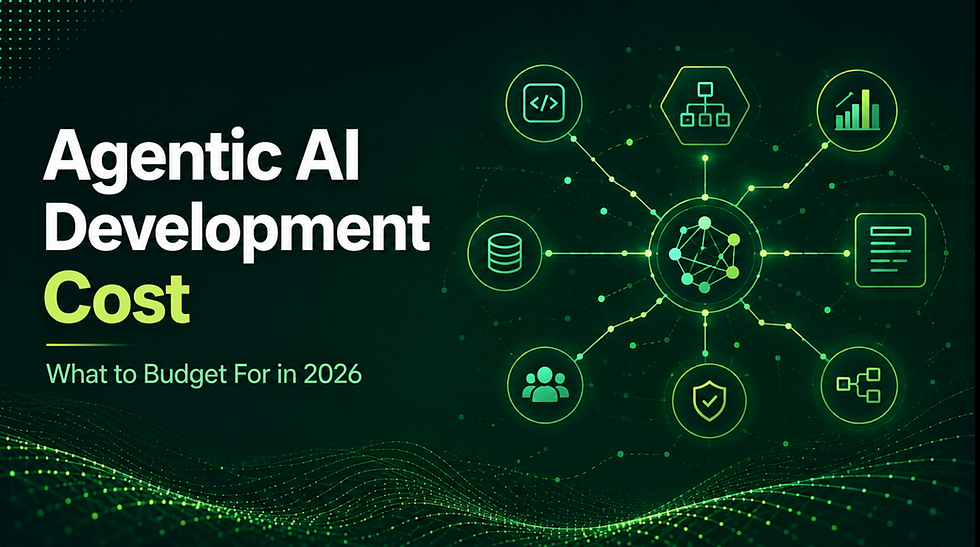
Total cost of ownership includes the initial build, but also integration work, security and compliance setup, ongoing prompt tuning and optimization, and infrastructure costs like LLM API usage — all of which continue well past launch. We cover this in detail, with cited industry benchmarks, in our Agentic AI development cost guide — as a general rule of thumb, first-year total cost of ownership tends to run meaningfully higher than the initial development quote alone, so budgeting around the build price by itself is a common and avoidable mistake.
A practical way to sanity-check an ROI estimate before committing: ask whether the projected value holds up even under a more conservative version of the numbers — a lower success rate, a longer implementation timeline, higher-than-expected maintenance costs. A project that only makes financial sense under best-case assumptions is a riskier bet than one that still clears the bar under more cautious ones.
The honest goal here isn't to produce a perfectly precise ROI figure before you've even built anything — that's rarely possible. It's to make sure the decision to move forward is based on a realistic, complete cost picture rather than an optimistic one that only accounts for the parts of the project that are easy to estimate.
Timelines, KPIs, and Measuring Success
Once a project is underway, two practical questions matter most: how long should this reasonably take, and how will you know if it's actually working once it's live?
How long does it take to develop and deploy an Agentic AI solution?
Timelines vary significantly by scope, which is worth knowing before setting expectations internally:
Project Type | Typical Timeline |
Proof of concept | 4–6 weeks |
MVP | 6–10 weeks |
Single-purpose production agent | 8–12 weeks |
Complex or multi-agent enterprise system | 12–24+ weeks |
These ranges align with the benchmarks covered in our cost guide, since timeline and cost tend to scale together — a useful cross-check if a quoted timeline seems unusually fast or slow relative to the proposed scope.
How do I measure the success of an Agentic AI implementation?
Success should be defined before launch, not retroactively decided based on how things feel a few months in. A clear definition typically includes a target task success rate, an acceptable escalation/failure rate, and a specific business outcome (cost saved, time reduced, conversion improved) tied to the original business case that justified the project.
What KPIs should I track for an Agentic AI project?
KPI Category | Example Metrics |
Task performance | Success rate, resolution rate, accuracy on defined test cases |
Efficiency | Average handling time, cost per interaction, reduction in manual hours |
Reliability | Failure rate, escalation rate, uptime |
Business outcome | Revenue impact, cost savings, customer satisfaction change |
Adoption | Usage volume, percentage of eligible tasks routed to the agent vs. handled manually |
A few things worth keeping in mind when setting these up:
Launch-day performance is a starting point, not the final verdict. As covered earlier in this guide, agents tend to improve meaningfully over the weeks and months following launch, as real usage surfaces edge cases and tuning catches up. Judging a system purely on its first-week numbers can lead to premature conclusions in either direction.
Track a mix of technical and business metrics, not just one or the other. A high task success rate that doesn't translate into measurable time or cost savings suggests the KPI itself may be misaligned with the actual business goal — success metrics should trace back to the original reason the project was approved.
Revisit KPIs periodically, not just at launch. As the agent's scope expands or business priorities shift, what counts as "success" can reasonably evolve too — a KPI framework set once and never revisited tends to become less meaningful over time as the system and the business around it keep changing.
What Happens After Launch — Support and Maintenance
Launch isn't the finish line, and it's worth confirming what happens next before signing an agreement — not discovering the gap once the system is already live and something needs fixing.
What ongoing maintenance does an Agentic AI system require?
At minimum: monitoring for failures and performance issues, periodic prompt and model tuning as real usage surfaces edge cases, integration upkeep as connected systems change, and adjustments as business requirements evolve. This isn't optional overhead — production agents that aren't actively maintained tend to degrade quietly over time rather than fail obviously.
What support should an Agentic AI development company provide after deployment?
At a minimum, a clear answer to what happens when something breaks, how quickly it gets addressed, and whether ongoing optimization is included or billed separately. Vague or evasive answers to this question during vendor evaluation are worth treating as a real warning sign, not a minor gap to sort out later.
A few direct questions worth confirming with any vendor before signing:
Question | Why It Matters |
Is post-launch support included, or a separate engagement? | Avoids an unpleasant surprise once the initial contract ends |
What's the expected response time for production issues? | Especially critical for customer-facing or business-critical agents |
Is ongoing tuning and optimization part of the offering? | Determines whether performance is expected to improve over time or stay static |
Who owns monitoring — the vendor, your team, or both? | Clarifies responsibility before an issue arises, not during one |
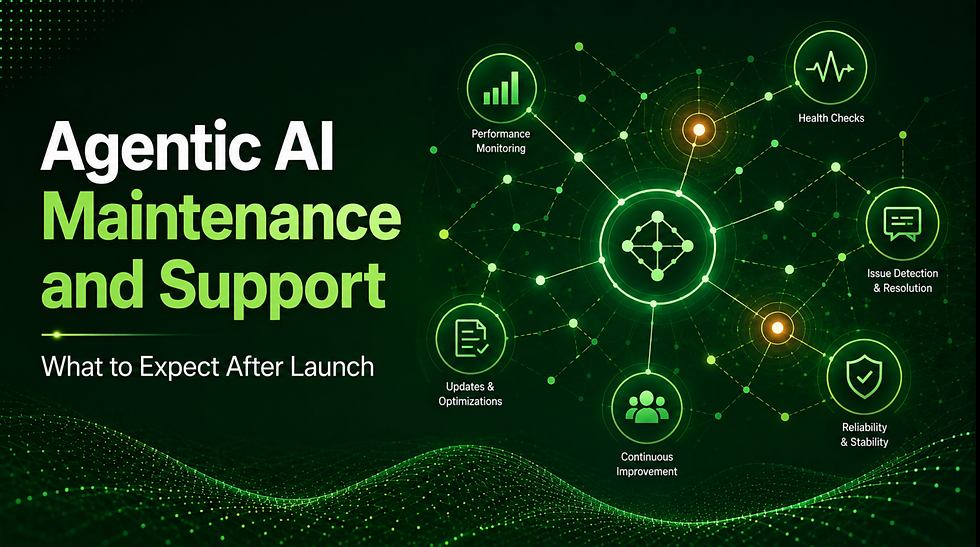
This is a large enough topic that it deserves its own dedicated treatment rather than a partial summary here — our guide to Agentic AI maintenance and support covers what ongoing care actually involves, how much it typically costs, and how to decide between in-house, outsourced, and hybrid support models in much more depth.
The practical takeaway for this stage of the buying decision: treat post-launch support as a core part of the evaluation, not an afterthought to figure out later. A company that's thought this through — and can speak to it clearly during your initial evaluation — is signaling the same kind of long-term thinking you'll want from them once the system is actually in production.
Proposals, RFPs, and Contracts
Once you've narrowed your options down to a few serious candidates, the evaluation shifts from conversations to documents — proposals, RFPs, and eventually a contract. This is where vague impressions need to become specific, comparable commitments.
What should be included in an Agentic AI development proposal?
Proposal Element | Why It Matters |
Defined scope | Clear boundaries on what's included — vague scope is the most common source of budget overruns later |
Architecture approach | Which frameworks, models, and integration approach are proposed, and why they fit your use case specifically |
Timeline with milestones | Not just a final delivery date, but checkpoints along the way to track progress |
Pricing model | Fixed-price, time & materials, or hybrid — and what triggers a change in cost |
What's excluded | Just as important as what's included — prevents assumptions about scope that differ between you and the vendor |
Post-launch support terms | Whether maintenance is included, and under what terms, as covered in the previous section |
What should I include in an RFP for Agentic AI development?
Be specific about your actual systems, compliance requirements, and success criteria — a generic RFP tends to produce generic proposals that are hard to meaningfully compare. Include the specific integrations needed, any regulatory requirements, your rough timeline expectations, and how you'll be evaluating responses, so vendors are responding to your actual situation rather than a template project.
What should an Agentic AI development contract include?
Beyond standard commercial terms, look specifically for: clearly defined scope and deliverables, IP ownership (who owns the resulting system and code), data handling and confidentiality terms, what happens if timelines slip, and terms covering post-launch support — ideally as an explicit section, not an assumed extension of the development agreement.
How do I compare proposals from different Agentic AI development companies?
Comparing on price alone is a common mistake, since proposals with very different scopes can look deceptively similar on a single number. A more reliable approach:
Normalize scope first — confirm each proposal is actually addressing the same problem before comparing price
Compare what's included in the base price versus what's billed separately (integrations, support, revisions)
Weigh proposal specificity — a proposal referencing your actual systems and constraints is a stronger signal than a more generic one, even if the price is similar
Check that timeline estimates are grounded in the same scope assumptions, not just presented as a bare number
The broader point: a proposal is as much a signal about how a company operates as it is a price quote. A detailed, specific, well-scoped proposal usually reflects a company that scopes and manages projects carefully — the same qualities you'll want once the actual engagement is underway.
Preparing Internally Before You Hire
A surprising amount of what determines a smooth engagement happens before a vendor is even chosen — the businesses that get the best results tend to walk into vendor conversations with a clear internal picture already in place.
What should I prepare before hiring an Agentic AI development company?
Area | What to Prepare |
Scope clarity | A clear description of the specific task or workflow you want automated — not just "we want an AI agent" |
Systems inventory | A list of every system the agent would need to connect to (CRM, ERP, internal databases, communication tools) |
Compliance requirements | Any regulatory or data-handling requirements relevant to your industry, identified upfront rather than discovered mid-project |
Budget range | A realistic sense of what you're prepared to invest, informed by the cost benchmarks covered earlier in this guide |
Success criteria | A rough definition of what "working well" looks like, tied to a real business outcome |
Internal stakeholders | Alignment among the people who'll need to approve, use, or maintain the system — surfacing disagreements before a vendor is chosen, not after |
Why this matters more than it might seem: vendors can only scope and price a project as accurately as the information you give them. A business that shows up with a vague description gets a vague, wide-ranging proposal in return — and often ends up paying for a discovery process the vendor has to run just to figure out what you actually need, which a bit of internal prep work upfront could have avoided.
Internal stakeholder alignment deserves particular attention. It's common for a project to be scoped around one department's needs, only for a different stakeholder (IT, compliance, a different business unit) to raise a conflicting requirement partway through development. Getting the relevant people in the same room — even briefly — before vendor conversations start tends to prevent this kind of costly mid-project scope shift.
You don't need perfect answers to every item above before your first vendor conversation. A good vendor will help refine scope and surface questions you hadn't considered. But walking in with a reasonable first pass at each of these — rather than nothing — makes that refinement conversation faster and far more productive, and it's also one of the clearest ways to tell early on whether a vendor is asking the right follow-up questions or just nodding along.
Choosing a Partner for the Long Term
Most of this guide has focused on evaluating a company for a specific project. But agentic AI is rarely a true one-and-done engagement — systems need maintenance, requirements evolve, and many businesses end up expanding their use of agentic AI once the first project proves out. It's worth factoring long-term fit into the decision now, not revisiting it from scratch a year later.
How do I choose an Agentic AI partner for a long-term engagement?
A few criteria matter more here than they do for a single, isolated project:
Criterion | Why It Matters for the Long Term |
Consistency of team | Continuity across projects preserves institutional knowledge about your systems and business — starting over with a new team each time erodes that |
Capacity to grow with you | A partner should be able to support additional agents, higher complexity, or expanded scope as your needs grow, not just the current project |
Post-launch commitment | As covered earlier, ongoing maintenance and optimization matter — a partner who disappears after delivery isn't built for a long-term relationship |
Communication and reliability over time | How responsive and consistent a partner is across many interactions matters more than how they perform in a single sales pitch |
Willingness to say no when appropriate | A partner comfortable telling you when something isn't the right fit — rather than always saying yes to more work — tends to be more trustworthy over a longer relationship |
A practical signal worth watching for: how a company handles the first project is a reasonable preview of how they'll handle the fifth. If scope, communication, and post-launch support were handled well the first time, that's a strong reason to continue the relationship rather than re-run the entire vendor evaluation process from scratch for every new initiative.
This doesn't mean locking into a single partner indefinitely regardless of performance.
It means weighing long-term fit as a real factor in the initial decision — alongside price and technical capability — rather than treating every engagement as fully independent, since the switching costs of changing partners (new team, new context-building, potential architecture inconsistencies) are real and worth avoiding if the current relationship is genuinely working.
If the first engagement goes well, the more valuable question eventually becomes less "which company should we hire for this next project" and more "how do we structure an ongoing relationship with a partner who already understands our systems" — a shift worth planning for from the outset, rather than defaulting back into a fresh vendor search every time a new need comes up.
How Codersarts Fits This Evaluation Framework
Running through the criteria in this guide is a useful exercise regardless of which company you end up choosing — but it's worth being direct about where Codersarts fits against it, since the same framework applies to us as to anyone else under consideration.
On technical expertise and specialization: Codersarts works across the orchestration frameworks and models covered throughout this guide — LangGraph, CrewAI, AutoGen, and the major LLM providers — with agentic AI development as a core, dedicated practice rather than a side offering layered onto broader IT services.
On experience across complexity levels: projects range from scoped single-purpose agents to multi-agent enterprise systems, giving a realistic basis for matching a project's actual complexity to the right approach, rather than defaulting every engagement to the same architecture.
On evaluation and reliability practices: production systems are built with monitoring, evaluation, and failure-handling in mind from the start — the same qualities this guide recommends probing for directly in any vendor conversation.
On integration and enterprise fit: engagements regularly involve connecting agents to CRMs, ERPs, and internal systems, with the kind of system-specific scoping conversations this guide recommends asking for, rather than generic assurances that "integration is possible."
On proposals and process: scoped proposals define architecture, timeline, and what's included versus excluded upfront — the specificity this guide flags as a strong signal when comparing vendors.
On what happens after launch: ongoing maintenance, monitoring, and optimization are available as a continued part of the relationship, not something that ends the moment a system goes live — covered in more depth in our dedicated maintenance and support guide.
On long-term fit: for businesses that see agentic AI becoming an ongoing capability rather than a single project, Codersarts supports continued engagements — expanding scope, adding agents, or evolving a system — with the same team that already understands the business, rather than requiring a fresh vendor relationship for every new initiative.
None of this is meant to substitute for actually running the evaluation yourself — the value of this guide is in the framework, and it's worth applying it rigorously to any company you're considering, Codersarts included. But if the criteria above line up with what you're looking for, that's a reasonable basis for a first conversation.
Frequently Asked Questions
What should I look for in an Agentic AI development company?
Relevant technical expertise (orchestration frameworks, evaluation practices), real production experience rather than just demos, and a transparent development process you can actually evaluate — covered in detail earlier in this guide.
How do I choose an Agentic AI development company?
Work through readiness, technical evaluation, integration fit, and proposal comparison in sequence — rather than jumping straight to comparing prices, which is one of the more common mistakes in this decision.
What should I ask before hiring an Agentic AI company?
Questions on relevant experience, development process, technical approach, and post-launch support — the specific question sets are covered earlier in this guide.
How do I evaluate an Agentic AI development partner?
Across technical expertise, past project quality, integration capability, and long-term fit — not on price or a single sales conversation alone.
How do I compare Agentic AI development companies?
Normalize scope across proposals first, then compare what's included versus billed separately, and weigh how specific each proposal is to your actual systems and requirements.
Should I hire Agentic AI engineers or outsource Agentic AI development?
Depends on whether the need is a single project (favoring outsourcing) or an ongoing capability (favoring dedicated hires or a long-term partner) — covered in more detail earlier in this guide.
Should I build an internal Agentic AI team or work with an external company?
An external company is the lower-risk starting point for most first projects; an internal team makes more sense once agentic AI becomes a permanent, core capability.
When should we use a dedicated Agentic AI development team?
When the need is ongoing rather than a single deliverable — multiple agents, evolving scope, or work spanning several months.
Should we start with an Agentic AI PoC?
In most cases, yes — a scoped PoC is the lowest-risk way to validate the approach before committing to a larger build.
How do I estimate the ROI of an Agentic AI project?
Compare the current cost of the task being automated against total investment (development plus ongoing costs), and stress-test the estimate against more conservative assumptions.
How do I evaluate an Agentic AI PoC?
Look at task success rate, how it fails when it doesn't succeed, and whether the core reasoning approach is sound — not just whether the demo looked polished.
How do I evaluate an Agentic AI company's technical expertise?
Ask specifically what frameworks and models they've shipped to production, and request a real, detailed example rather than a general portfolio.
How do I assess the security of an Agentic AI solution?
Ask specifically about data handling, encryption, access controls, and whether your data is ever used for model training — vague reassurance is a weaker signal than specific answers.
Can an Agentic AI solution integrate with our existing enterprise systems?
Generally yes — the more important question is how deep and reliable that integration will be for your specific systems, which is worth probing directly.
How long does it take to develop and deploy an Agentic AI solution?
Typically 4–6 weeks for a PoC, 8–12 weeks for a single-purpose agent, and 12–24+ weeks for complex multi-agent systems — covered with more detail in our cost guide.
What ongoing maintenance does an Agentic AI system require?
Monitoring, prompt and model tuning, integration upkeep, and adaptation as business requirements change.
What should be included in an Agentic AI development proposal?Defined scope, architecture approach, timeline with milestones, pricing model, what's excluded, and post-launch support terms.
How do I choose an Agentic AI partner for a long-term engagement?Weigh team consistency, capacity to grow with your needs, and post-launch commitment alongside technical capability — not just performance on a single first project.
Ready to Put This Framework Into Practice?
Working through readiness, evaluation, and proposal comparison takes real effort — but it's what separates a confident, well-scoped agentic AI decision from an expensive guess. If you've made it through this guide, you're already in a stronger position than most businesses starting this process.
Whether you're still deciding if agentic AI is the right fit, ready to evaluate vendors against this framework, or want a second opinion on a proposal you've already received, that's exactly the kind of conversation worth having before committing to any partner.


Comments