

Agentic AI Maintenance and Support: What to Expect After Launch
.jfif/v1/fill/w_320,h_320/file.jpg)
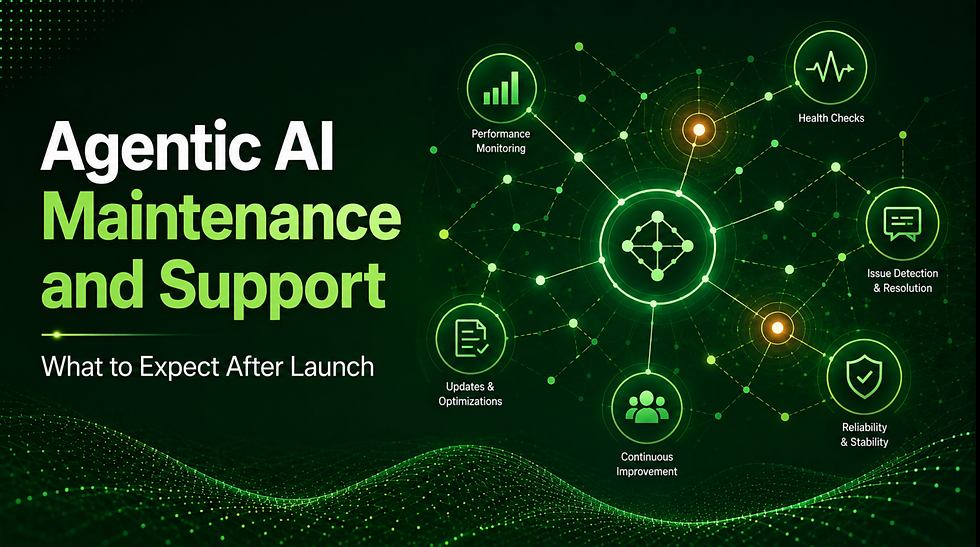
Most conversations about agentic AI focus on getting to launch — architecture, framework choice, integrations, deployment. Far fewer focus on what happens after, even though that's where an agent's real performance is decided. A launched agent isn't a finished product; it's a system operating in a live environment that keeps changing underneath it — new edge cases, shifting business requirements, API updates, model behavior drift.
Left unmonitored, even a well-built agent tends to degrade quietly: accuracy slips, costs creep up, failures go unnoticed until a customer or employee hits one. This guide covers what ongoing agentic AI maintenance actually involves, who's responsible for monitoring and improving a system after it ships, how much support typically costs, and how to decide whether to handle it in-house or bring in outside help.
If you're already past the build phase and thinking about what comes next, this is a good place to start — and if you'd rather skip straight to a conversation about your specific system, Codersarts' agentic AI development team supports projects at exactly this stage, not just at launch.
Why Agentic AI Systems Need Ongoing Maintenance
Software has always needed maintenance, but agentic AI systems need it for reasons that go beyond typical bug fixes and patches. A handful of factors make ongoing care less optional than it might seem at launch.
Model behavior isn't static.
Underlying LLMs get updated by their providers, sometimes changing subtle aspects of reasoning, tone, or tool-use behavior. An agent tuned carefully against one model version can behave differently after a provider-side update — without a single line of your own code changing.
Real-world usage surfaces edge cases testing never caught.
No matter how thorough a pre-launch evaluation is, production traffic eventually presents inputs, phrasing, and scenarios nobody anticipated. This is normal — but it means an agent's failure modes are only fully visible after real users start interacting with it.
The systems an agent depends on keep changing.
CRMs get updated, APIs get deprecated, internal databases get restructured. An agent that reliably read from a system last quarter can quietly break when that system changes shape, often without an obvious error message pointing to the cause.
Business requirements shift faster than most systems account for.
A support agent scoped for one set of policies needs to reflect new policies, new products, or new escalation rules as the business evolves — an agent that isn't updated alongside the business it serves becomes wrong in ways that are hard to notice until a customer flags it.
Costs can drift without anyone watching.
Token usage, API calls, and infrastructure costs scale with traffic and agent complexity. Without active monitoring, a system that was cost-efficient at launch can become quietly expensive as usage grows or as the agent's reasoning paths get more complex over time.
A useful way to think about it: launching an agentic AI system is closer to hiring an employee than shipping a static piece of software. Employees need onboarding updates, performance feedback, and occasional correction as circumstances change — a production AI agent needs the equivalent, just implemented through monitoring, evaluation, and iteration rather than a conversation.
The rest of this guide breaks down what that ongoing care actually looks like in practice.
What Does Ongoing Agentic AI Maintenance Actually Include?
"Maintenance" covers more ground than it might initially sound like. It's not a single activity but a set of distinct, ongoing practices — each addressing a different way an agentic AI system can degrade or fall out of step with the business over time.
Category | What It Covers | Why It Matters |
Monitoring & Observability | Tracing agent decisions, logging tool calls, tracking success/failure rates in real time | Without visibility into why an agent made a decision, diagnosing a bad outcome after the fact is close to guesswork |
Prompt & Model Optimization | Refining prompts, adjusting reasoning logic, evaluating whether a newer model version improves results | Small, incremental tuning is often what separates a mediocre agent from a reliable one over time |
Integration Upkeep | Updating connections to CRMs, ERPs, and internal APIs as those systems change | An integration that silently breaks is one of the most common causes of unexplained agent failures |
Tool Maintenance | Keeping the functions and tools an agent calls (lookups, actions, external APIs) accurate and working | Agents are only as reliable as the tools they depend on — a broken tool produces a confidently wrong answer, not an obvious error |
Reliability & Hallucination Checks | Ongoing evaluation for factual accuracy, especially in reasoning or knowledge-retrieval steps | Hallucination risk doesn't disappear after launch — it needs continuous checking, particularly as inputs and edge cases evolve |
Cost & Performance Optimization | Reviewing token usage, latency, and infrastructure spend against actual value delivered | Left unchecked, a system's operating cost can grow disproportionately to the value it's providing |
A few things worth understanding about how these pieces fit together:
These aren't one-time fixes — they're recurring practices. Monitoring isn't something you set up once; it's an ongoing feed of information that should be actively reviewed. The same is true for prompt tuning, integration checks, and cost review — each needs a rhythm, not a single pass.
Multi-agent systems add a layer of complexity to all of the above. When multiple agents coordinate on a task, maintenance also means understanding which agent, and which decision path, produced a given outcome — a debugging problem that doesn't exist in simpler, single-agent systems.
Not every system needs every category at the same intensity. A simple, low-stakes internal agent may need light monitoring and occasional tuning. A customer-facing agent handling financial or healthcare data needs all six categories running continuously, with tighter tolerances for failure. Scoping maintenance to the system's actual risk and complexity — rather than applying a blanket level of effort everywhere — is itself part of doing this well.
Who Monitors and Troubleshoots Production Agentic AI Systems?
Once an agent is live, someone needs to be actively watching it — not waiting for a customer complaint to reveal that something's gone wrong. Monitoring and troubleshooting are related but distinct responsibilities, and understanding both helps clarify what "support" should actually mean in a maintenance engagement.
Monitoring is the continuous, largely automated side: tracking success and failure rates, logging every tool call and decision an agent makes, and flagging anomalies before they become visible to end users. Good monitoring answers the question "is something wrong right now?" without requiring a human to go looking for the answer.
Troubleshooting is the investigative side that kicks in once monitoring flags an issue, or once a failure gets reported directly. This is where tracing matters most — being able to reconstruct exactly which decision path an agent took, which tool it called, and where reasoning went off track.
Failure Type | How It's Typically Caught & Resolved |
Silent tool/integration failure | Caught via monitoring alerts on tool-call error rates; resolved by fixing or re-authenticating the broken connection |
Hallucinated or inaccurate response | Caught via ongoing accuracy evaluation or user-reported cases; resolved through prompt refinement or added grounding/retrieval steps |
Escalation loop or dead end | Caught via conversation/session logs showing repeated failed attempts; resolved by adjusting routing or fallback logic |
Latency or cost spike | Caught via performance and cost monitoring dashboards; resolved by optimizing reasoning paths or reducing unnecessary tool calls |
Multi-agent coordination failure | Caught via cross-agent tracing showing where handoff broke down; resolved by adjusting orchestration logic between agents |
24/7 support is a real requirement for some systems, and unnecessary for others. A customer-facing agent handling live support tickets around the clock genuinely needs monitoring and response coverage that matches that uptime. An internal agent used only during business hours doesn't need the same level of always-on coverage — matching support intensity to actual usage patterns avoids paying for monitoring depth the system doesn't need.
Who should own this depends on the team. Some businesses keep monitoring and first-line troubleshooting in-house once a system is stable, calling in outside expertise only for deeper architecture-level issues. Others prefer a dedicated support arrangement where an outside team owns monitoring and troubleshooting end-to-end, particularly when the in-house team doesn't have deep experience debugging multi-step, orchestrated agent systems specifically — a genuinely different skill set from typical application debugging.
The through-line across all of this: an agent without active monitoring isn't actually "in production" in any meaningful sense — it's just running, with no one able to say with confidence whether it's working well or quietly failing.
Optimizing Agentic AI Performance Over Time
Monitoring tells you something is wrong. Optimization is the ongoing work of making the system better even when nothing is technically broken — the difference between an agent that merely functions and one that keeps getting more accurate, more efficient, and more aligned with what the business actually needs.
Prompt and reasoning refinement is usually the most frequent form of optimization. Real usage surfaces phrasing, edge cases, and ambiguous requests that weren't anticipated during initial development. Adjusting prompts and reasoning steps in response to these patterns is ongoing work, not a one-time setup — most sources on this topic estimate a recurring monthly time investment for exactly this reason, echoing the tuning-cost figures covered in our Agentic AI development cost guide.
Accuracy and reliability improvements compound over time. Every incorrectly handled case is, in principle, a data point — a signal about where the agent's reasoning, retrieval, or tool logic needs adjustment. Systems that treat production failures as improvement signals tend to get measurably more reliable quarter over quarter; systems that don't tend to plateau or slowly degrade instead.
Cost-performance optimization is a distinct discipline from accuracy tuning, though the two often intersect. This includes:
Reducing unnecessary tool calls or reasoning steps that add latency and token cost without improving output quality
Evaluating whether a newer or different model would deliver comparable accuracy at lower cost
Right-sizing how much context or retrieval an agent pulls in per request, since over-retrieval is a common, quiet source of both cost and latency
Model and prompt optimization aren't purely technical exercises — they require judgment. Tightening an agent's behavior to reduce hallucination risk can sometimes make it more conservative or less helpful in edge cases; optimizing purely for cost can degrade accuracy if pushed too far. Good optimization work balances these trade-offs deliberately, rather than chasing a single metric in isolation.
This is where experience genuinely shows. A team that has optimized many production agents develops pattern recognition for where issues typically cluster — retrieval quality, tool selection logic, escalation thresholds — that a team optimizing its first live system usually has to discover the hard way. This is part of why ongoing optimization is often better handled by a team with broad, cross-project experience rather than treated as a task any available engineer can pick up as a side responsibility.
The practical takeaway: a production agent that hasn't been meaningfully adjusted since launch is very unlikely to be performing at its best — not because the original build was flawed, but because optimization is a continuous practice, not a phase that ends at deployment.
Maintaining Multi-Agent Systems and Enterprise Integrations
Maintenance gets meaningfully harder once a system involves multiple coordinated agents, or connects deeply into enterprise systems like CRMs and ERPs. Both introduce failure modes and upkeep requirements that don't exist in a simpler, single-agent setup.
Multi-agent systems add a debugging layer that single agents don't have. When one agent hands off a task to another, or several agents contribute to a single outcome, a wrong result could originate from any point in that chain — the initial routing decision, a specific agent's reasoning, a failed handoff, or a breakdown in shared memory between agents.
Maintaining these systems well requires:
Cross-agent tracing — the ability to reconstruct which agent made which decision, and in what order, for any given outcome
Orchestration-level monitoring — tracking not just whether individual agents succeed, but whether handoffs and coordination between them are working as designed
Isolated testing of individual agents — so that when something breaks, it's possible to determine whether the fault lies in one agent's logic or in how agents are coordinating
This is meaningfully different from debugging a single-agent system, and it's one of the more common reasons multi-agent deployments benefit from a team with specific experience in orchestration frameworks like LangGraph or CrewAI — not just general AI/ML maintenance experience.
Enterprise integrations require their own ongoing attention, separate from the agent's core logic. A few common sources of integration drift:
Integration Type | Common Maintenance Need |
CRM / ERP connections | API version updates, schema changes, authentication token renewals |
Internal databases | Schema migrations, changing data structures the agent reads from |
Third-party APIs | Rate limit changes, deprecated endpoints, provider-side breaking changes |
Communication tools (Slack, email, etc.) | Permission scope changes, webhook reliability, formatting updates |
None of these are dramatic failures on their own — but left unmonitored, they tend to produce exactly the kind of silent breakage covered earlier: an agent that appears to be running fine while quietly failing at a specific step, because the system it depends on shifted underneath it.
Tool maintenance deserves its own mention. The specific functions an agent calls — a pricing lookup, an inventory check, a scheduling action — need to stay accurate as the underlying business logic changes. An outdated tool doesn't usually throw an error; it just returns a wrong or stale answer with the same confidence as a correct one, which makes it one of the harder failure types to catch without deliberate, ongoing review.
The general pattern across both multi-agent systems and enterprise integrations: complexity that made a system valuable at launch is the same complexity that makes it require closer, more specialized ongoing attention — treating a multi-agent, deeply integrated system with the same maintenance approach as a simple single-purpose agent is one of the more common ways production issues go undetected for longer than they should.
Adapting Agentic AI Systems as Business Requirements Change
Maintenance isn't only about keeping a system from breaking — it's also about keeping it aligned with a business that keeps changing around it. An agent that was accurate and well-scoped at launch can become quietly wrong simply because the business it serves has moved on without it.
Policies and processes change. A support agent trained on return policies, pricing rules, or eligibility criteria needs those updated the moment the underlying policy changes — otherwise it's not malfunctioning in any technical sense, it's just confidently giving outdated answers. This is one of the easiest maintenance gaps to overlook, because nothing about the system itself is broken.
New products, services, or workflows get added. An agent scoped around today's product catalog or service offering will need retraining, updated knowledge sources, or expanded tool access as the business grows — otherwise its usefulness quietly shrinks relative to what the business actually needs it to handle.
Scale changes what "working well" means. An agent designed for a few hundred interactions a month faces very different demands at ten times that volume — not just technically, but in terms of the variety of edge cases it now needs to handle reliably. Maintenance at scale often means expanding an agent's scope and robustness, not just keeping the original version running.
Organizational priorities shift. A team might initially deploy an agent purely for cost reduction, then later need it to also support a customer experience metric, or vice versa. Since these goals can pull optimization in different directions, an agent's tuning priorities sometimes need deliberate revisiting as business priorities evolve — not because the system failed, but because what "success" means for it changed.
This is where continuous improvement becomes a genuine, ongoing question, not a one-time achievement. Can an agentic AI system be continuously improved after deployment? Yes — in fact, systems that are actively maintained and adjusted against real usage data tend to outperform their own launch-day version significantly over time, simply because they've had the chance to be corrected against real-world feedback that no amount of pre-launch testing can fully anticipate.
The practical implication: a maintenance plan built only around "keep it from breaking" misses half the picture. The other half is a periodic, deliberate review of whether the agent still reflects what the business actually needs it to do — a review that's easy to skip when things appear to be running smoothly, and easy to regret skipping once a gap has quietly grown large enough for someone to notice.
In-House vs. Outsourced Agentic AI Maintenance
Once it's clear how much ongoing work maintenance actually involves, the practical question becomes who should own it. There's no universally right answer — it depends on the team you already have, the complexity of the system, and how much of this work you want to build internal capability around versus hand off entirely.
In-House | Outsourced | Hybrid (Augmentation) | |
Best fit for | Teams with existing ML/AI engineers and bandwidth to dedicate to ongoing care | Teams without deep agentic AI expertise, or who'd rather focus internal resources elsewhere | Teams with engineering capacity but not specific agent-orchestration experience |
Speed to competency | Slower — team needs to build framework-specific and orchestration-specific expertise | Fast — brings existing, cross-project experience immediately | Moderate — internal team gains expertise while working alongside specialists |
Cost structure | Fixed internal headcount cost, regardless of how much active maintenance is needed week to week | Scales with actual need — dedicated engineers or retainer-based support | Blended — internal team handles routine work, outside experts handle specialized issues |
Best for multi-agent complexity | Only if the team already has orchestration-specific debugging experience | Strong fit — brings pattern recognition from maintaining other multi-agent systems | Strong fit — outside expertise covers the orchestration layer specifically |
Risk | Knowledge concentrated in one or two people; slower response if that expertise is unavailable | Less day-to-day familiarity with internal business context unless engagement is ongoing and close | Requires clear division of responsibility to avoid gaps between teams |
When outsourcing tends to make the most sense:
The system involves multi-agent orchestration and no one in-house has debugged one before
The team that built the system is a freelancer or a provider no longer engaged, leaving no clear internal owner
Maintenance needs (monitoring, tuning, troubleshooting) are real but don't justify a full-time internal hire
The business wants 24/7 monitoring coverage without building an internal on-call rotation from scratch
Yes, ongoing Agentic AI maintenance and support can be fully outsourced — either as a dedicated engineering arrangement or as a defined support retainer, depending on how much ownership the business wants to retain internally. This is also true even when the original system wasn't built by the team taking over support: a provider experienced in maintenance work should be able to audit an existing system, understand its architecture, and take over ongoing care without needing to rebuild it from scratch — a common and reasonable request, not an unusual one.
The hybrid model is worth taking seriously if you're not sure which direction to go. Keeping monitoring and first-line response in-house while bringing in outside expertise for optimization, architecture-level troubleshooting, or multi-agent debugging specifically often gets the best of both — internal familiarity with the business, paired with specialized experience the in-house team hasn't had the chance to build yet.
How Much Does Agentic AI Maintenance and Support Cost?
Maintenance cost is often underestimated because it's easy to focus budgeting entirely on the initial build. In reality, ongoing support is a recurring line item with its own real cost — one that's worth planning for from the start rather than discovering after launch.
Pulling from the benchmark data covered in our Agentic AI development cost guide, a few figures are directly relevant to maintenance specifically:
Maintenance Category | Typical Cost | Source |
Prompt tuning & optimization | $1,000–$2,500/month (10–20 hrs/month) | Azilen, 2026 |
Security & access control upkeep | $500–$2,000/month | Azilen, 2026 |
General ongoing maintenance | 5–15% of initial development cost, annually | Nocodefinder, 2026 |
Active custom-solution maintenance | 20–30% of development cost, annually | Sparkouttech, 2026 |
Hidden infra/token/retraining costs | 30–50% of first-year total cost of ownership | Musketeers Tech, 2026 |
A few patterns worth understanding rather than just the numbers themselves:
Maintenance cost scales with how actively a system is being improved, not just kept alive. The lower end of these ranges (5–15% annually) tends to reflect lighter-touch maintenance — keeping a stable system running with minimal changes. The higher end (20–30%) reflects systems being actively tuned, expanded, and optimized on an ongoing basis — which, as covered earlier in this guide, tends to produce meaningfully better long-term performance.
Hidden costs are the part most budgets miss. Musketeers Tech's figure — 30–50% of first-year total cost of ownership coming from infrastructure, tokens, and retraining — is a significant enough number that treating maintenance as a minor afterthought in a budget is a common and costly mistake, not a small oversight.
Dedicated ongoing support is priced differently than one-off fixes. As covered in the cost guide, dedicated team retainers typically run $15,000–$60,000/month according to Sparkouttech's 2026 data — a model many businesses use specifically for ongoing agentic AI support rather than one-time development, since it provides continuous coverage rather than per-incident billing.
The honest range to budget: for most production agentic AI systems, planning for roughly 15–30% of the original development cost annually in ongoing maintenance and support is a reasonable starting estimate, adjusted up for systems with multi-agent complexity, heavy compliance requirements, or 24/7 coverage needs, and down for simpler, lower-stakes internal tools.
As with development cost, these are benchmarks for budgeting purposes — the accurate number for a specific system depends on its complexity, usage volume, and how actively it needs to be improved, which is really only knowable once someone has looked at the system directly.
How Often Should an Agentic AI System Be Monitored and Optimized?
There's no single universal cadence for agentic AI maintenance — the right rhythm depends on how the system is used and what's at stake if it fails. That said, a few patterns hold across most production systems.
Monitoring should be continuous, not periodic. Tracking success/failure rates, tool-call errors, and cost/latency metrics is something that should be running at all times, with alerts for anomalies — not a weekly or monthly check-in. The whole value of monitoring is catching issues before they compound or reach end users, which requires it to be always-on rather than scheduled.
Prompt and reasoning tuning tends to follow a recurring monthly rhythm for most active systems. As referenced earlier, industry estimates commonly cite 10–20 hours per month of prompt tuning and optimization work for systems under active improvement — a cadence that lines up with how quickly real usage tends to surface new edge cases worth addressing.
Deeper architecture and performance review works well on a quarterly cycle. This is where broader questions get revisited: Is the current model still the right choice? Has usage volume changed enough to warrant an architecture change? Are cost-performance trade-offs still balanced correctly? These questions don't need daily attention, but going a full year without revisiting them is usually too long for anything but the simplest, lowest-stakes systems.
Integration and tool checks should be triggered by change, not just calendar time. Whenever a connected system — a CRM, an ERP, an internal API — gets updated on its own timeline, that's a natural trigger to verify the agent's integration still works correctly, rather than waiting for a scheduled check to catch a break that may have already been silently causing problems.
A simple way to think about cadence by system type:
System Type | Monitoring | Tuning Review | Architecture Review |
High-stakes / customer-facing / regulated | Real-time, continuous | Monthly or more frequent | Quarterly |
Standard business-function agent | Real-time, continuous | Monthly | Semi-annually |
Low-stakes internal tool | Continuous but lighter-weight alerting | As-needed, based on flagged issues | Annually |
The underlying principle: monitoring should never really pause, but the intensity of active tuning and review can — and should — scale down for lower-risk systems. Applying enterprise-grade review cadence to a simple internal tool wastes effort; applying light-touch, infrequent review to a customer-facing regulated system is a genuine risk. Matching cadence to actual stakes is the goal, not a fixed schedule applied uniformly everywhere.
How Codersarts Can Help With Ongoing Agentic AI Support
Whether a system was originally built by our team or handed over from elsewhere, Codersarts offers a range of maintenance and support services scoped to where a production agentic AI system actually is — not a single fixed support package applied regardless of need.
Monitoring & Observability
Continuous monitoring and tracing for production agents — including multi-step, multi-agent systems where diagnosing a wrong outcome requires understanding exactly which decision path the system took, not just that something went wrong.
Prompt & Model Optimization
Ongoing refinement of prompts, reasoning logic, and model selection based on real production usage — improving accuracy and reliability incrementally over time rather than treating launch-day performance as the ceiling.
Troubleshooting & Incident Response
Investigation and resolution of production issues — silent tool failures, integration breakage, hallucinated responses, escalation loops — with response coverage scoped to how critical the system is, including 24/7 support where genuinely needed.
Integration & Tool Maintenance
Ongoing upkeep of an agent's connections to CRMs, ERPs, internal databases, and third-party APIs, including the specific tools and functions an agent calls — keeping them accurate as the underlying systems and business logic evolve.
Multi-Agent System Support
Specialized maintenance for orchestrated, multi-agent systems built on frameworks like LangGraph, CrewAI, and AutoGen — including cross-agent tracing and orchestration-level debugging that general AI maintenance experience doesn't typically cover.
Cost & Performance Optimization
Ongoing review of token usage, latency, and infrastructure spend against actual value delivered — catching cost drift before it becomes a significant, unplanned expense.
Dedicated Support Engineers & Team Augmentation
Dedicated engineers for ongoing agentic AI support, or specialists who work alongside an existing in-house team — scaling support up or down as the system's needs change over time.
Takeover & System Audits
Auditing and taking over maintenance of an existing agentic AI system — including ones originally built by another team, a freelancer, or an in-house effort that's no longer supported — without requiring a full rebuild to bring it under proper ongoing care.
Whether the need is real-time monitoring, a one-time architecture review, or a dedicated engineer embedded long-term, these services are built to meet a production system wherever it currently stands.
Frequently Asked Questions
Who provides Agentic AI maintenance services?
Specialized agentic AI development companies with production support experience — like Codersarts — as well as some in-house AI/ML teams, depending on internal expertise. The right choice depends on whether the system involves multi-agent orchestration, which typically requires more specialized experience than general software maintenance.
Who can maintain an existing Agentic AI system?
A provider experienced in maintenance work can audit and take over an existing system without needing to rebuild it — including systems originally built by another team, a freelancer, or an in-house effort that's no longer actively supported.
Who can maintain Agentic AI workflows and pipelines?
Teams with experience in the specific orchestration frameworks (LangGraph, CrewAI, AutoGen) the system was built on tend to maintain workflows and pipelines most effectively, since debugging multi-step logic requires understanding how the framework itself handles routing and state.
Who can monitor Agentic AI agents after deployment?
Either an in-house team with monitoring infrastructure in place, or an outsourced provider offering continuous monitoring and tracing as part of an ongoing support arrangement — as covered earlier, monitoring should run continuously regardless of who owns it.
Who can optimize a production Agentic AI system?
Teams with experience across multiple production agent deployments tend to optimize most effectively, since they've developed pattern recognition for where issues commonly cluster — retrieval quality, tool selection, escalation logic — that's harder to build from a single system alone.
Who can provide ongoing Agentic AI engineering support?
Providers offering dedicated engineers or retainer-based support arrangements specifically for agentic AI systems, as opposed to general software support that hasn't been scoped for agent-specific failure modes like hallucination or orchestration breakdown.
Can Codersarts provide long-term Agentic AI support?
Yes — Codersarts offers ongoing maintenance, monitoring, and optimization for agentic AI systems, whether originally built by our team or handed over from elsewhere, structured as dedicated support engineers or team augmentation depending on what a project needs.
Who can take responsibility for ongoing Agentic AI development?
A provider willing to own maintenance as a continuous relationship, not a one-time engagement — including monitoring, tuning, and adapting the system as business requirements change, as covered earlier in this guide.
Who can monitor and improve Agentic AI agent performance over time?
A team combining continuous monitoring with a regular tuning cadence, treating production failures and edge cases as improvement signals rather than isolated incidents to patch and forget.
Who can troubleshoot issues in production Agentic AI systems?
Teams with tracing and observability tooling in place, able to reconstruct exactly which decision path an agent took for a given outcome — troubleshooting without that visibility tends to be closer to guesswork than diagnosis.
Who can maintain multi-agent AI systems after deployment?
Teams specifically experienced in orchestration frameworks and cross-agent tracing, since multi-agent debugging is a meaningfully different skill from maintaining single-agent systems.
Who can optimize Agentic AI workflows for cost and performance?
Providers who treat cost-performance optimization as a distinct, ongoing discipline — reviewing token usage, reasoning paths, and model choice regularly rather than only at launch.
Who can update and maintain tools used by AI agents?
Whoever owns the agent's ongoing maintenance should also own tool upkeep, since outdated tools tend to fail silently, returning confidently wrong answers rather than obvious errors.
Who can maintain Agentic AI integrations with enterprise systems?
Teams experienced with the specific systems involved (CRM, ERP, internal APIs), since integration maintenance often means catching schema or API changes before they cause silent breakage.
Who can improve the accuracy and reliability of deployed AI agents?
Teams running continuous evaluation against real production data, treating accuracy improvement as an ongoing process rather than a single pre-launch benchmark.
Who can provide Agentic AI model and prompt optimization services?
Providers with experience tuning prompts and evaluating model choice across multiple production systems, since this work benefits significantly from pattern recognition built across projects.
Who can monitor Agentic AI systems for failures and hallucinations?
Teams running ongoing accuracy evaluation alongside standard uptime/error monitoring — hallucination detection specifically requires evaluation practices beyond typical system monitoring.
Who can maintain Agentic AI systems as business requirements change?
A provider who treats maintenance as including periodic review of whether the system still reflects current business needs — not just technical upkeep to prevent breakage.
Who can provide 24/7 support for production Agentic AI systems?
Providers offering dedicated support arrangements with round-the-clock monitoring coverage — a reasonable requirement for customer-facing systems handling continuous traffic, though not necessary for every deployment.
Can I outsource ongoing Agentic AI maintenance and support?
Yes — fully outsourced maintenance, dedicated support engineers, and hybrid augmentation models are all common arrangements, as covered earlier in this guide.
Can Codersarts take over and maintain an existing Agentic AI project?
Yes — Codersarts audits existing systems and takes over ongoing maintenance without requiring a full rebuild, regardless of who originally built the system.
Can Codersarts provide dedicated engineers for ongoing Agentic AI support?
Yes — dedicated engineers and team augmentation are both offered, scaling based on how much ongoing support a project actually needs.
Can an Agentic AI system be continuously improved after deployment?
Yes — systems that are actively monitored and tuned against real usage data tend to outperform their launch-day version significantly over time, as covered earlier in this guide.
What does ongoing Agentic AI maintenance include?
Monitoring and observability, prompt and model optimization, integration and tool upkeep, reliability and hallucination checks, and cost-performance optimization — covered in detail earlier in this guide.
How much does Agentic AI maintenance and support cost?
Roughly 15–30% of the original development cost annually is a reasonable planning estimate, based on benchmarks from Nocodefinder, Sparkouttech, Azilen, and Musketeers Tech, adjusted for system complexity and support intensity.
How often should an Agentic AI system be monitored and optimized?
Monitoring should be continuous; tuning typically follows a monthly rhythm for actively improved systems; deeper architecture review works well on a quarterly cycle — with cadence scaled to how high-stakes the system is.
When should I consider outsourcing Agentic AI maintenance?
When the system involves multi-agent orchestration your team hasn't debugged before, when the original builder is no longer available, or when maintenance needs are real but don't justify a full-time internal hire.
Ready for Long-Term Support on Your Agentic AI System?
A well-built agent is only the starting point. What determines whether it stays accurate, cost-efficient, and genuinely useful six months or a year after launch is the quality of the ongoing care behind it — monitoring, tuning, and adapting the system as real usage and business needs evolve.
Whether you need continuous monitoring, help optimizing a system that's underperforming, or a team to take over a project that's currently unsupported, that's ongoing work worth planning for deliberately rather than leaving to chance.



Comments