

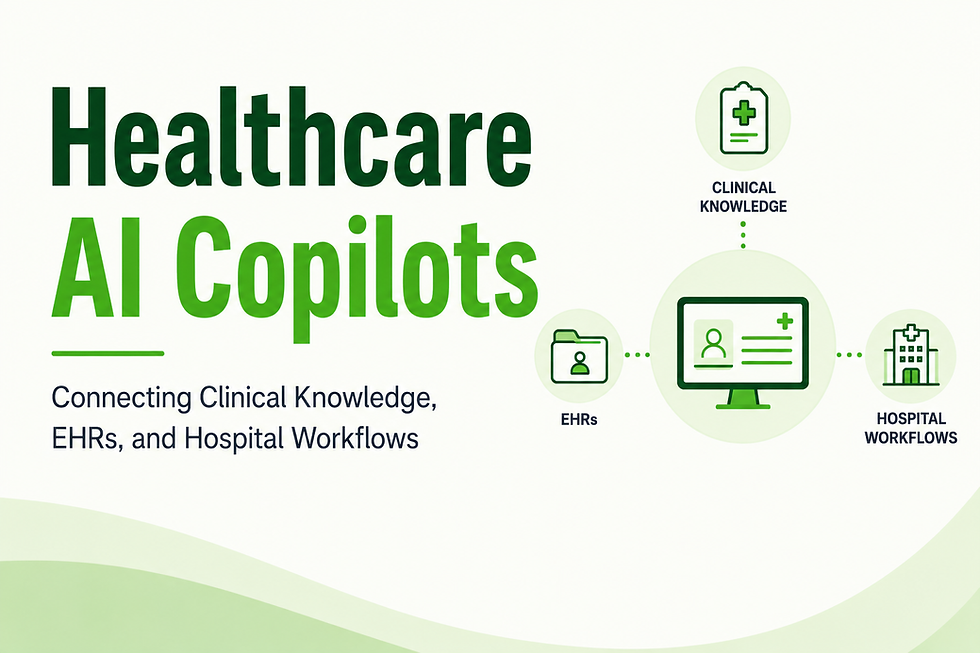
Healthcare AI Copilots: Connecting Clinical Knowledge, EHRs, and Hospital Workflows

What You'll Learn in This Guide
Healthcare organizations are under increasing pressure to improve patient care while managing growing volumes of clinical data, complex regulatory requirements, and an expanding ecosystem of digital systems. Although hospitals have invested significantly in technologies such as Electronic Health Records (EHRs), Hospital Information Systems (HIS), laboratory platforms, and patient portals, healthcare professionals often spend valuable time navigating multiple applications instead of focusing on patient care.
Healthcare AI copilots are emerging as a practical solution to this challenge. By connecting clinical knowledge, enterprise systems, and hospital workflows into a single conversational interface, they help clinicians, administrators, and support staff access the right information faster and complete routine tasks more efficiently.
This guide explores how healthcare organizations can design, implement, and scale enterprise AI copilots while maintaining security, compliance, and human oversight.
Who Should Read This Guide?
This article is intended for decision-makers and technical teams evaluating AI adoption in healthcare, including:
Hospital CIOs and Chief Digital Officers leading digital transformation initiatives.
Healthcare IT leaders responsible for integrating enterprise systems.
Enterprise architects designing AI-enabled healthcare platforms.
Clinical operations teams looking to improve staff productivity.
Engineering teams building secure AI applications for healthcare organizations.
What You'll Learn
By the end of this guide, you will understand:
What a healthcare AI copilot is and how it differs from chatbots and autonomous AI agents.
How AI copilots connect clinical knowledge, EHRs, and hospital workflows through a unified enterprise architecture.
The core components required to design and deploy a secure healthcare AI copilot.
Security, governance, and compliance considerations for protecting sensitive healthcare data.
Common implementation challenges and best practices for enterprise adoption.
How to determine whether a commercial or custom healthcare AI copilot is the right choice for your organization.
Implementation Complexity
Implementing a healthcare AI copilot is a multidisciplinary initiative that extends beyond deploying a large language model. Success depends on securely integrating enterprise systems, grounding responses in trusted clinical knowledge, establishing governance controls, and designing workflows that align with existing hospital operations.
Many organizations begin with a focused pilot in a single department, validate the business value, and then expand the copilot across additional clinical and administrative workflows.
Typical Enterprise Investment
The overall investment varies depending on the number of enterprise systems being integrated, deployment model, security requirements, and the complexity of the workflows being automated. Organizations that already have well-integrated digital infrastructure can typically adopt AI copilots more quickly, while larger healthcare networks often require a phased implementation strategy to ensure scalability, governance, and compliance across multiple facilities.
Why Healthcare Organizations Are Turning to AI Copilots
Healthcare organizations have made remarkable progress in digitizing clinical and administrative operations. Electronic Health Records (EHRs), laboratory systems, imaging platforms, patient portals, and hospital management systems have transformed how information is captured and stored. However, these investments have also introduced new operational challenges. As more systems are deployed, healthcare professionals often spend more time locating information than using it to improve patient care.
Healthcare AI copilots are emerging as a practical way to bridge these disconnected systems. Rather than replacing existing technology, they provide a unified interface that enables clinicians and staff to access enterprise knowledge, patient information, and operational workflows through natural language.
The Challenge of Fragmented Healthcare Systems
A typical hospital relies on multiple specialized systems. Patient records, lab results, medical images, scheduling, and clinical protocols all live in separate applications. While each system works well individually, they rarely provide a unified view, forcing clinicians to switch between multiple applications to find the information they need.
For example, a physician preparing for a consultation may need to:
Review the patient's medical history from the EHR.
Check the latest laboratory results.
Examine recent imaging reports.
Verify current medications.
Look up the hospital's treatment protocol.
Confirm whether follow-up appointments have been scheduled.
Although the required information already exists within the organization, retrieving it often requires navigating several disconnected systems.
The Growing Administrative Burden on Healthcare Professionals
Administrative responsibilities continue to expand alongside clinical responsibilities. Doctors, nurses, and care coordinators are expected to document patient encounters, review historical records, respond to patient inquiries, coordinate referrals, and comply with internal policies and regulatory requirements.
Many of these activities involve repetitive information retrieval rather than clinical decision-making. Every additional minute spent searching for records or navigating multiple applications is time that cannot be spent with patients.
As healthcare organizations continue to digitize their operations, improving access to information has become just as important as collecting it.
Why Traditional Healthcare Software Is No Longer Enough
Most healthcare applications are designed to solve a specific operational problem. An EHR manages patient records. A scheduling platform coordinates appointments. A laboratory system stores diagnostic results. A document repository maintains hospital policies and clinical guidelines.
While these systems are essential, they generally require users to know where information is stored before they can retrieve it. Healthcare professionals must adapt to the software rather than having the software adapt to their workflow.
Adding more applications does not necessarily improve efficiency. In many cases, it increases complexity by introducing additional interfaces, authentication processes, and disconnected data sources.
How Healthcare AI Copilots Change the Experience
Healthcare AI copilots introduce a different way of interacting with hospital systems. Instead of asking users to search across multiple applications, the copilot retrieves information from authorized enterprise sources, combines the relevant context, and presents it through a single conversational interface.
For example, a physician could ask:
"Summarize this patient's admissions over the past year, highlight any abnormal laboratory results, list current medications, and identify any pending follow-up appointments."
The copilot retrieves information from the appropriate systems, generates a concise summary, cites the underlying sources where appropriate, and can even initiate approved workflows such as scheduling referrals or notifying specialists.
Rather than replacing existing hospital systems, the copilot enhances their value by making enterprise knowledge more accessible and actionable.
Why Healthcare AI Copilots Are Becoming a Strategic Investment
Healthcare organizations are no longer evaluating AI solely for innovation. They are looking for practical solutions that reduce administrative workload, improve operational efficiency, and help clinical teams make better use of existing enterprise information.
Healthcare AI copilots align with these objectives because they work alongside existing digital infrastructure rather than requiring hospitals to replace the systems they have already invested in. As organizations continue to expand their use of AI, copilots are increasingly becoming a foundational layer that connects people, enterprise knowledge, and hospital workflows into a more intelligent and efficient healthcare experience.
What Is a Healthcare AI Copilot?
Healthcare AI copilots are transforming how clinicians and hospital staff interact with enterprise systems. Instead of navigating multiple applications to retrieve patient information, clinical guidelines, or operational data, users can ask questions in natural language and receive context-aware responses grounded in trusted organizational knowledge.
Unlike consumer AI assistants, enterprise healthcare copilots are designed to operate within a hospital's existing technology ecosystem. They connect clinical systems, knowledge repositories, and business workflows while respecting security, governance, and compliance requirements.
Defining a Healthcare AI Copilot
A healthcare AI copilot is an intelligent assistant that helps healthcare professionals access information, complete routine tasks, and navigate enterprise workflows more efficiently.
Rather than replacing doctors, nurses, or administrative staff, the copilot works alongside them by retrieving relevant information, summarizing complex records, answering operational questions, and assisting with repetitive processes.
For example, instead of manually searching across multiple systems, a clinician could ask:
"Show me the patient's latest laboratory results, current medications, allergies, and discharge summary."
The copilot retrieves the requested information from authorized systems, organizes it into a concise summary, and provides references to the underlying records where appropriate.
How Healthcare AI Copilots Work
A healthcare AI copilot acts as an orchestration layer between users and enterprise systems.
When a user submits a request, the copilot interprets the question, determines which systems contain the required information, retrieves relevant data from authorized sources, and generates a response based on trusted enterprise content.
Depending on the request, it may also initiate workflows such as creating follow-up appointments, notifying specialists, generating referral summaries, or drafting documentation for review.
Instead of requiring clinicians to know where information is stored, the copilot brings the right information together in one place.
Healthcare AI Copilot vs. Traditional Chatbots
Although both technologies use conversational interfaces, they serve very different purposes.
Traditional Healthcare Chatbot | Healthcare AI Copilot |
Primarily answers predefined questions | Understands complex clinical and operational requests |
Usually relies on scripted responses | Retrieves information from enterprise systems in real time |
Limited access to organizational data | Connects EHRs, hospital systems, knowledge bases, and workflows |
Mostly used by patients | Primarily designed for clinicians and hospital staff |
Cannot perform enterprise actions | Can assist with workflow automation and operational tasks |
A chatbot is generally designed to answer frequently asked questions. A healthcare AI copilot, on the other hand, becomes an intelligent assistant that helps employees perform their daily work.
Healthcare AI Copilot vs. Autonomous AI Agent
Healthcare AI copilots and AI agents are often discussed together, but they solve different problems.
A copilot assists users during their work and keeps humans in control of important decisions. It provides recommendations, retrieves information, and automates routine activities while allowing clinicians to review every action before it is completed.
An autonomous AI agent is designed to perform tasks with minimal human intervention. It can make decisions, execute workflows independently, and coordinate multiple systems based on predefined objectives.
In healthcare, most organizations begin with AI copilots because they offer greater transparency, stronger human oversight, and easier alignment with clinical governance requirements.
Where Healthcare AI Copilots Deliver the Greatest Value
Healthcare AI copilots can support a wide range of clinical and administrative functions across the organization.
Common use cases include:
Summarizing patient histories before consultations.
Retrieving clinical guidelines and hospital policies.
Assisting nurses during shift handovers.
Helping administrative staff answer patient inquiries.
Coordinating referrals and follow-up appointments.
Retrieving laboratory and imaging reports.
Drafting discharge summaries and clinical documentation.
Assisting billing teams with insurance and coding information.
Providing enterprise knowledge to support operational decisions.
Because the copilot integrates with existing systems, these capabilities can be introduced gradually without disrupting established workflows.
What a Healthcare AI Copilot Is Not
Despite its capabilities, a healthcare AI copilot should not be viewed as a replacement for clinical expertise.
It does not diagnose patients independently, prescribe treatments without approval, or replace established clinical decision-making processes. Instead, it provides healthcare professionals with faster access to trusted information so they can make better-informed decisions.
The goal is to reduce administrative effort and improve operational efficiency while ensuring that clinicians remain responsible for patient care.
Key Characteristics of an Enterprise Healthcare AI Copilot
A production-ready healthcare AI copilot typically includes the following capabilities:
Secure integration with EHRs, HIS, laboratory systems, and other enterprise applications.
Retrieval of information from trusted clinical knowledge sources using Retrieval-Augmented Generation (RAG).
Role-based access to ensure users only view authorized information.
Workflow automation for routine operational tasks.
Source-grounded responses that improve transparency and trust.
Audit logging for governance and compliance.
Human oversight for clinical and operational decisions.
Together, these capabilities enable healthcare organizations to create an AI assistant that enhances existing hospital systems rather than replacing them, making enterprise knowledge more accessible while maintaining the security and governance standards required in healthcare environments.
Enterprise Architecture for a Healthcare AI Copilot
A healthcare AI copilot is only as effective as the architecture behind it. While the user experiences a simple conversational interface, every response requires multiple enterprise systems to work together securely and reliably.
Unlike standalone AI applications, an enterprise healthcare AI copilot does not store all organizational knowledge in one place. Instead, it acts as an intelligent orchestration layer that retrieves information from authorized sources, applies AI to understand the user's request, and coordinates workflows across existing hospital systems.
A well-designed architecture allows healthcare organizations to introduce AI without replacing the systems they have already invested in.

User Interaction Layer
The user interaction layer is where healthcare professionals engage with the AI copilot through natural language. Instead of navigating multiple applications, users simply ask questions or request assistance as they would from a colleague.
Typical users include:
Physicians
Nurses
Care coordinators
Administrative staff
Billing teams
Clinical managers
Hospital executives
For example, a physician might ask:
"Summarize this patient's previous admissions and highlight any abnormal laboratory results."
Meanwhile, an administrative employee could ask:
"Has this patient's insurance authorization been approved?"
Although the requests differ, both are handled through the same conversational interface.
Enterprise Systems Layer
Healthcare organizations already maintain a wide range of enterprise systems, each responsible for a specific function. Rather than replacing these applications, the AI copilot securely connects to them and retrieves information when required.
Common integrations include:
Electronic Health Records (EHR)
Hospital Information Systems (HIS)
Laboratory Information Systems (LIS)
Picture Archiving and Communication Systems (PACS)
Pharmacy systems
Appointment scheduling platforms
Billing and insurance applications
Customer Relationship Management (CRM) systems
Internal document repositories
Clinical guideline databases
Each system continues to operate independently while the copilot provides a unified way to access their information.
Enterprise Knowledge Layer
Not every question requires patient data. Healthcare professionals frequently need access to organizational knowledge, including clinical guidelines, hospital policies, standard operating procedures, and training materials.
The enterprise knowledge layer makes this information searchable through the AI copilot, allowing staff to retrieve trusted guidance without manually searching document repositories.
Typical knowledge sources include:
Clinical practice guidelines
Hospital policies
Standard operating procedures (SOPs)
Infection control protocols
Medication guidelines
Medical device documentation
Employee handbooks
Internal training materials
Regulatory documentation
By grounding responses in trusted enterprise knowledge, the copilot provides answers that are relevant to the organization's own practices rather than relying solely on a general-purpose language model.
AI Intelligence Layer
The AI intelligence layer is responsible for understanding user requests, retrieving relevant information, and generating meaningful responses.
Rather than relying on the language model alone, this layer combines several AI capabilities to produce accurate and context-aware answers.
These capabilities typically include:
Natural language understanding
Retrieval-Augmented Generation (RAG)
Context management
Response generation
Tool calling
Conversation memory
Multi-step reasoning
For example, if a physician asks about a patient's treatment history, the AI first identifies the required information, retrieves it from the appropriate systems, and then generates a concise summary instead of simply producing a generic response.
Workflow Automation Layer
Many healthcare tasks involve more than retrieving information. They require actions to be performed across multiple systems.
The workflow automation layer enables the copilot to coordinate these activities while keeping users informed and in control.
Examples include:
Scheduling follow-up appointments
Creating specialist referrals
Sending patient reminders
Notifying care teams
Initiating discharge workflows
Drafting clinical documentation
Escalating complex requests for human review
Instead of asking staff to switch between several applications, the copilot can initiate these workflows from within the same conversation.
Security and Governance Layer
Healthcare organizations operate under strict privacy and regulatory requirements. Every interaction with the AI copilot must therefore comply with organizational policies and applicable healthcare regulations.
The governance layer ensures that AI operates within these boundaries.
Typical capabilities include:
Role-based access control
Identity and authentication
Data encryption
Audit logging
Source attribution
Human approval workflows
Compliance monitoring
Data retention policies
These controls help ensure that users only access information they are authorized to view while maintaining complete visibility into how the AI system is being used.
End-to-End Request Flow
To understand how these layers work together, consider a physician asking:
"Summarize the patient's recent admissions, current medications, latest laboratory results, and outstanding follow-up appointments."
The healthcare AI copilot processes the request through the following sequence:
The physician submits the request through the conversational interface.
The AI interprets the intent and identifies the required information.
The copilot retrieves data from the EHR, laboratory system, medication records, and scheduling platform.
Relevant hospital policies or clinical guidelines are retrieved if needed.
The AI combines the information into a structured summary.
The response is presented with references to the underlying enterprise systems.
If requested, the copilot initiates approved workflows such as scheduling a referral or notifying the care coordinator.
From the user's perspective, the entire process feels like interacting with a knowledgeable assistant. Behind the scenes, however, the AI copilot orchestrates multiple enterprise systems, applies AI reasoning, enforces governance policies, and coordinates workflows to deliver a secure and context-aware experience.
Core Components of an Enterprise Healthcare AI Copilot
The architecture of a healthcare AI copilot defines how the different systems interact. The components determine how the copilot retrieves information, understands user requests, protects sensitive data, and executes workflows.
Each component has a specific responsibility, and together they create a secure, scalable, and intelligent assistant that integrates seamlessly with existing hospital systems.
Conversational Interface
The conversational interface is the primary touchpoint between healthcare professionals and the AI copilot. Rather than navigating multiple applications or remembering where information is stored, users interact with the system using natural language.
This interface can be embedded into existing applications such as hospital portals, EHR systems, Microsoft Teams, Slack, or custom web and mobile applications.
Typical interactions include:
Retrieving patient summaries.
Looking up hospital policies.
Checking laboratory or imaging results.
Scheduling follow-up appointments.
Drafting clinical documentation.
Answering operational questions.
The goal is to simplify access to enterprise information without changing how healthcare professionals work.
Enterprise Knowledge Retrieval
Healthcare organizations generate thousands of documents that contain valuable operational and clinical knowledge. However, this information is often distributed across document repositories, shared drives, SharePoint sites, internal portals, and content management systems.
The knowledge retrieval component enables the AI copilot to search these trusted sources and retrieve only the information relevant to the user's request.
Common knowledge sources include:
Clinical practice guidelines.
Standard operating procedures.
Hospital policies.
Treatment protocols.
Medication guidelines.
Infection prevention procedures.
Internal training documentation.
Regulatory and compliance documents.
Rather than relying solely on the knowledge contained within a language model, the copilot retrieves current organizational information before generating a response. This Retrieval-Augmented Generation (RAG) approach helps ensure that responses are based on trusted enterprise content.
Enterprise System Connectors
Healthcare AI copilots derive much of their value from their ability to connect with operational systems already used across the organization.
These integrations allow the copilot to retrieve live information instead of relying on manually uploaded documents or static datasets.
Typical integrations include:
Electronic Health Records (EHR)
Hospital Information Systems (HIS)
Laboratory Information Systems (LIS)
PACS and imaging platforms
Pharmacy management systems
Appointment scheduling platforms
Billing and insurance systems
Customer Relationship Management (CRM) platforms
Because information remains within its original systems, organizations can continue using their existing infrastructure while providing users with a unified experience.
AI Reasoning and Decision Support
Once information has been retrieved, the AI reasoning component interprets the user's request, combines information from multiple sources, and generates a response that is both relevant and easy to understand.
Instead of simply displaying raw records, the copilot can:
Summarize lengthy patient histories.
Highlight significant laboratory changes.
Explain hospital procedures.
Compare clinical information across multiple encounters.
Organize information into concise summaries.
This enables healthcare professionals to review important information more efficiently while still accessing the original records when additional detail is required.
Workflow Orchestration
Many healthcare activities involve multiple people and systems. Retrieving information is often only the first step in a larger operational process.
The workflow orchestration component enables the AI copilot to coordinate these activities automatically while keeping users in control.
Typical workflow examples include:
Scheduling specialist referrals.
Booking follow-up appointments.
Creating patient care tasks.
Sending notifications to care teams.
Requesting additional documentation.
Initiating approval workflows.
Updating enterprise applications after user confirmation.
By integrating workflow automation into the copilot, organizations reduce manual effort and eliminate the need for employees to repeatedly switch between different applications.
Security and Access Control
Healthcare data is among the most sensitive information an organization manages. Every interaction with the AI copilot must therefore comply with strict security and privacy requirements.
The security component ensures that users only access information they are authorized to view.
Typical capabilities include:
Single Sign-On (SSO)
Multi-factor authentication
Role-based access control (RBAC)
Identity federation
Session management
Secure API authentication
These controls allow the copilot to provide personalized responses while maintaining patient privacy and organizational security.
Audit Logging and Compliance
Healthcare organizations must maintain detailed records of how sensitive information is accessed and used.
The audit component records interactions with the AI copilot to support governance, compliance, and operational oversight.
Typical audit information includes:
User identity.
Timestamp of each interaction.
Systems accessed.
Documents retrieved.
AI-generated responses.
Workflow actions performed.
Human approvals when required.
These records help organizations satisfy regulatory requirements while providing transparency into how AI is being used across the enterprise.
Human Oversight
Healthcare AI copilots are designed to assist healthcare professionals, not replace them.
The human oversight component ensures that clinicians and staff remain responsible for reviewing recommendations and approving important actions before they are executed.
Examples include:
Reviewing AI-generated clinical summaries.
Approving referrals before submission.
Validating discharge documentation.
Confirming appointment changes.
Reviewing communications before they are sent to patients.
This human-in-the-loop approach helps organizations adopt AI responsibly while maintaining clinical accountability.
How These Components Work Together
Although each component performs a specific function, the real value of a healthcare AI copilot comes from how they operate as a unified platform.
When a clinician asks a question, the conversational interface captures the request, enterprise connectors retrieve information from hospital systems, the knowledge retrieval layer supplements the response with relevant clinical guidance, the AI reasoning engine generates a context-aware summary, workflow orchestration executes approved actions, and the governance layer ensures every interaction complies with organizational policies.
Together, these components transform fragmented healthcare systems into a unified, intelligent assistant that helps clinicians access information faster, streamline routine tasks, and deliver more efficient patient care while maintaining the security and governance expected in enterprise healthcare environments.
Choosing the Right Technology Stack for a Healthcare AI Copilot
There is no single technology that powers a healthcare AI copilot. Instead, enterprise deployments combine multiple technologies that work together to provide secure access to healthcare data, retrieve organizational knowledge, automate workflows, and generate intelligent responses.
The right technology stack depends on an organization's existing infrastructure, security requirements, regulatory obligations, and long-term AI strategy. Hospitals rarely replace their existing systems. Instead, they extend them by introducing an AI layer that connects enterprise applications through standardized integrations.
The following sections explore the major technology categories that organizations should evaluate when designing a healthcare AI copilot.
Large Language Models (LLMs)
The Large Language Model serves as the reasoning engine behind the healthcare AI copilot. It interprets user requests, understands context, synthesizes information retrieved from enterprise systems, and generates natural language responses.
Healthcare organizations can choose between commercial cloud-hosted models and self-hosted open-source alternatives depending on their security, compliance, and performance requirements.
Option | Best For | Advantages | Considerations |
Commercial APIs | Rapid deployment | High performance, managed infrastructure | Data governance and residency requirements should be evaluated |
Open-source LLMs | Private deployments | Greater control and customization | Higher infrastructure and operational overhead |
Domain-specific models | Specialized clinical applications | Better performance on healthcare terminology | May require additional evaluation and fine-tuning |
For most enterprise healthcare copilots, the language model should be viewed as one component of the overall architecture rather than the entire solution.
Retrieval-Augmented Generation (RAG)
Healthcare organizations generate new information every day. Clinical guidelines evolve, hospital policies are updated, and patient records change continuously.
Training a language model every time enterprise knowledge changes is impractical. Instead, most healthcare AI copilots use Retrieval-Augmented Generation (RAG) to retrieve relevant information at the time of the request.
This approach allows the copilot to generate responses based on current organizational knowledge rather than relying solely on information learned during model training.
Typical knowledge sources include:
Clinical guidelines
Hospital policies
Standard operating procedures
Medical documentation
Internal knowledge bases
Research publications
Regulatory documentation
For enterprise healthcare deployments, RAG has become one of the most important architectural components because it enables AI responses to remain grounded in trusted organizational information.
Workflow Automation Platforms
Generating answers is only part of a healthcare AI copilot's responsibilities. Many requests require actions to be performed across multiple enterprise systems.
Workflow automation platforms coordinate these activities by connecting the copilot with scheduling systems, notification services, approval processes, and business applications.
Common workflow capabilities include:
Appointment scheduling
Referral creation
Notification management
Human approval workflows
Care coordination
Enterprise system integrations
API orchestration
Instead of embedding workflow logic directly into the language model, organizations typically use a dedicated orchestration platform that manages these operational processes independently.
Enterprise Integration Layer
Healthcare organizations operate dozens, and sometimes hundreds, of enterprise applications.
An integration layer enables the healthcare AI copilot to communicate securely with these systems without requiring extensive customization for every individual application.
Typical integrations include:
Electronic Health Records (EHR)
Hospital Information Systems (HIS)
Laboratory Information Systems (LIS)
PACS
Pharmacy platforms
Billing systems
Identity providers
CRM systems
Email platforms
Collaboration tools
A well-designed integration layer allows organizations to add new systems over time without redesigning the entire AI architecture.
Vector Databases
When enterprise knowledge is used through Retrieval-Augmented Generation, documents must be indexed in a format that enables semantic search.
Vector databases store mathematical representations of documents, allowing the healthcare AI copilot to retrieve information based on meaning rather than exact keyword matches.
This improves the quality of responses when clinicians ask questions using natural language instead of the precise wording found in hospital documentation.
Security and Identity Services
Security should be integrated into every layer of the healthcare AI copilot rather than treated as an additional feature.
Enterprise deployments typically integrate with existing identity providers and security platforms to ensure users can only access information appropriate to their role.
Common capabilities include:
Single Sign-On (SSO)
Role-Based Access Control (RBAC)
Multi-Factor Authentication (MFA)
Audit logging
Data encryption
Secrets management
API security
These controls help organizations maintain compliance while providing a seamless user experience.
Observability and Monitoring
Like any enterprise application, healthcare AI copilots require continuous monitoring after deployment.
Observability platforms provide visibility into how the system is performing and help organizations identify operational or quality issues before they affect users.
Organizations commonly monitor:
Response quality
Retrieval accuracy
Workflow execution
System latency
API failures
User adoption
AI usage trends
Security events
Continuous monitoring enables healthcare organizations to improve the copilot over time while maintaining reliability and governance.
Bringing the Technology Stack Together
Although each technology serves a distinct purpose, their value comes from working together as a unified platform.
A clinician's request may begin with a conversational interface, pass through an identity service for authentication, retrieve relevant information using RAG, query patient data from enterprise systems, generate a response using a Large Language Model, trigger workflow automation for follow-up actions, and record every interaction for governance and compliance.
Rather than relying on a single AI model, enterprise healthcare copilots combine these technologies to deliver secure, context-aware, and operationally integrated experiences that fit seamlessly into existing hospital environments.
Enterprise Considerations Before Deploying a Healthcare AI Copilot
Deploying a healthcare AI copilot involves more than integrating AI into existing systems. Healthcare organizations must also ensure that the solution aligns with regulatory requirements, organizational policies, security standards, and operational workflows.
A successful implementation balances innovation with governance. While AI can improve efficiency and streamline daily operations, it must do so without compromising patient privacy, data security, or clinical accountability.
The following considerations should be evaluated before introducing a healthcare AI copilot into production.
Protecting Patient Data and Privacy
Patient records contain highly sensitive information that must be protected throughout every interaction with the AI copilot.
Whether the copilot retrieves patient histories, summarizes laboratory results, or assists with appointment scheduling, organizations should ensure that patient information is accessed, processed, and stored according to applicable privacy regulations and internal security policies.
Important considerations include:
Encrypting data during transmission and storage.
Restricting access based on user roles.
Preventing unauthorized disclosure of patient information.
Applying organizational data retention policies.
Protecting confidential information when interacting with external AI services.
Protecting patient data should be a foundational design principle rather than an afterthought.
Integrating with Existing Hospital Systems
Most healthcare organizations already operate mature digital ecosystems consisting of EHR platforms, laboratory systems, imaging repositories, pharmacy applications, scheduling platforms, and billing solutions.
A healthcare AI copilot should enhance these systems instead of replacing them.
Organizations should evaluate:
Availability of APIs and integration capabilities.
Data synchronization across systems.
Authentication mechanisms.
Existing interoperability standards.
Long-term maintainability of integrations.
The more seamlessly the copilot integrates with existing infrastructure, the faster organizations can realize business value while minimizing disruption.
Establishing Strong Identity and Access Controls
Not every employee should have access to the same information.
A physician may require complete access to patient records, while billing teams need insurance information and administrators may only require operational data.
Healthcare AI copilots should inherit the organization's existing identity and permission model so that users only receive information they are authorized to access.
Typical access controls include:
Role-Based Access Control (RBAC).
Single Sign-On (SSO).
Multi-Factor Authentication (MFA).
Department-level permissions.
Session management.
Secure API authorization.
Maintaining consistent access policies across both enterprise systems and the AI copilot helps reduce security risks while improving user trust.
Ensuring Transparency and Explainability
Healthcare professionals must understand where AI-generated information comes from, especially when it supports clinical or operational decisions.
Rather than presenting unsupported responses, enterprise healthcare AI copilots should reference the documents, patient records, or systems used to generate each answer.
Organizations should prioritize capabilities such as:
Source citations.
Linked references to enterprise records.
Retrieval transparency.
Confidence indicators where appropriate.
Clear distinction between retrieved facts and AI-generated summaries.
Transparent responses help users verify information quickly and build confidence in the system.
Maintaining Human Oversight
Healthcare AI copilots are designed to assist healthcare professionals, not replace their expertise.
Clinical decisions, patient communications, and operational approvals should remain under human control, particularly when actions could affect patient outcomes.
Examples include:
Reviewing AI-generated discharge summaries.
Approving referrals before submission.
Confirming appointment changes.
Validating clinical documentation.
Reviewing communications sent to patients.
Keeping humans involved in critical workflows supports responsible AI adoption and aligns with established clinical governance practices.
Planning for Scalability
Many organizations begin by introducing an AI copilot within a single department before expanding across the hospital or healthcare network.
Designing the architecture with scalability in mind helps reduce future implementation effort.
Scalability considerations include:
Supporting multiple hospitals or clinics.
Integrating additional enterprise systems.
Expanding to new clinical departments.
Supporting multiple languages.
Handling increasing user volumes.
Managing growing enterprise knowledge bases.
A scalable architecture allows organizations to extend the copilot as business needs evolve.
Monitoring Performance After Deployment
Deploying a healthcare AI copilot is not the end of the implementation process. Like any enterprise platform, it requires continuous monitoring and improvement.
Organizations should regularly evaluate:
User adoption.
Response quality.
Retrieval accuracy.
Workflow success rates.
Integration reliability.
Security events.
Compliance reporting.
User feedback.
Monitoring these metrics enables organizations to identify opportunities for optimization while ensuring the copilot continues to meet business and operational objectives.
Building Trust Through Responsible AI
Technology alone does not determine the success of a healthcare AI copilot. Adoption depends on whether clinicians and staff trust the system in their daily work.
Organizations can build that trust by ensuring the copilot delivers accurate, transparent, and secure responses while operating within established clinical and organizational governance frameworks.
When these considerations are addressed from the beginning, healthcare AI copilots become more than productivity tools. They become trusted enterprise assistants that improve access to information, streamline workflows, and support better collaboration across the healthcare organization.
A Practical Roadmap for Implementing a Healthcare AI Copilot
Implementing a healthcare AI copilot is not a one-time technology deployment. It is a phased transformation that combines enterprise data, AI capabilities, workflow automation, and governance into a unified solution.
Rather than attempting a hospital-wide rollout from the beginning, most healthcare organizations achieve better results by starting with a focused use case, validating the business value, and expanding gradually.
The following roadmap outlines a practical approach for deploying a healthcare AI copilot while minimizing risk and ensuring long-term scalability.
Healthcare AI Copilot Implementation Roadmap
Phase | Purpose | Typical Activities / Scope |
Phase 1: Identify High-Value Use Cases | Select the right business problem before building the copilot. Focus on workflows where employees spend significant time searching for information, performing repetitive administrative tasks, or navigating multiple systems. | Clinical knowledge retrieval, patient record summarization, nurse shift handovers, appointment scheduling, referral management, internal policy assistance, and administrative support. |
Phase 2: Connect Enterprise Data & Knowledge Sources | Securely connect enterprise systems and knowledge repositories rather than consolidating everything into a single platform. Establish authentication, security, and data access controls. | Electronic Health Records (EHR), Hospital Information Systems (HIS), Laboratory Information Systems (LIS), PACS, pharmacy systems, appointment platforms, internal knowledge bases, clinical guidelines, and hospital policies. |
Phase 3: Develop & Validate the AI Copilot | Configure retrieval pipelines, prompts, and workflow logic, then validate that responses are accurate, grounded in trusted sources, and aligned with governance requirements. | Response quality testing, knowledge retrieval evaluation, user acceptance testing, security verification, workflow validation, and performance benchmarking. |
Phase 4: Launch a Departmental Pilot | Deploy the copilot within a limited operational environment to gather user feedback, measure adoption, and validate real-world performance before broader rollout. | Pilot deployments in outpatient clinics, emergency departments, radiology, nursing operations, patient support centers, or administrative services while monitoring adoption, response quality, workflow performance, and user satisfaction. |
Phase 5: Expand Across the Healthcare Organization | Gradually extend the copilot to additional departments, systems, and workflows while maintaining governance and continuously improving the platform. | Expansion to additional hospital departments, multi-site healthcare networks, enterprise integrations, workflow automation, AI capabilities, and organization-wide knowledge management. |
Objectives and Deliverables
Phase | Objectives | Deliverables |
Phase 1: Identify High-Value Use Cases | Identify high-impact workflows. Define business goals and success criteria. Prioritize departments for the initial deployment. | Prioritized use case list. Stakeholder alignment. Initial implementation scope. |
Phase 2: Connect Enterprise Data & Knowledge Sources | Integrate enterprise systems. Connect organizational knowledge repositories. Configure secure access controls. | |
Phase 3: Develop & Validate the AI Copilot | Ensure reliable AI responses. Validate integrations and workflows. Confirm governance requirements are met. | Production-ready AI copilot. Evaluation reports. Approved workflow configurations. |
Phase 4: Launch a Departmental Pilot | Validate the copilot in real clinical workflows. Collect feedback from healthcare professionals. Measure operational improvements. | Pilot deployment. User feedback reports. Improvement recommendations. |
Phase 5: Expand Across the Healthcare Organization | Increase organizational adoption. Expand enterprise integrations. Standardize AI-assisted workflows. | Organization-wide deployment. Expanded governance framework. Continuous improvement strategy. |
Measuring Success Throughout the Journey
Every phase of implementation should be evaluated using measurable business and operational outcomes rather than technical metrics alone.
Healthcare organizations commonly track indicators such as:
Time required to retrieve clinical information.
Administrative workload reduction.
User adoption across departments.
Workflow completion times.
Response quality and accuracy.
Employee satisfaction.
Compliance with governance policies.
Return on investment (ROI).
By measuring these outcomes throughout the implementation journey, organizations can demonstrate the value of the healthcare AI copilot, identify areas for optimization, and build a strong foundation for long-term enterprise adoption.
Common Mistakes When Deploying Healthcare AI Copilots
Healthcare AI copilots can significantly improve how clinicians and staff access information and complete daily tasks. However, successful deployments require more than selecting a large language model or connecting an EHR system. Many organizations encounter avoidable challenges because they focus on the technology while overlooking governance, workflow design, and user adoption.
The following are some of the most common mistakes healthcare organizations make when implementing enterprise AI copilots and how to avoid them.
Mistake | Why It Happens | Business Impact | Best Practice |
Treating the AI Copilot Like a Chatbot | Organizations view copilots as advanced chatbots instead of workflow assistants. | Limited ROI, low adoption, missed automation opportunities, continued manual work. | Design the copilot to retrieve information, summarize records, coordinate workflows, and assist employees throughout their daily work. |
Deploying Without a Trusted Knowledge Base | Teams focus on selecting an AI model instead of connecting enterprise knowledge. | Inconsistent responses, reduced clinician confidence, increased verification effort, higher operational risk. | Use RAG to ground every response in trusted policies, clinical guidelines, and approved documentation. |
Ignoring Existing Clinical Workflows | Solutions are designed around technology instead of how clinicians actually work. | Poor adoption, increased training, workflow disruption, reduced productivity. | Integrate the copilot into existing clinical systems and workflows instead of introducing new ones. |
Applying the Same Access to Every User | Permission management is treated as an afterthought. | Unauthorized access, increased compliance risk, reduced trust. | Enforce role-based access control (RBAC) through the organization's identity management system. |
Expecting AI to Replace Clinical Judgment | AI copilots are mistaken for autonomous decision-makers. | Reduced clinician trust, governance concerns, operational risk, potential patient safety issues. | Keep clinicians responsible for decisions while the copilot supports information retrieval and administrative tasks. |
Neglecting Governance and Auditability | Governance is viewed as a compliance task rather than an architectural requirement. | Limited visibility, compliance challenges, difficult investigations, reduced trust. | Build audit logging, source attribution, approval workflows, and monitoring into the platform from the start. |
Measuring Success Only by AI Response Quality | Teams prioritize AI metrics instead of business outcomes. | Difficulty demonstrating ROI, misaligned priorities, slower adoption. | Measure information retrieval time, workload reduction, workflow completion, adoption, employee satisfaction, and operational efficiency. |
Turning Common Challenges into Long-Term Success
Most implementation challenges stem from treating the healthcare AI copilot as a standalone AI application rather than an enterprise platform.
Organizations that focus on secure integrations, trusted knowledge retrieval, workflow orchestration, governance, and user-centered design are far more likely to achieve sustainable adoption and measurable business value.
By avoiding these common mistakes, healthcare providers can transform AI copilots from simple conversational tools into trusted assistants that support clinicians, streamline operations, and improve the overall delivery of healthcare services.
Best Practices for Enterprise Healthcare AI Copilot Deployments
Avoiding common implementation mistakes is only part of building a successful healthcare AI copilot. Organizations also need a clear set of principles that guide architecture, deployment, governance, and long-term adoption.
The following best practices are based on common patterns seen in successful enterprise AI implementations. While every healthcare organization has unique requirements, these recommendations provide a strong foundation for designing secure, scalable, and user-centric AI copilots.
Best Practice | Why It Matters | Key Considerations | Business Outcome |
Start with a High-Impact Use Case | Avoid unnecessary complexity by solving one valuable workflow before expanding. | Patient record summarization, clinical knowledge retrieval, internal policy assistance, appointment coordination, referral management, administrative support. | Validate the technology, gather user feedback, demonstrate business value, and scale with confidence. |
Keep Humans in Control | AI should support healthcare professionals, not replace clinical expertise. | Human review for clinical recommendations, referral approvals, discharge summaries, patient communications, medication workflows, and care plan updates. | Greater trust, responsible AI adoption, and safer clinical operations. |
Ground Every Response in Trusted Enterprise Knowledge | Healthcare professionals need accurate, verifiable information based on organizational knowledge. | Hospital policies, clinical practice guidelines, standard operating procedures, internal knowledge repositories, approved medical documentation, regulatory guidance. | Faster verification, higher confidence, and more reliable responses. |
Design Around Existing Clinical Workflows | Adoption improves when AI fits into existing tools instead of introducing new platforms. | Access the copilot from the EHR, collaboration tools, hospital portals, and existing clinical applications. | Reduced training, higher adoption, and seamless workflows. |
Apply Security and Governance from Day One | Governance should be built into the architecture, not added later. | Role-based access control, identity verification, data encryption, audit logging, source attribution, approval workflows, compliance monitoring. | Stronger security, simpler audits, and greater organizational trust. |
Design for Scalability | A scalable architecture supports long-term growth without major redesign. | Additional hospital locations, enterprise integrations, larger knowledge repositories, higher user volumes, expanded workflow automation, future AI capabilities. | Easier expansion, lower implementation effort, and long-term flexibility. |
Continuously Monitor and Improve Performance | The copilot should evolve with changing clinical and operational needs. | Monitor user adoption, retrieval accuracy, workflow completion, system performance, integration reliability, user feedback, governance, and compliance metrics. | Better performance, improved user experience, and continuous optimization. |
Invest in User Adoption and Change Management | Technology delivers value only when employees trust and use it. | Role-specific training, real clinical and administrative use cases, user feedback, continuous refinement, and clear communication that AI supports—not replaces—healthcare professionals. | Faster adoption, greater user confidence, and higher return on investment. |
Focus on Better Healthcare Operations | Success is measured by operational impact, not model sophistication. | Solve real business problems, integrate with existing systems, maintain governance, and continuously improve the user experience. | Reduced administrative effort, improved efficiency, and better patient care. |
Real-World Example: How a Healthcare AI Copilot Improves Hospital Operations
Understanding the architecture and capabilities of a healthcare AI copilot is important, but seeing how it fits into everyday hospital operations makes its value much clearer.
Consider a large healthcare network that operates multiple hospitals, outpatient clinics, diagnostic centers, and specialty care facilities. Over the years, the organization has invested in modern digital systems, including Electronic Health Records (EHRs), Laboratory Information Systems (LIS), imaging platforms, scheduling applications, billing systems, and an extensive repository of clinical policies and operational documentation.
Although these systems contain the information clinicians need, employees often spend valuable time searching across multiple applications before they can complete a task.
The organization decides to introduce a healthcare AI copilot—not to replace existing systems, but to unify them through a single conversational interface.
The Challenge
Before implementing the AI copilot, healthcare professionals encountered several operational challenges.
A physician preparing for a consultation needed to open multiple applications to review patient history, laboratory reports, imaging studies, medications, and discharge summaries.
Nurses searched through hospital documentation to verify treatment protocols and care procedures.
Administrative teams manually checked appointment systems, insurance platforms, and referral applications to answer patient inquiries.
Although the information existed, finding it required navigating numerous disconnected systems.
The AI Copilot Solution
The healthcare organization deployed an enterprise AI copilot that securely connected its existing technology ecosystem.
Rather than moving information into a new application, the copilot retrieved data directly from authorized enterprise systems and organizational knowledge sources.
The solution integrated with:
Electronic Health Records (EHR)
Laboratory Information Systems (LIS)
Picture Archiving and Communication Systems (PACS)
Appointment scheduling platforms
Billing and insurance systems
Internal clinical guidelines
Hospital policies and procedures
Collaboration platforms for clinical teams
Healthcare professionals continued using the systems they were already familiar with, while the AI copilot provided a unified interface for accessing information and initiating approved workflows.
A Typical Workflow
A physician begins the day by reviewing the first patient on the schedule.
Instead of manually opening multiple systems, the physician asks:
"Provide a summary of this patient's recent admissions, laboratory results, current medications, imaging reports, and any outstanding follow-up appointments."
The healthcare AI copilot performs several tasks in the background. It authenticates the physician, verifies access permissions, retrieves information from the EHR, laboratory and imaging systems, checks appointment records, and searches the organization's clinical knowledge base for any relevant treatment guidelines.
Within moments, the physician receives a concise summary with links to the original records and supporting documentation.
If additional action is needed, such as scheduling a specialist referral or notifying a care coordinator, the copilot can prepare the workflow for approval without requiring the physician to switch between applications.
Benefits Across the Organization
The value of the healthcare AI copilot extends well beyond physicians.
Clinical Teams
Doctors and nurses spend less time searching for information and more time focusing on patient care.
The copilot helps summarize complex patient histories, retrieve clinical guidance, and streamline documentation tasks.
Administrative Staff
Patient service teams can answer appointment, referral, and insurance questions more efficiently because they no longer need to manually navigate multiple enterprise systems.
Care Coordinators
Care coordinators gain faster visibility into referrals, discharge plans, and follow-up activities, making it easier to manage patient transitions across departments.
Hospital Leadership
Executives benefit from standardized workflows, improved visibility into operational processes, and a scalable AI platform that supports future digital transformation initiatives.
Governance Remains Central
Despite the increased automation, every interaction remains governed by the organization's security and compliance framework.
The AI copilot enforces role-based access controls, retrieves information only from authorized systems, logs user interactions for auditing, and supports human approval for actions that require clinical or administrative oversight.
Rather than replacing governance, the copilot strengthens it by making AI interactions more transparent and easier to monitor.
Lessons for Healthcare Organizations
This example illustrates an important principle: the value of a healthcare AI copilot does not come from replacing hospital systems or introducing a more advanced chatbot.
Its value comes from connecting existing enterprise technologies, organizational knowledge, and operational workflows into a unified experience.
Organizations that focus on integration, governance, and workflow optimization are better positioned to improve staff productivity, reduce administrative complexity, and make enterprise information more accessible without disrupting established clinical processes.
This is why many healthcare organizations view AI copilots not as standalone applications, but as a strategic layer that enhances the digital infrastructure they have already built.
Should You Buy or Develop a Healthcare AI Copilot?
One of the first decisions healthcare organizations face is whether to purchase an existing AI copilot platform or develop a custom solution tailored to their specific needs.
There is no universal answer. The right approach depends on factors such as existing technology investments, security requirements, integration complexity, available expertise, and long-term AI strategy.
Organizations should evaluate both options carefully before making a decision.
When Buying an AI Copilot Makes Sense
Commercial AI copilot platforms provide a faster path to adoption by offering pre-built capabilities and managed infrastructure.
For organizations with relatively standard workflows and limited customization requirements, these platforms can significantly reduce implementation effort.
Buying an AI copilot may be the right choice when an organization wants to:
Accelerate deployment.
Minimize infrastructure management.
Leverage built-in AI capabilities.
Support common productivity use cases.
Reduce internal development effort.
However, commercial solutions may offer limited flexibility when organizations need to integrate deeply with proprietary systems or support highly specialized clinical workflows.
When Developing a Custom AI Copilot Is the Better Choice
Healthcare organizations often operate highly specialized environments that cannot be fully addressed by off-the-shelf solutions.
A custom AI copilot allows organizations to design workflows, integrations, and governance models that align with their operational requirements.
Developing a custom solution is often appropriate when organizations need to:
Integrate with multiple enterprise healthcare systems.
Support unique clinical workflows.
Connect proprietary knowledge repositories.
Maintain complete control over data processing.
Deploy within private or on-premises environments.
Extend the platform as business requirements evolve.
Although custom development requires a larger initial investment, it provides greater flexibility and long-term control.
Key Factors to Consider
Before deciding whether to buy or develop a healthcare AI copilot, organizations should evaluate several strategic factors.
Existing Technology Ecosystem
Organizations that already rely heavily on a specific technology ecosystem may benefit from solutions that integrate naturally with their existing infrastructure.
If enterprise applications, identity providers, collaboration tools, and productivity platforms are already standardized, compatibility becomes an important consideration.
Integration Requirements
The value of a healthcare AI copilot depends largely on its ability to connect with enterprise systems.
Organizations should assess:
Number of systems requiring integration.
Availability of APIs.
Support for interoperability standards.
Complexity of existing workflows.
Long-term maintenance requirements.
Highly integrated environments often benefit from greater customization.
Security and Compliance Requirements
Healthcare organizations must ensure that any AI platform aligns with their security policies and regulatory obligations.
Important questions include:
Where will patient data be processed?
Can the platform support private deployments?
How are user permissions managed?
What audit capabilities are available?
How are sensitive credentials protected?
These considerations often influence whether a commercial platform or a custom implementation is more appropriate.
Scalability
An AI copilot should support future growth without requiring significant architectural changes.
Organizations should consider whether the solution can:
Support additional hospitals.
Connect new enterprise systems.
Handle increasing user volumes.
Expand to new departments.
Incorporate additional AI capabilities.
Choosing a scalable platform reduces future implementation effort.
Total Cost of Ownership
Initial implementation cost is only one part of the investment.
Organizations should also evaluate ongoing costs associated with:
Infrastructure.
AI model usage.
Software licensing.
Integration maintenance.
Monitoring.
Security.
Support and upgrades.
Understanding the total cost of ownership helps organizations make more informed long-term decisions.
Comparison at a Glance
Consideration | Commercial AI Copilot | Custom Healthcare AI Copilot |
Deployment Speed | Faster | Longer implementation timeline |
Customization | Limited to platform capabilities | Designed around organizational requirements |
Enterprise Integrations | Standard connectors | Fully customized integrations |
Clinical Workflow Support | General-purpose workflows | Tailored clinical and operational workflows |
Data Control | Depends on the platform | Full organizational control |
Scalability | Platform dependent | Designed to match organizational growth |
Maintenance | Managed by the vendor | Managed by the organization or implementation partner |
A Hybrid Approach Is Becoming More Common
Many healthcare organizations are choosing a hybrid strategy rather than viewing the decision as either buying or developing.
For example, an organization might use a commercial Large Language Model while developing its own retrieval pipelines, workflow automation, governance framework, and enterprise integrations.
This approach allows organizations to benefit from advances in AI models while maintaining control over their data, workflows, and operational processes.
Choosing the Right Approach
The goal is not to select the most advanced AI platform but to choose the approach that best aligns with the organization's clinical, operational, and technical requirements.
For some healthcare providers, a commercial AI copilot may deliver immediate value with minimal implementation effort. For others, a custom enterprise solution offers the flexibility needed to integrate deeply with hospital systems, support specialized workflows, and maintain complete control over security and governance.
Ultimately, the most successful healthcare AI copilots are those that fit seamlessly into the organization's existing technology landscape while enabling clinicians and staff to work more efficiently, securely, and confidently.
Real-World Healthcare AI Copilot Case Studies
To see how healthcare AI copilots perform under real operational pressure, consider three enterprise deployments led by Codersarts, each addressing a different part of the healthcare ecosystem: nursing operations, outpatient referral coordination, and payer-side prior authorization.
Case Study 1: Regional Hospital Network, Reducing Nurse Shift Handoff Errors
The Enterprise Context: A regional hospital network operating 6 facilities relied on verbal handoffs and manually compiled notes for nurse shift changes across its 420-bed inpatient capacity, with nurses cross-referencing the EHR, medication administration records, and care plans separately for each patient.
The Problem: Shift handoffs averaged 4.2 minutes per patient, and a quarterly quality review found that 1 in 12 handoffs omitted a clinically relevant detail, such as a pending lab result or a recent medication change, that had to be caught later in the shift. The hospital network estimated these gaps contributed to 38 documented care-delay incidents over a 6-month period.
Codersarts Intervention & Architecture:
Built a healthcare AI copilot that generates a structured, source-cited handoff summary per patient by pulling from the EHR, laboratory system, medication records, and care plan simultaneously.
Integrated role-based access control so incoming and outgoing nurses see the same authorized summary without manually cross-referencing multiple systems.
Kept a human review step in place, requiring the outgoing nurse to confirm the AI-generated summary before it was finalized in the handoff record.
Results & Metric Impact:
Average handoff time per patient: reduced from 4.2 minutes to 1.6 minutes, a 62% reduction across the network's daily shift changes.
Handoffs missing a clinically relevant detail: reduced from 1 in 12 to 1 in 65 in the 6 months following deployment.
Documented care-delay incidents attributable to handoff gaps: reduced from 38 to 9 over the following 6-month period.
Nursing staff reported handoffs as measurably more complete in post-implementation surveys, with the AI-generated summary cited as the primary reference during shift transitions.
Case Study 2: Multi-Specialty Outpatient Clinic Group, Cutting Referral Coordination Time
The Enterprise Context: A multi-specialty outpatient group with 14 clinic locations and roughly 65,000 active patients managed specialist referrals manually, requiring care coordinators to check EHR notes, call specialist offices, and track authorization status across separate spreadsheets.
The Problem: The average time from a referral being ordered to the patient receiving a confirmed specialist appointment was 11.4 days. A review of coordinator workload found that referral tracking consumed roughly 34% of each coordinator's working hours, and 16% of referrals required rework because incomplete information had been sent to the specialist on the first attempt.
Codersarts Intervention:
Deployed a healthcare AI copilot that retrieves the relevant clinical history, prior notes, and insurance authorization status automatically when a referral is initiated, assembling a complete referral packet before it reaches the coordinator.
Connected the copilot to the appointment scheduling platform so it could identify specialist availability and draft a scheduling request for coordinator approval.
Logged every referral action for audit purposes, keeping coordinators and physicians in control of final approval at each step.
Results & Metric Impact:
Average referral-to-appointment time: reduced from 11.4 days to 6.8 days, a 40% reduction.
Referrals requiring rework due to incomplete information: reduced from 16% to 4%.
Coordinator time spent on manual referral tracking: reduced from 34% of working hours to an estimated 14%, freeing capacity for direct patient support work.
Patient no-show rates for specialist appointments declined alongside faster scheduling, though the clinic group attributed part of this to the shorter wait time rather than the copilot alone.
Case Study 3: Health Insurance Payer, Accelerating Prior Authorization Turnaround
The Enterprise Context: A regional health insurance payer processing prior authorization requests for roughly 280,000 members relied on utilization review staff to manually review clinical documentation against internal medical policy for each request submitted by provider offices.
The Problem: Average prior authorization turnaround time was 5.3 business days, driven largely by staff manually locating relevant clinical guidelines and cross-checking submitted documentation against policy criteria. Provider offices submitted an average of 2.1 follow-up calls per request asking about status, consuming significant call center capacity, and 21% of initial determinations were later reversed on appeal due to overlooked documentation.
Codersarts Intervention:
Built an AI copilot for utilization review staff that retrieves the relevant medical policy and clinical criteria for each request and highlights which submitted documentation does or does not meet policy requirements.
Kept every coverage determination as a human decision, with the copilot providing a source-cited recommendation rather than an automated approval or denial.
Integrated the copilot with the claims and provider communication systems to generate status updates automatically, reducing the need for manual follow-up calls.
Results & Metric Impact:
Average prior authorization turnaround time: reduced from 5.3 business days to 2.1 business days.
Provider follow-up calls per request: reduced from 2.1 to 0.6, freeing call center capacity for other member and provider needs.
Initial determinations later reversed on appeal due to overlooked documentation: reduced from 21% to 7%, attributed to more consistent policy matching at the initial review stage.
Utilization review staff reported reviewing more requests per shift without an increase in reported reviewer fatigue, since the copilot handled documentation retrieval rather than the coverage decision itself.
Metric | Before AI Copilot | After Codersarts AI Copilot |
Avg. handoff time per patient (Case 1) | 4.2 minutes | 1.6 minutes |
Handoffs missing key details (Case 1) | 1 in 12 | 1 in 65 |
Avg. referral-to-appointment time (Case 2) | 11.4 days | 6.8 days |
Referrals requiring rework (Case 2) | 16% | 4% |
Avg. prior authorization turnaround (Case 3) | 5.3 business days | 2.1 business days |
Determinations reversed on appeal (Case 3) | 21% | 7% |
Frequently Asked Questions About Healthcare AI Copilots
How does a healthcare AI copilot differ from a chatbot?
Traditional chatbots primarily answer predefined questions using scripted responses or limited knowledge bases. A healthcare AI copilot goes much further by retrieving information from enterprise systems, understanding context, coordinating workflows, and assisting healthcare professionals with everyday operational tasks.
Can a healthcare AI copilot connect to existing EHR or EMR systems?
Yes. Enterprise healthcare AI copilots are designed to integrate with existing Electronic Health Records (EHRs), Electronic Medical Records (EMRs), Laboratory Information Systems (LIS), Picture Archiving and Communication Systems (PACS), scheduling platforms, billing systems, and other enterprise applications through secure APIs and integration layers.
How is patient data protected?
Healthcare AI copilots protect patient information through enterprise security controls such as encryption, role-based access control (RBAC), identity management, secure authentication, audit logging, and compliance with organizational security policies. Access to patient records is governed by the same permission model used across the healthcare organization.
Can healthcare AI copilots automate hospital workflows?
Yes. In addition to answering questions, healthcare AI copilots can support workflow automation by coordinating tasks such as appointment scheduling, referral creation, care coordination, documentation assistance, approval workflows, and notifications. The exact capabilities depend on how the copilot is integrated with the organization's enterprise systems.
Does a healthcare AI copilot replace doctors or nurses?
No. Healthcare AI copilots are designed to assist healthcare professionals, not replace them. They reduce administrative effort by retrieving information, summarizing records, and supporting routine workflows, while clinical decisions and patient care remain the responsibility of qualified healthcare professionals.
Can a healthcare AI copilot be deployed on-premises?
Yes. Depending on an organization's security, compliance, and infrastructure requirements, healthcare AI copilots can be deployed on-premises, in a private cloud, or in a hybrid environment. The deployment model is typically selected based on the organization's governance policies and operational needs.
What infrastructure is required?
The required infrastructure depends on the deployment approach and the systems being integrated. A typical enterprise implementation includes access to healthcare systems such as EHRs and HIS platforms, organizational knowledge repositories, identity and access management services, AI models, workflow orchestration, monitoring tools, and secure networking components.
How long does it take to implement a healthcare AI copilot?
Implementation timelines vary depending on the complexity of the project, the number of enterprise systems involved, and the scope of the deployment. Many organizations begin with a focused pilot for a specific department or use case before expanding the AI copilot across additional clinical and administrative functions.
Can a healthcare AI copilot scale across multiple hospitals or healthcare facilities?
Yes. When designed with scalability in mind, enterprise healthcare AI copilots can support multiple hospitals, clinics, and healthcare networks while maintaining centralized governance, consistent security policies, and standardized workflows. Additional departments, enterprise systems, and knowledge sources can be integrated as organizational needs evolve.
This FAQ section reinforces the topics covered throughout the article while targeting common search queries from healthcare executives, architects, and IT leaders evaluating enterprise AI copilots.
How CodersArts Helps Healthcare Organizations Build Enterprise AI Copilots
Building a healthcare AI copilot requires more than choosing a large language model. Organizations need a secure architecture that connects enterprise systems, retrieves trusted clinical knowledge, automates workflows, and enforces governance across every interaction.
At CodersArts, we help healthcare organizations design and implement enterprise AI copilots that integrate with existing clinical and administrative systems while maintaining security, compliance, and operational reliability. Our solutions enable healthcare professionals to access trusted information faster, automate repetitive tasks, and improve day-to-day workflows without disrupting existing processes.
Our capabilities include:
Enterprise healthcare AI copilot development
RAG-powered clinical knowledge assistants
EHR, HIS, LIS, PACS, and hospital system integrations
Clinical workflow automation with AI
Role-based access control and identity-aware AI
Audit logging and governance workflows
Secure, self-hosted, and cloud AI deployments
End-to-end enterprise AI solution development
Whether you are building your first healthcare AI copilot or expanding AI across multiple departments, we help you create secure, scalable, and production-ready solutions that improve operational efficiency while supporting better patient care.
If you are planning to implement a healthcare AI copilot, our team can help you design an architecture tailored to your clinical workflows, security requirements, and organizational goals.
Ready to Build an Enterprise Healthcare AI Copilot?
Successful healthcare AI copilots combine trusted knowledge, enterprise integrations, workflow automation, and governance into a single intelligent platform. The right architecture helps clinicians and staff access information faster, reduce administrative effort, and improve operational efficiency while maintaining security and compliance.
At CodersArts, we help healthcare organizations build enterprise AI copilots with capabilities such as:
Healthcare AI copilot development
RAG-powered enterprise search
EHR and hospital system integrations
Clinical workflow automation
Role-based access control and governance
Audit-ready AI platforms
Self-hosted and cloud deployments
End-to-end enterprise AI implementation
If you are evaluating healthcare AI copilots or planning an enterprise deployment, our team can help you design a solution tailored to your clinical, operational, and compliance requirements.
Reach out at contact@codersarts.com or visit www.codersarts.com to discuss your healthcare AI project.
Continue Exploring Enterprise AI Resources
If you found this guide helpful, explore more enterprise AI, workflow automation, and AI engineering articles from CodersArts to learn how organizations are building secure, scalable, and production-ready AI solutions.


Comments