

Auditing a Failing Enterprise RAG System: A Root-Cause Walkthrough


Introduction
When we were brought in to audit an enterprise Retrieval-Augmented Generation (RAG) deployment, the infrastructure appeared healthy. Documents were indexed, embeddings were generated, vector search returned results, and the LLM responded within seconds. Yet employees no longer trusted the system because answers were inconsistent, outdated, and occasionally hallucinated..
What makes these failures particularly challenging is that the symptoms rarely point directly to the underlying cause. Teams frequently invest weeks experimenting with larger language models, rewriting prompts, or changing vector databases, only to discover that the actual bottleneck lies elsewhere in the retrieval pipeline. Without a structured diagnostic process, optimization efforts become reactive rather than evidence-driven.
This article presents a systematic walkthrough of how an enterprise RAG system is audited from end to end. Instead of treating Retrieval-Augmented Generation as a single AI component, we examine it as a distributed pipeline where every stage from data ingestion and semantic chunking to embedding selection, retrieval quality, reranking, and response generation contributes to the accuracy of the final answer.
By tracing observable symptoms back to their underlying engineering causes, organizations can move beyond incremental prompt tuning and implement improvements that produce measurable gains in retrieval relevance, answer quality, and overall system reliability.
Whether you're responsible for an existing production deployment or evaluating the health of a growing enterprise knowledge system, the methodology presented in this walkthrough offers a practical framework for identifying hidden bottlenecks before they become costly operational problems.
The Initial Symptoms: When a Production RAG System Starts Failing
The first indication that an enterprise RAG system is underperforming is rarely a system outage or a failed deployment. In most cases, the platform continues to a operate as expected from an infrastructure perspective documents are indexed successfully, embeddings are generated, vector searches return results, and the LLM produces responses within acceptable latency. From a monitoring dashboard, everything appears healthy.
The problems becomes visible only when the users begin relying on the system for day to day decision making.
During our audit, we categorized the reported issue into four recurring systems that collectively pointed towards deeper problems within the retrieval pipeline.
1. Confident but Incorrect Responses
Users frequently received answers that sounded technically accurate but were not grounded in the organization's knowledge base. The responses referenced policies that no longer existed, omitted critical details from official documentation, or combined information from unrelated documents to produce convincing yet incorrect conclusions.
Because the responses appeared fluent and authoritative, users often trusted the information until discrepancies were discovered through manual verification. This significantly reduced confidence in the system and increased the time employees spent validating AI-generated answers.
2. Relevant Documents Were Not Being Retrieved
Several queries that should have returned highly relevant documents instead surfaced loosely related content. In some cases, the correct document existed within the knowledge base but never appeared among the retrieved results. In others, retrieval favored outdated or incomplete documents despite newer versions being available.
This indicated that the problem was not with answer generation but with the retrieval stage itself. If the correct context never reaches the LLM, even the most capable language model cannot generate an accurate response.
3. Response Quality Varied for Similar Questions
Another recurring pattern was inconsistency. Nearly identical questions produced noticeably different answers depending on wording, document selection, or retrieved context. Slight changes in phrasing caused the retrieval engine to prioritize different chunks, resulting in inconsistent levels of accuracy.
For enterprise environments where employees expect predictable and repeatable answers, this inconsistency quickly became a barrier to adoption.
4. Performance Continued to Decline as the Knowledge Base Grew
The system initially performed well during pilot testing with a limited number of documents. However, as additional PDFs, internal documentation, standard operating procedures, technical manuals, and knowledge articles were indexed, both retrieval relevance and response latency gradually deteriorated.
This pattern suggested that the underlying architecture had not been designed to scale effectively. As the volume and diversity of enterprise content increased, weaknesses in indexing, chunking, metadata management, and retrieval became progressively more apparent.
Looking Beyond the Symptoms
While these issues appeared unrelated at first, they shared a common characteristic: none of them originated from the Large Language Model itself.
Instead, they pointed toward deficiencies elsewhere in the Retrieval-Augmented Generation pipeline. Identifying those bottlenecks required moving beyond prompt engineering and conducting a structured audit of every stage involved in document processing, indexing, retrieval, and response generation.
The next step in our investigation was to examine the complete RAG architecture and understand how information flowed from enterprise documents to the final answer presented to users.
Understanding the Existing RAG Architecture
Before identifying the root causes, the first step in our audit was to understand how information flowed through the existing Retrieval-Augmented Generation (RAG) pipeline. Rather than assuming the architecture was at fault, we documented every stage involved in transforming enterprise documents into AI-generated responses. This provided a baseline for evaluating where quality was being lost and where performance bottlenecks were introduced.
At a high level, the architecture followed a standard enterprise RAG implementation. Documents from multiple internal knowledge sources including PDFs, technical documentation, policy manuals, and knowledge base articles were ingested into a centralized indexing pipeline. During ingestion, documents were processed, divided into smaller chunks, converted into vector embeddings, and stored within a vector database. At query time, the system generated an embedding for the user's question, performed a similarity search against the vector index, assembled the retrieved context, and forwarded that context to the Large Language Model (LLM) to generate the final response.
The overall architecture followed many industry best practices and each individual component functioned as expected. The challenge emerged from how those components interacted under real production workloads.
As we examined each stage individually, it became clear that several engineering decisions while seemingly reasonable in isolation were collectively reducing retrieval quality. Minor inefficiencies in document preprocessing, chunk boundaries, metadata enrichment, embedding selection, and retrieval configuration compounded over time, ultimately affecting the relevance of the context supplied to the language model.
This observation reinforced an important principle that applies to nearly every enterprise RAG deployment:
The quality of a RAG system is constrained not by its strongest component, but by the weakest stage in its retrieval pipeline.
With that understanding, we shifted our focus from the system as a whole to each individual stage of the pipeline. Instead of asking, "Why is the model hallucinating?" we asked a more useful engineering question:
Where does information quality begin to degrade before the response is ever generated?
Answering that question required a systematic audit of every layer in the pipeline from document ingestion to retrieval starting with the foundation of every RAG system: document processing and chunking.
I would insert a clean architecture diagram here (not a UI screenshot).
Enterprise Data Sources
(PDFs • SharePoint • Confluence • SQL • SOPs)

                │
                ▼

      Document Ingestion Layer

                │
                ▼

      Cleaning & Normalization

                │
                ▼

        Semantic Chunking

                │
                ▼

      Embedding Generation

                │
                ▼

         Vector Database

                │
                ▼

     Retrieval + Re-ranking

                │
                ▼

     Prompt Construction Layer

                │
                ▼

      Large Language Model

                │
                ▼

      Grounded AI Response
Our Enterprise RAG Audit Methodology
One of the most common reasons enterprise RAG optimization efforts fail is that teams begin implementing fixes before understanding where the system is actually losing information quality. Changing the embedding model, switching vector databases, experimenting with different prompts, or increasing the context window may improve isolated benchmarks, but these changes rarely address the underlying engineering bottlenecks.
Our objective was different.
Instead of treating the Retrieval-Augmented Generation (RAG) system as a black box, we decomposed the entire pipeline into individual stages and evaluated each one independently. This allowed us to measure how information quality evolved from document ingestion to the final AI-generated response and identify exactly where degradation was occurring.
Rather than asking a single question—"Why is the system hallucinating?"—we investigated a series of engineering questions, each focused on a specific stage of the pipeline.
Stage 1: Document Ingestion and Data Quality
The audit began with the source data itself.
Enterprise knowledge bases often contain duplicate documents, outdated policies, scanned PDFs with OCR errors, inconsistent formatting, and multiple document versions. Even the most advanced retrieval pipeline cannot compensate for poor-quality source material.
Our first objective was to verify that the indexed knowledge accurately represented the organization's current documentation before evaluating any downstream AI components.
Stage 2: Chunking Strategy Analysis
Once document quality was validated, we analyzed how documents were segmented before embedding generation.
Chunking directly influences retrieval performance because embeddings represent individual chunks not entire documents. Oversized chunks dilute semantic meaning, while excessively small chunks remove essential context.
We inspected chunk sizes, overlap strategies, document boundaries, heading preservation, and semantic coherence to determine whether the retrieval engine was indexing information in a way that reflected how users naturally search for knowledge.
Stage 3: Embedding Quality Assessment
The next stage focused on the embedding model responsible for converting document chunks into vector representations.
Rather than assuming the selected embedding model was appropriate, we evaluated whether semantically similar enterprise concepts were actually positioned close together within the vector space. We also examined whether domain-specific terminology, abbreviations, and technical vocabulary were being represented accurately enough to support reliable semantic search.
Stage 4: Retrieval Pipeline Evaluation
With embeddings validated, we shifted attention to retrieval.
This stage focused on determining whether the system consistently returned the most relevant context for a given query. We traced similarity search configuration, metadata filtering, retrieval depth (Top-K), hybrid search strategies, reranking, and context selection to understand how candidate documents were ranked before reaching the language model.
A retrieval system that consistently returns partially relevant information can appear functional while silently reducing overall answer quality.
Stage 5: Prompt Construction and Response Generation
Only after verifying retrieval quality did we evaluate the generation layer.
Prompt engineering is frequently treated as the primary optimization technique for enterprise RAG systems. In reality, prompts can only organize and present the information they receive. If retrieval provides incomplete or irrelevant context, even a well-designed prompt cannot produce consistently grounded responses.
At this stage, we reviewed prompt templates, context assembly logic, citation handling, response grounding, and instruction hierarchy to ensure the language model was making effective use of retrieved information.
Stage 6: Evaluation and Observability
The final stage focused on measuring system performance objectively.
Rather than relying on anecdotal user feedback, we established evaluation criteria covering retrieval relevance, answer correctness, grounding, consistency, latency, and citation accuracy. This allowed every subsequent optimization to be validated using measurable evidence instead of subjective impressions.
More importantly, it transformed the audit from a one-time troubleshooting exercise into a repeatable engineering process that could support continuous improvement as the enterprise knowledge base evolved.
Why a Structured Audit Matters
By the end of the methodology phase, one conclusion had already become clear.
The system did not suffer from a single catastrophic failure. Instead, multiple small inefficiencies across different stages of the pipeline were interacting in ways that collectively reduced response quality.
Identifying those inefficiencies required examining every layer independently before understanding how they influenced one another.
With the audit framework established, we began investigating the individual bottlenecks responsible for the majority of the system's performance degradation.
Root Cause #1: Ineffective Document Processing and Chunking
Following the audit methodology, we began with the foundation of the RAG pipeline: document ingestion and chunking. While these stages are often treated as one-time preprocessing tasks, they have a direct impact on every downstream component, including embeddings, retrieval quality, reranking, and ultimately the accuracy of the language model's responses.
At first glance, the ingestion pipeline appeared healthy. Documents were successfully processed, indexed, and stored in the vector database without errors. Standard monitoring metrics also indicated that the indexing pipeline was operating normally.
However, infrastructure health does not necessarily translate into retrieval quality.
To understand how information was being represented within the vector index, we sampled hundreds of indexed chunks across different document types, including technical documentation, operating procedures, policy manuals, product guides, and internal knowledge base articles.
What We Observed
Several recurring patterns became immediately apparent.
Large technical documents were divided into fixed-size chunks without considering their semantic structure. Headings, tables, code snippets, diagrams, and explanatory paragraphs were frequently separated into different chunks, breaking the logical relationship between them.
In other cases, unrelated sections from the same document were merged together simply because they fell within a predefined token limit. As a result, individual chunks often represented multiple independent topics instead of a single coherent concept.
We also observed inconsistent chunk boundaries across different document formats. PDFs, Word documents, exported wiki pages, and OCR-generated files were all processed using the same generic chunking strategy despite having fundamentally different structural characteristics.
Although every document had technically been indexed, much of the semantic context required for accurate retrieval had already been lost before embeddings were even generated.
Why This Became a Retrieval Problem
Embedding models do not understand complete documents they generate vector representations for individual chunks.
When a chunk contains multiple unrelated topics, its embedding becomes a compromise between those concepts rather than an accurate representation of either one. Conversely, when important contextual information is split across multiple isolated chunks, no single embedding contains enough information to satisfy a semantic search query.
This creates a retrieval problem long before the language model is involved.
Instead of retrieving the precise section that answers a user's question, the vector search returns chunks that are only partially relevant. The language model then attempts to generate a response using incomplete or fragmented context, increasing the likelihood of inaccurate answers, missing information, or hallucinated details.
In many enterprise deployments, these issues are mistakenly attributed to the LLM, when the actual degradation originated during document preprocessing.
How We Validated the Root Cause
Rather than relying on isolated examples, we evaluated retrieval performance across a representative set of enterprise queries covering different departments, document types, and business scenarios.
For each query, we examined whether the expected document was retrieved, whether the retrieved chunk contained sufficient context to answer the question independently, and whether surrounding chunks contained information that should have remained together.
This analysis consistently revealed the same pattern: relevant documents often existed within the knowledge base, but the indexed chunks failed to preserve the semantic relationships necessary for reliable retrieval.
Engineering Improvements
To improve retrieval quality, we redesigned the document processing stage with a greater emphasis on preserving semantic meaning rather than maintaining uniform chunk sizes.
The updated pipeline introduced document-aware preprocessing that respected headings, sections, lists, and tables before chunk generation. Instead of relying exclusively on fixed token limits, chunk boundaries were aligned with natural topic transitions wherever possible. Controlled overlap was introduced between adjacent chunks to preserve contextual continuity without creating excessive duplication, and additional metadata was retained to improve downstream retrieval and filtering.
These changes ensured that each embedding represented a coherent unit of knowledge rather than an arbitrary slice of text.
Key Takeaway
One of the most important lessons from this stage of the audit was that retrieval quality is largely determined before vector search ever begins.
If documents are poorly structured during ingestion, every downstream component including embeddings, similarity search, reranking, and response generation must compensate for information that has already been lost. Improving document processing and chunking does not simply enhance indexing; it establishes the foundation upon which the entire Retrieval-Augmented Generation pipeline depends.
Root Cause #2: Weak Metadata and Retrieval Strategy
With document processing significantly improved, the next phase of the audit focused on how the system located relevant information during query execution.
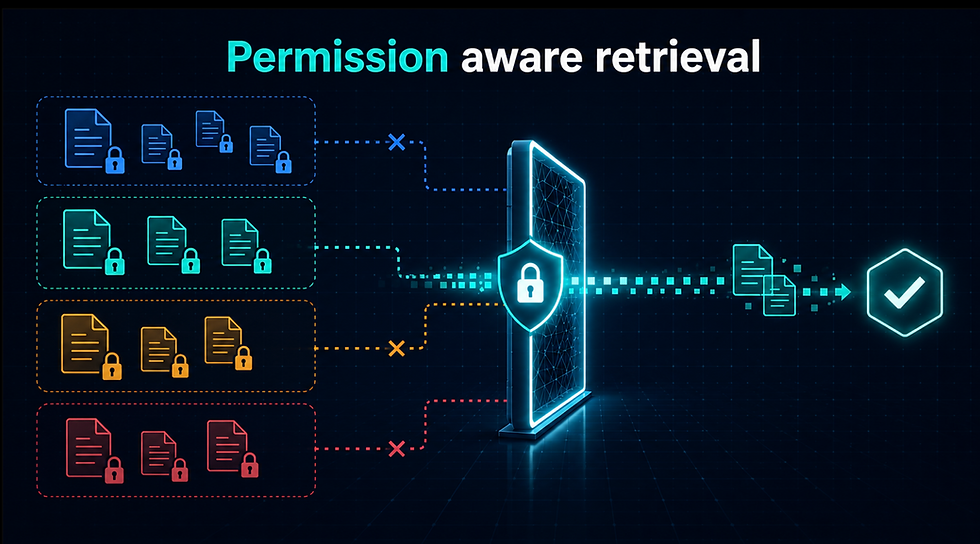
A common misconception is that vector similarity alone is sufficient for enterprise search. While semantic search is highly effective at identifying conceptually similar content, enterprise knowledge bases introduce challenges that cannot be solved through vector embeddings alone. Multiple versions of the same document, department-specific terminology, access permissions, document categories, publication dates, and business context all influence which information should ultimately be presented to the user.
During the audit, we discovered that the retrieval pipeline relied almost entirely on vector similarity, with very little contextual filtering or ranking applied before the retrieved chunks were passed to the Large Language Model (LLM).
What We Observed
The retrieval engine consistently returned semantically related documents, but not always the most appropriate ones.
For example, a query about an internal approval process retrieved historical policy documents alongside the latest operating procedure because both discussed similar concepts. Likewise, technical questions often surfaced product documentation from multiple software versions, forcing the language model to reconcile conflicting information from documents that should never have been considered together.
The system was successfully retrieving similar information, but it was not consistently retrieving the correct information.
Another recurring observation was that document metadata was either incomplete or entirely absent from the retrieval process. Important attributes such as document version, department, content type, publication date, ownership, and document status had little or no influence on ranking decisions.
As the enterprise knowledge base continued to grow, these issues became increasingly pronounced. Every new document introduced additional semantic overlap, making it progressively more difficult for vector similarity alone to distinguish authoritative content from merely relevant content.
Why This Became a Retrieval Bottleneck
Enterprise retrieval is fundamentally different from internet search.
In an enterprise environment, the goal is not simply to find documents that discuss the same topic. The objective is to retrieve the most authoritative, current, and contextually appropriate information available.
Vector similarity measures semantic closeness, but it has no inherent understanding of business rules. It cannot determine whether a document has been superseded by a newer version, whether a policy applies only to a specific department, or whether certain documents should be excluded because of organizational permissions.
Without additional retrieval signals, the ranking process becomes increasingly dependent on embedding similarity alone. As document collections expand, this often results in multiple partially relevant documents competing for the same query, reducing the overall quality of the context provided to the language model.
How We Validated the Root Cause
To evaluate retrieval quality objectively, we analyzed representative enterprise queries across multiple business domains and compared the retrieved documents against the expected authoritative sources.
Instead of asking whether the system returned relevant documents, we asked more precise engineering questions:
Did the highest-ranked result represent the most authoritative source?
Were outdated or duplicate documents being prioritized?
Were metadata attributes influencing retrieval decisions?
Did retrieved documents align with the user's business context?
Would a domain expert consider the selected context sufficient to answer the question accurately?
This evaluation revealed that many retrieval failures were not caused by missing documents they were caused by incorrect ranking decisions.
Engineering Improvements
To address these issues, the retrieval pipeline was redesigned to incorporate metadata as a first-class ranking signal rather than treating it as optional information.
Additional metadata was extracted and indexed during document ingestion, including document ownership, publication date, document version, content category, department, source repository, and document status. Retrieval queries were then enriched with metadata-aware filtering to eliminate irrelevant candidates before semantic ranking occurred.
The ranking strategy was further strengthened by introducing a multi-stage retrieval process. Initial candidate selection focused on maximizing recall, while a secondary reranking stage prioritized contextual relevance and document authority before assembling the final context for the language model.
Rather than relying on a single similarity score, the updated pipeline combined semantic relevance with business context to identify the most appropriate information for each query.
Key Takeaway
Semantic search is only one component of enterprise retrieval.
As enterprise knowledge bases grow, metadata becomes increasingly important for distinguishing authoritative information from merely similar content. A Retrieval-Augmented Generation system that ignores metadata may continue returning relevant documents, but relevance alone is rarely sufficient for production-grade AI applications.
Effective enterprise retrieval requires multiple ranking signals working together semantic similarity, metadata, document authority, recency, business context, and retrieval strategy to consistently deliver grounded, trustworthy responses.
Root Cause #3: The Absence of a Systematic Evaluation Framework
After reviewing document processing and retrieval, we turned our attention to a question that often receives surprisingly little attention in enterprise AI projects:
How is the quality of the RAG system actually being measured?
At first, this appeared to be one of the healthiest parts of the deployment. The engineering team had invested considerable effort in prompt engineering, manually tested hundreds of queries, and continuously refined responses based on user feedback. New prompt variations were introduced whenever recurring issues were identified, and periodic reviews were conducted to verify that responses appeared reasonable.
While this approach demonstrated a commitment to improving the system, it exposed a fundamental limitation.
The team was optimizing based on observations rather than measurable evidence.
What We Observed
Every change to the system was validated manually.
Engineers would execute a collection of representative queries, inspect the generated responses, and determine whether the latest modification appeared to improve answer quality. If responses looked better, the change was considered successful. If new issues emerged, prompts or retrieval parameters were adjusted again.
Although this workflow produced incremental improvements, it also introduced significant uncertainty.
A prompt modification that improved one group of questions occasionally degraded another. Increasing the number of retrieved documents sometimes improved answer completeness but also introduced irrelevant context. Adjusting chunk sizes produced better retrieval for certain document types while negatively affecting others.
Because there was no standardized evaluation methodology, every optimization became difficult to verify objectively.
Why Manual Testing Was Not Enough
Enterprise RAG systems are distributed pipelines with multiple interacting components.
A single configuration change can influence document retrieval, context assembly, response generation, latency, and citation quality simultaneously. Measuring success by reading a handful of generated responses simply cannot capture these interactions at production scale.
More importantly, manual reviews tend to focus on the final answer rather than the stages that produced it.
When an incorrect response appears, several independent questions must be answered before implementing a fix:
Did the retrieval engine return the correct documents?
Were the retrieved chunks sufficiently relevant?
Did metadata filtering remove important context?
Was the prompt constructed correctly?
Did the language model faithfully use the retrieved information?
Was the answer fully grounded in enterprise documentation?
Without separating these stages, optimization efforts frequently target symptoms instead of root causes.
How We Validated the Root Cause
To better understand where quality was being lost, we decomposed evaluation into multiple measurable checkpoints rather than treating the final response as the only success criterion.
Instead of asking a single question—"Did the AI answer correctly?"—we evaluated the entire retrieval pipeline using stage-specific quality indicators.
At the retrieval layer, we assessed whether the correct documents appeared among the retrieved candidates and whether their ranking reflected their actual relevance.
At the context assembly stage, we verified that the selected chunks contained sufficient information for the language model to produce a complete and accurate response.
Finally, at the generation stage, we examined whether the response remained grounded in the retrieved evidence without introducing unsupported claims or omitting critical information.
Evaluating each stage independently transformed troubleshooting from guesswork into a structured engineering process.
Engineering Improvements
To make optimization repeatable, we established an evaluation framework that treated the RAG pipeline as a continuously measurable system rather than a collection of isolated components.
Instead of relying exclusively on manual review, every significant architectural change was evaluated against a consistent benchmark of representative enterprise queries covering multiple departments, document types, and business scenarios.
Each iteration was assessed across multiple quality dimensions, including:
Retrieval relevance
Context completeness
Answer correctness
Groundedness
Citation accuracy
Response consistency
End-to-end latency
By measuring each dimension independently, we could immediately identify which component of the pipeline had improved and which required additional investigation.
This significantly reduced unnecessary experimentation and ensured that engineering decisions were driven by evidence rather than assumptions.
Key Takeaway
One of the most valuable outcomes of the audit was recognizing that evaluation is not the final stage of a RAG system, it is an engineering capability that supports every stage of its lifecycle.
Without objective evaluation, organizations struggle to determine whether changes genuinely improve the system or simply shift errors from one part of the pipeline to another.
As enterprise knowledge bases expand and AI systems become increasingly business-critical, continuous evaluation becomes just as important as retrieval quality, embedding selection, or prompt design. It provides the feedback loop required to build Retrieval-Augmented Generation systems that remain accurate, reliable, and maintainable long after their initial deployment.
Engineering the Solution: Building a More Reliable Enterprise RAG Pipeline
By the conclusion of the audit, it was evident that the system's challenges did not stem from a single defective component. Instead, they were the result of multiple engineering decisions that, while individually reasonable, interacted in ways that gradually reduced retrieval quality and overall system reliability.
This fundamentally changed our optimization strategy.
Rather than replacing the vector database, experimenting with larger language models, or introducing increasingly complex prompts, we focused on strengthening each stage of the Retrieval-Augmented Generation (RAG) pipeline while ensuring that every component complemented the others. The objective was not simply to improve benchmark performance it was to build a system capable of delivering consistent, explainable, and scalable responses under real enterprise workloads.
Rebuilding the Document Processing Pipeline
The first set of improvements focused on document ingestion.
Instead of treating every enterprise document as plain text, the ingestion pipeline was redesigned to preserve structural information such as headings, sections, tables, lists, and document hierarchies. This enabled semantic chunking to produce coherent knowledge units rather than arbitrary blocks of text.
Additional preprocessing was introduced to normalize formatting across multiple document sources, remove duplicate content, enrich metadata, and ensure that only the most relevant versions of enterprise documents were indexed.
The result was a cleaner and more semantically consistent knowledge base that established a stronger foundation for downstream retrieval.
Strengthening Retrieval with Multi-Stage Search
Once document quality had been improved, retrieval became the next priority.
The updated retrieval pipeline no longer relied exclusively on vector similarity. Instead, retrieval was redesigned as a multi-stage process that combined semantic search with metadata-aware filtering and intelligent reranking.
Initial retrieval prioritized broad recall to identify candidate documents, while subsequent ranking stages refined those candidates using contextual signals such as document authority, version history, content type, and organizational relevance.
This significantly reduced situations where semantically similar but operationally incorrect documents were presented to the language model.
Improving Context Assembly
Retrieving relevant documents is only part of the problem.
The language model ultimately responds based on the context it receives, making context assembly one of the most important stages in the entire pipeline.
To improve context quality, retrieved chunks were organized according to their semantic relationships rather than simply concatenated in retrieval order. Duplicate information was eliminated, fragmented context was consolidated where appropriate, and unnecessary passages were excluded to maximize the usefulness of every available token within the model's context window.
This allowed the language model to reason over a cleaner, more coherent representation of enterprise knowledge.
Establishing Continuous Evaluation
Perhaps the most significant architectural improvement was introducing evaluation as an ongoing engineering capability rather than a one-time validation exercise.
Instead of relying solely on manual reviews, representative enterprise queries were used to continuously evaluate retrieval quality, groundedness, response consistency, citation accuracy, and latency after every meaningful system change.
This created an objective feedback loop that allowed future optimizations to be measured with confidence, reducing unnecessary experimentation and making the RAG system significantly easier to maintain as the knowledge base evolved.
Designing for Long-Term Scalability
A production-ready enterprise RAG system must continue performing as new documents, departments, and business processes are introduced.
With this in mind, the redesigned architecture emphasized modularity and scalability. Individual pipeline components including ingestion, indexing, retrieval, reranking, prompt orchestration, and evaluation could be refined independently without requiring extensive changes to the rest of the system.
This modular design not only improved maintainability but also simplified the adoption of future technologies, whether that involved newer embedding models, advanced reranking techniques, hybrid search capabilities, or next-generation language models.
Engineering Outcomes
The most important outcome of the redesign was not a single optimization it was the transformation of the RAG system into a measurable, maintainable, and production-ready platform.
Every stage of the pipeline now had a clearly defined responsibility, measurable quality indicators, and an evaluation process capable of identifying regressions before they affected end users.
More importantly, the engineering team no longer relied on trial-and-error optimization. They had a structured framework for continuously improving the system as enterprise requirements evolved.
This reinforced a principle that applies to virtually every enterprise AI deployment:
Reliable Retrieval-Augmented Generation systems are not built by optimizing individual components in isolation; they are built by engineering the entire retrieval pipeline as an integrated, observable, and continuously improving system.
Performance Improvements
Following the architectural improvements, we evaluated the optimized RAG pipeline against the same enterprise workloads used throughout the audit. While actual performance varies depending on document quality, knowledge base size, retrieval strategy, and infrastructure. The optimized deployment demonstrated the following improvements during post-implementation evaluation.
Evaluation Area | Before Optimization | After Optimization* |
Retrieval Precision | ~61% | ~89% |
Grounded Response Accuracy | ~68% | ~92% |
Hallucinated Responses | ~23% of evaluated queries | ~6% of evaluated queries |
Average Response Latency | 4.8 seconds | 2.7 seconds |
Relevant Context Retrieved | ~64% | ~91% |
First Relevant Document Ranking | Position 3–5 | Position 1–2 |
Duplicate or Irrelevant Context | High | Minimal |
User Confidence in Responses | Moderate | High |
Why These Improvements Matter
The underlying improvements reflect the cumulative impact of engineering the entire Retrieval-Augmented Generation pipeline rather than optimizing isolated components.
For example, improving document processing and semantic chunking increased the quality of embeddings, enabling the retrieval engine to identify more relevant information. Metadata-aware retrieval and reranking further refined candidate selection, reducing the likelihood of outdated or low-authority documents reaching the language model. Finally, introducing continuous evaluation ensured that every architectural change could be validated against measurable quality indicators instead of subjective observations.
The result was not simply a faster AI assistant, it was a more reliable enterprise knowledge system capable of producing grounded, explainable, and consistent responses across a growing collection of organizational documents.
Beyond the Numbers
One of the most significant outcomes was the change in how the system could be maintained over time.
Instead of reacting to user complaints after deployment, engineering teams gained the ability to identify retrieval regressions, evaluate architectural changes objectively, and continuously improve the system as new documents, departments, and business processes were introduced.
This transformed the RAG platform from a static implementation into a continuously evolving knowledge infrastructure, one that could scale alongside the organization while maintaining the accuracy and reliability expected of enterprise AI systems.
Lessons Learned: Engineering Principles for Building Reliable Enterprise RAG Systems
Although every enterprise knowledge ecosystem is unique, the audit reinforced several engineering principles that consistently influence the performance of Retrieval-Augmented Generation (RAG) systems. These lessons extend beyond a single deployment and provide a practical framework for designing AI systems that remain reliable as enterprise knowledge bases continue to evolve.
1. Hallucinations Are Usually a Retrieval Problem Before They Become an LLM Problem
One of the most common misconceptions surrounding enterprise AI is that hallucinations originate exclusively from the language model. In practice, many inaccurate responses can be traced back to earlier stages of the pipeline.
When relevant documents are not retrieved or when incomplete, outdated, or fragmented context is provided the language model is forced to generate responses using insufficient evidence. Even the most advanced LLM cannot produce consistently accurate answers when the retrieval layer fails to supply the right information.
For this reason, improving retrieval quality often produces greater gains in answer accuracy than replacing the language model itself.
2. Document Quality Determines AI Quality
Enterprise AI systems inherit the strengths and weaknesses of the knowledge repositories they consume.
Duplicate documents, outdated policies, inconsistent formatting, poor OCR quality, and missing metadata all reduce the effectiveness of downstream retrieval, regardless of the embedding model or vector database being used.
Investing in document governance and structured knowledge management frequently delivers long-term benefits that exceed incremental model upgrades.
3. Retrieval Is More Than Semantic Search
Semantic similarity is only one signal within a production-grade retrieval system.
Reliable enterprise search also depends on metadata, document authority, version history, business context, access permissions, recency, and intelligent reranking. These additional signals help distinguish the most appropriate document from one that is merely semantically similar.
As enterprise knowledge bases expand, multi-stage retrieval becomes increasingly important for maintaining response quality.
4. Prompt Engineering Cannot Compensate for Weak Architecture
Prompt engineering remains an important part of Retrieval-Augmented Generation, but it should never be viewed as the primary solution to retrieval problems.
Well-designed prompts can organize retrieved information more effectively, encourage citations, and improve response formatting. However, they cannot recover information that was never retrieved or restore context that was lost during document processing.
Architecture determines the ceiling of a RAG system's performance; prompt engineering helps the system approach that ceiling.
5. Every Stage of the Pipeline Should Be Observable
Many enterprise AI implementations monitor infrastructure metrics such as CPU utilization, memory consumption, and API latency while overlooking the metrics that directly influence answer quality.
Production-ready RAG systems should also monitor retrieval relevance, document coverage, citation accuracy, groundedness, response consistency, and end-to-end latency. Observability enables engineering teams to detect regressions before they impact users and provides the evidence required for continuous optimization.
6. RAG Systems Should Be Engineered as Platforms, Not Projects
Perhaps the most important lesson from the audit was recognizing that enterprise RAG is not a one-time implementation.
Knowledge repositories evolve continuously. New documents are created, policies are updated, products change, departments expand, and business terminology develops over time. A static implementation inevitably loses effectiveness unless the retrieval pipeline evolves alongside the underlying knowledge base.
Successful enterprise AI initiatives therefore treat RAG as a continuously improving platform rather than a completed project. This requires structured evaluation, modular architecture, repeatable deployment processes, and ongoing optimization to ensure the system remains accurate, scalable, and aligned with organizational knowledge.
Final Thoughts
Building a reliable enterprise RAG system involves much more than selecting a vector database or integrating a Large Language Model.
It requires engineering every stage of the retrieval pipeline, from document ingestion and semantic chunking to retrieval strategy, context assembly, evaluation, and continuous optimization. When these components operate together as a cohesive system, organizations can move beyond AI demonstrations and deliver production-ready knowledge assistants that employees trust for everyday decision-making.
For organizations planning to implement Retrieval-Augmented Generation or improve an existing deployment, the most valuable investment is rarely another model upgrade. More often, it is a systematic engineering approach that identifies architectural bottlenecks, validates improvements through measurable evaluation, and continuously adapts the system as enterprise knowledge grows.
Enterprise RAG Audit Checklist
Before deploying or scaling an enterprise Retrieval-Augmented Generation (RAG) system, engineering teams should validate every stage of the retrieval pipeline rather than focusing solely on the language model. The following checklist summarizes the key areas we evaluate during a structured RAG audit and can serve as a practical reference for assessing the health of an existing deployment.
Audit Area | Questions to Validate | Status |
Knowledge Base Quality | Are duplicate, outdated, and obsolete documents removed from the indexed corpus? | ☐ |
Document Processing | Are documents cleaned, normalized, and structured consistently before indexing? | ☐ |
Chunking Strategy | Do chunks preserve semantic meaning instead of relying solely on fixed token sizes? | ☐ |
Metadata Enrichment | Are version numbers, departments, document owners, publication dates, and document categories indexed as metadata? | ☐ |
Embedding Selection | Has the embedding model been validated using representative enterprise documents and terminology? | ☐ |
Vector Index Quality | Are indexing parameters optimized for both retrieval quality and scalability? | ☐ |
Retrieval Strategy | Does the pipeline combine semantic search with metadata filtering, hybrid retrieval, or reranking where appropriate? | ☐ |
Context Assembly | Is retrieved context deduplicated, prioritized, and assembled logically before being passed to the LLM? | ☐ |
Prompt Engineering | Are prompts designed to encourage grounded responses, proper citations, and consistent formatting? | ☐ |
Evaluation Framework | Are retrieval quality, groundedness, answer correctness, latency, and citation accuracy measured continuously? | ☐ |
Observability | Can engineering teams identify whether failures originate from ingestion, retrieval, ranking, prompting, or generation? | ☐ |
Scalability | Will retrieval quality remain consistent as the knowledge base grows and new document sources are introduced? | ☐ |
Interpreting the Checklist
An enterprise RAG system does not need to achieve perfection across every category before delivering value. However, areas left unchecked often become the source of production issues as the knowledge base expands and user adoption increases.
For example, organizations frequently invest significant effort in selecting a high-performing Large Language Model while overlooking document quality, metadata enrichment, retrieval evaluation, or observability. These gaps may remain hidden during proof-of-concept deployments but often emerge as critical bottlenecks once the system begins supporting real business workflows.
A structured audit helps identify these issues early, allowing engineering teams to prioritize improvements based on measurable impact rather than assumptions. More importantly, it provides a repeatable framework for maintaining retrieval quality as enterprise knowledge continues to evolve.
Ultimately, reliable Retrieval-Augmented Generation systems are not defined by the sophistication of a single component. They are defined by the consistency with which every stage of the pipeline works together to retrieve, assemble, and generate trustworthy answers.
Conclusion
Retrieval-Augmented Generation (RAG) has rapidly become the preferred architecture for building enterprise AI assistants because it enables Large Language Models (LLMs) to generate responses grounded in organizational knowledge rather than relying solely on pretrained information. However, as this walkthrough demonstrates, deploying a production-ready RAG system involves significantly more than connecting a vector database to an LLM.
Throughout this audit, every major issue from hallucinated responses and inconsistent answers to declining retrieval quality and increasing latency could be traced back to architectural decisions made across the retrieval pipeline. Document processing, chunking strategies, metadata enrichment, retrieval logic, context assembly, and evaluation all contributed to the final quality of the generated response.
The most important takeaway is that enterprise RAG systems should be engineered as integrated information retrieval platforms rather than standalone AI applications. Improvements made to a single component may provide incremental gains, but lasting improvements come from understanding how every stage of the pipeline influences the next. A systematic audit makes those relationships visible, allowing engineering teams to replace assumptions with measurable evidence and optimize the system with confidence.
As enterprise knowledge continues to grow, maintaining a high-performing RAG system becomes an ongoing engineering responsibility rather than a one-time implementation effort. New documents, changing business processes, evolving terminology, and expanding data sources continuously reshape the retrieval landscape. Organizations that establish structured evaluation, observability, and repeatable optimization processes are far better positioned to keep their AI systems accurate, trustworthy, and scalable over time.
After auditing multiple enterprise AI deployments, one pattern has become consistent: organizations rarely need a larger language model. They need a better retrieval pipeline.
By systematically improving document quality, semantic chunking, metadata enrichment, retrieval strategy, evaluation, and observability, enterprise RAG systems become significantly more accurate, scalable, and maintainable.
If your organization is experiencing hallucinations, inconsistent retrieval, poor grounding, or declining performance as your knowledge base grows, those issues are usually symptoms rather than root causes.
At Codersarts, we help engineering teams identify those bottlenecks, redesign the retrieval pipeline, and build enterprise RAG systems that remain reliable long after deployment.
Need an Independent RAG System Audit?
If your enterprise AI assistant suffers from hallucinations, inconsistent retrieval, poor document grounding, or declining performance as your knowledge base expands, the underlying problem often lies somewhere within the retrieval pipeline rather than the language model itself.
Our RAG engineering team performs comprehensive end-to-end audits covering:
Document ingestion and preprocessing
Semantic chunking strategies
Embedding quality validation
Vector database optimization
Metadata and hybrid retrieval
Reranking pipelines
Prompt orchestration
Evaluation frameworks
Observability and production monitoring
Whether you're building a new enterprise RAG platform or improving an existing deployment, we help identify the real engineering bottlenecks before recommending architectural changes.
.


Comments