

AI Innovations in Drug Development with AI

The world of drug development is changing fast. Thanks to artificial intelligence (AI), the process of discovering new medicines is becoming quicker, cheaper, and more precise. I want to take you through how AI is shaking up this field and why it matters for businesses looking to innovate in healthcare and pharmaceuticals.
How Drug Development with AI is Transforming the Industry
Drug development traditionally takes years and costs billions. It involves testing thousands of compounds, running clinical trials, and navigating complex regulations. AI is stepping in to speed up these steps by analyzing huge datasets and predicting outcomes that humans might miss.
For example, AI algorithms can scan millions of chemical structures to find promising drug candidates. This reduces the time spent on trial and error in the lab. AI also helps identify potential side effects early, improving safety and reducing costly failures.
By integrating AI into drug development, companies can:
Cut down research time from years to months
Lower costs by focusing on the most promising compounds
Improve accuracy in predicting drug effectiveness
Accelerate clinical trial design and patient recruitment
This means businesses can bring new drugs to market faster and with less risk.
Key AI Technologies Driving Drug Development with AI
Several AI technologies are making a big impact in drug development:
Machine Learning (ML): ML models learn from data to predict how molecules will behave. They can identify patterns in chemical properties and biological effects that guide drug design.
Natural Language Processing (NLP): NLP tools analyze scientific papers, patents, and clinical reports to extract valuable insights. This helps researchers stay updated and find hidden connections.
Deep Learning: Deep neural networks can model complex biological processes, such as protein folding or drug-target interactions, with high accuracy.
Generative Models: These AI systems create new molecular structures that meet specific criteria, opening up possibilities for novel drugs.
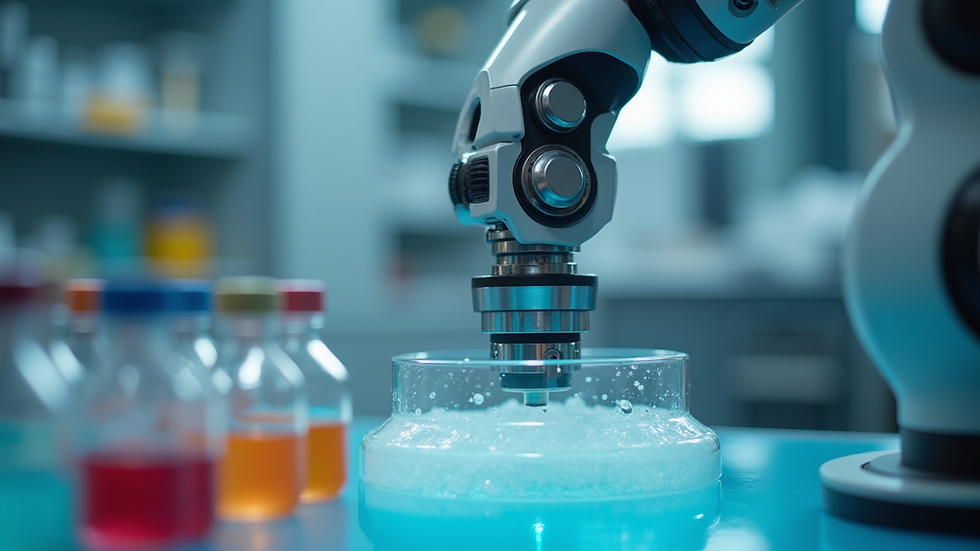
Robotics and Automation: AI-powered robots can perform high-throughput screening of compounds, speeding up lab experiments.
Together, these technologies form a powerful toolkit for drug developers.
Real-World Examples of AI in Drug Discovery
Let me share some concrete examples where AI has made a difference:
Insilico Medicine used AI to design a new drug candidate for fibrosis in just 46 days. This is a huge improvement over the typical timeline of years.
Atomwise applies deep learning to predict how small molecules bind to proteins. Their AI helped identify potential treatments for Ebola and multiple sclerosis.
BenevolentAI combines NLP and ML to analyze scientific literature and suggest drug repurposing opportunities. This approach can find new uses for existing drugs, saving time and money.
Exscientia uses AI to design molecules optimized for safety and efficacy. Their AI-designed drug entered clinical trials faster than traditional methods.
These examples show how AI is not just a buzzword but a practical tool delivering results.
How Businesses Can Leverage AI for Drug Development
If you are a business looking to integrate AI into your drug development process, here are some actionable steps:
Start with Data: Collect and organize your chemical, biological, and clinical data. AI thrives on quality data, so invest in data management systems.
Partner with AI Experts: Collaborate with AI development firms or consultants who understand both AI and drug discovery. This helps avoid common pitfalls and accelerates progress.
Pilot Small Projects: Begin with focused AI projects, such as predicting drug-target interactions or automating literature review. Measure results and scale up gradually.
Invest in Talent: Hire or train staff with skills in AI, data science, and pharmaceutical sciences to bridge the gap between technology and domain knowledge.
Use Cloud and Automation: Leverage cloud computing for scalable AI processing and automate repetitive lab tasks to increase efficiency.
Stay Compliant: Ensure AI tools comply with regulatory standards for drug development to avoid delays.
By following these steps, businesses can harness AI to reduce costs, speed up innovation, and stay competitive.

The Future of Drug Development with AI
Looking ahead, AI will become even more integral to drug development. Advances in quantum computing, AI explainability, and personalized medicine will open new frontiers.
We can expect:
More precise drug targeting based on individual genetic profiles
Faster response to emerging diseases through AI-driven rapid drug design
Greater collaboration between AI platforms and human experts for better decision-making
Reduced costs and risks making drug development accessible to smaller companies and startups
For businesses, this means a huge opportunity to innovate and lead in healthcare. Partnering with AI specialists like Codersarts AI can help you turn your ideas into real-world applications quickly and efficiently. This reduces the need for deep in-house AI expertise and cuts development costs.
If you want to stay ahead in the pharmaceutical industry, embracing AI innovations in drug development is no longer optional - it’s essential.
By understanding and applying AI in drug development, businesses can unlock faster, smarter, and more cost-effective ways to bring new medicines to market. The future of healthcare depends on it.


Comments