

LangGraph for RAG: What to Know Before You Build
.jfif/v1/fill/w_320,h_320/file.jpg)
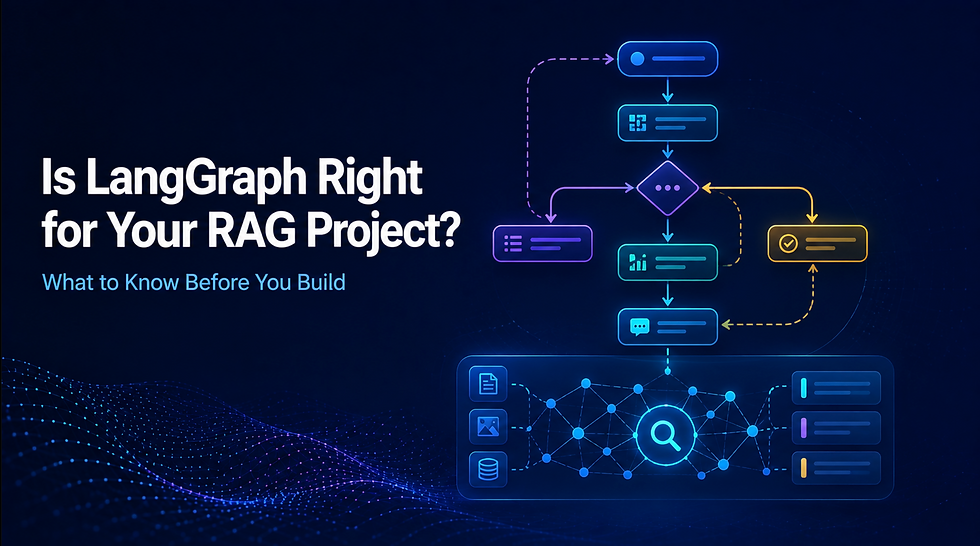
If you've spent any time researching more advanced RAG development — beyond a basic retrieve-then-generate pipeline — LangGraph has almost certainly come up. It's the framework behind most of what gets called "agentic RAG": systems that route queries intelligently, grade their own retrieval quality, correct course when retrieval comes up short, and coordinate multiple specialized agents rather than following one fixed sequence of steps.
That also makes LangGraph one of the more commonly misunderstood tools in the RAG conversation. It gets mentioned in the same breath as models and vector databases, as if it belongs in the same category — but LangGraph isn't a model, and it doesn't retrieve or store anything. It's an orchestration layer: a way of structuring how a RAG system's steps connect, branch, loop, and make decisions. That distinction matters a lot when you're trying to figure out whether it's actually the right tool for your project, or added complexity you don't yet need.
This isn't a tutorial, and it isn't a case for using graph-based orchestration on every RAG project. It's a practical look at what LangGraph actually does, the real problems it solves that a simple linear pipeline can't, and — just as importantly — where it adds engineering overhead that isn't justified for simpler use cases.
What LangGraph Actually Is (and Isn't)
Before evaluating whether LangGraph fits a RAG project, it's worth being precise about what it actually does — because it sits in a different category from most of the other tools that come up in RAG conversations.
A stateful, graph-based orchestration framework
LangGraph is a framework, built on top of LangChain, for defining AI workflows as a graph rather than a fixed sequence. Instead of writing a single, linear chain of steps — retrieve, then generate, done — LangGraph lets you define nodes (individual processing steps), edges (the transitions between them), and conditional branches (decision points that determine which node runs next based on the current state). This is what makes it possible to build systems that loop back, backtrack, and adapt their behavior mid-execution, rather than always moving forward through the same fixed steps regardless of what happens along the way.
Why "graph" instead of "chain" matters
A traditional chain assumes a predictable path: step one always leads to step two, which always leads to step three. That works fine when a RAG system's behavior genuinely is that predictable. But the moment a system needs to behave differently depending on what happens at an earlier step — re-retrieving when the first attempt comes back irrelevant, routing a simple factual question differently than an ambiguous or multi-part one, or looping between agents until a task is actually complete — a fixed chain can't represent that. A graph can, because edges can be conditional, and the same node can be revisited more than once.
What LangGraph doesn't do
LangGraph doesn't retrieve documents, generate embeddings, store vectors, or produce text on its own. All of that still comes from the same components any RAG system needs — a vector database, an embedding model, and a generative model. LangGraph's role is to coordinate when and how those components get called, and what happens based on their output — not to replace any of them.
Seeing it in a real implementation
This distinction is easier to see in a concrete build than in the abstract. Codersarts' walkthrough of building a fully agentic RAG pipeline with LangGraph shows this directly — implementing query routing, retrieval grading, corrective RAG, and adaptive RAG as a single graph, where LangGraph's job throughout is purely to manage the flow between these steps, while retrieval and generation are still handled by the same underlying RAG components any pipeline would need.
Why "Agentic RAG" Needs More Than a Linear Pipeline
To understand why LangGraph exists at all, it helps to look at exactly where a simple, linear RAG pipeline starts to break down — because that's precisely the gap graph-based orchestration was built to close.
The naive pipeline, and where it falls short
A basic RAG system follows a fixed sequence: take the user's query, retrieve some number of relevant chunks, pass them to the model, generate an answer. This works reasonably well when queries are straightforward and retrieval reliably surfaces the right context. It falls apart in a few common, entirely predictable ways: a vague or ambiguous query returns loosely related chunks that don't actually answer the question; a query that needs information from multiple sources only gets a narrow slice of what's relevant; or retrieval simply misses the mark, and the system has no way to recognize that and try again. A linear pipeline has no mechanism to detect any of this — it retrieves once, generates once, and returns whatever comes out, regardless of quality.
The patterns that address this
Several architectural patterns have emerged specifically to handle these failure modes, and they're exactly what LangGraph's graph structure is designed to support:
Query routing — deciding, before retrieval even happens, how a given query should be handled (e.g., whether it needs retrieval at all, which data source it should pull from, or whether it's simple enough to answer directly).
Retrieval grading — evaluating whether retrieved chunks are actually relevant before passing them to the generation step, rather than assuming retrieval succeeded by default.
Corrective RAG (CRAG) — when grading determines retrieval was poor, triggering a fallback: re-querying, searching a different source, or adjusting the retrieval strategy rather than generating from bad context anyway.
Adaptive RAG — adjusting the overall strategy based on query complexity, so simple questions take a fast, direct path while complex ones get more thorough, multi-step handling.
Why this requires looping and branching, not just more steps
The key detail is that these patterns aren't just "more steps added to the pipeline" — they require the system to make decisions and sometimes revisit earlier steps based on what happened at a later one. Grading retrieval quality only makes sense if there's a path back to re-retrieval when grading fails. That kind of conditional loop is exactly what a linear chain can't represent, and exactly what a graph structure handles naturally.
Where this has been put into practice
Beyond the core agentic RAG patterns, this same graph-based approach extends to more advanced setups. Codersarts' guide to building a self-correcting RAG system with LangChain and LangGraph walks through exactly this kind of failure mode in detail — including how naive cosine-similarity retrieval can return content that's topically related but not actually relevant to a nuanced or version-specific query, and how a graph-based correction loop catches and fixes that before it reaches the user.
Where LangGraph Fits in a RAG Stack
As with the other tools covered in this series, it's worth being clear about which part of a RAG system LangGraph actually addresses — because it's easy to assume an orchestration framework does more than it does once terms like "agentic" and "self-correcting" enter the conversation.
The same core components, still required
A RAG system built with LangGraph still needs everything a simpler RAG system needs: a vector database to store and search embeddings, an embedding model to convert content into searchable vectors, a chunking strategy to structure source data sensibly, and a generative model to produce the final answer. None of these get replaced by adding LangGraph — they're still the foundation the graph is coordinating.
What LangGraph adds on top
What LangGraph contributes sits above these components: the logic that decides which node runs next, what state gets passed between them, when a loop should trigger (like re-retrieval after a failed grading check), and how multiple specialized steps or agents hand off work to one another. It's the coordination layer, not the retrieval or generation layer.
An independent decision from model and infrastructure choice
This means choosing LangGraph is a separate decision from the ones covered elsewhere in this series — which model handles generation, and whether that model runs through a hosted API or locally through something like Ollama. A LangGraph-orchestrated RAG system can be built on top of virtually any model or vector database; the graph structure doesn't dictate or constrain those choices. In practice, this also means LangGraph pairs naturally with tool-calling and external integrations — Codersarts' beginner's guide to MCP covers a closely related piece of this puzzle: how agentic systems, LangGraph-orchestrated or otherwise, connect to external tools and data sources in a standardized way.
A useful way to frame the evaluation
Given this, the right question isn't "does LangGraph make our RAG system better" in the abstract — it's "does our system's behavior actually require branching, looping, or multi-step coordination that a fixed pipeline can't represent." The next few sections work through exactly what LangGraph brings to the table when the answer is yes, and where that answer is honestly no.
Core Capabilities LangGraph Brings to RAG
With the framing established, it's worth walking through specifically what LangGraph contributes to a RAG system once you've decided graph-based orchestration is warranted.
State management across steps
LangGraph maintains a shared state object that flows through the graph as execution moves from node to node — tracking things like retrieved documents, relevance grades, retry counts, or intermediate reasoning. This matters because agentic RAG patterns depend on later steps knowing what happened earlier: a retry node needs to know retrieval already failed once; a routing node needs to know what type of query it's handling. Without structured state, coordinating this kind of contextual decision-making across multiple steps becomes far harder to manage cleanly.
Conditional branching and query routing
Because edges in a LangGraph graph can be conditional, a query can be routed differently depending on its characteristics — sent to a fast, direct-answer path if it's simple, or through a more thorough multi-step retrieval and verification path if it's complex or ambiguous. This is the mechanism underneath query routing and adaptive RAG, covered earlier.
Loops and retries
Corrective RAG depends on the ability to loop back to an earlier step — re-retrieving with a modified query, trying a different data source, or adjusting search parameters — when a grading step determines the first attempt didn't return useful context. LangGraph's graph structure supports this natively, since a node can be revisited rather than the flow being locked into always moving strictly forward.
Multi-agent orchestration
Beyond single-pipeline RAG, LangGraph is also commonly used to coordinate multiple specialized agents — a supervisor agent that delegates to worker agents handling specific sub-tasks, each with their own tools and responsibilities. Codersarts has documented several real systems built this way: a multi-agent research assistant built with LangGraph, FastAPI, and Next.js, and a LangGraph-orchestrated crypto analyst agent that coordinates indicator calculation, anomaly detection, and backtesting as distinct, cooperating agents rather than a single monolithic process — patterns that extend naturally to RAG systems needing to draw on multiple specialized retrieval or reasoning steps.
Production-oriented structure, not just flexibility
Beyond enabling more complex behavior, well-designed LangGraph nodes bring a level of engineering discipline that a loosely structured pipeline often lacks: typed inputs and outputs per node, explicit error handling, and retry logic scoped to individual steps rather than the whole system. Codersarts' broader take on what production-grade LLM engineering actually requires makes the case that this kind of structure — not prompt tuning — is usually where the real engineering effort in production agent systems goes, and LangGraph's node-based design is well suited to enforcing it.
When Graph-Based Orchestration Is Worth the Complexity
Everything covered so far explains what LangGraph can do — but capability isn't the same as necessity. Adding a graph-based orchestration layer is a real engineering investment, and it's worth being honest about when that investment pays off and when it doesn't.
The added overhead is real
Compared to a simple linear pipeline, a LangGraph-based system requires designing the state schema, defining each node's responsibilities and error handling, mapping out the conditional edges between them, and testing a system that can now behave differently depending on execution path — not just one fixed sequence. This is meaningfully more design and testing surface than a straightforward retrieve-then-generate pipeline, and it's not free just because the framework makes it possible.
When it's clearly worth itGraph-based orchestration earns its complexity in a few common, recognizable situations:
Queries vary significantly in type or complexity — a system fielding both simple factual lookups and complex, multi-part questions benefits from routing them differently rather than forcing every query through the same heavy process.
Retrieval quality genuinely needs a safety net — for use cases where a bad retrieval passed straight to generation would produce a confidently wrong answer (compliance, legal, technical documentation), the ability to grade and correct retrieval before generating is a meaningful reliability improvement, not a nice-to-have.
The task requires multiple, specialized reasoning or retrieval steps — systems that need to consult more than one data source, coordinate between specialized agents, or perform multi-step reasoning genuinely can't be represented as a single linear pass.
Production reliability and observability matter — the node-level structure, typed inputs/outputs, and explicit error handling that come naturally with a well-designed graph pay off specifically in systems that need to be debugged, monitored, and maintained over time, not just demoed once.
When it's overkill
For a narrow, well-defined use case — answering questions from a single, well-structured knowledge base, where retrieval is reliably accurate and queries don't vary much in complexity — a simple linear RAG pipeline often performs just as well, with far less to build, test, and maintain. Adding graph-based orchestration here doesn't meaningfully improve output quality; it just adds engineering surface area that has to be maintained without a corresponding benefit. The honest question to ask isn't whether LangGraph could improve a given system — it almost always technically could — but whether the specific failure modes it addresses (bad retrieval going unnoticed, one-size-fits-all handling of varied queries, single-pass limitations) are actually failure modes your system experiences in practice.
Limitations and Common Misconceptions
As with the other tools covered in this series, it's worth being direct about where LangGraph's appeal gets oversold, and where teams commonly misjudge what it actually delivers.
A graph is only as good as the logic inside each node
This is the most common misconception: assuming that adopting LangGraph automatically makes a RAG system smarter or more reliable. It doesn't. A retrieval grading node is only useful if the grading criteria are actually well-designed; a routing node is only useful if the routing logic correctly distinguishes the query types that matter for your use case.
LangGraph provides the structure to implement these patterns — it doesn't provide the judgment behind them. A poorly designed graph with weak grading logic can still produce a system that confidently generates from bad retrieval, just with more architectural complexity around the same underlying problem.
More nodes and edges means more to test and more that can fail
Every additional node, conditional edge, and loop is a new place where something can go wrong — a routing decision that misclassifies a query, a grading step that's miscalibrated, a retry loop that doesn't have a sensible exit condition and risks looping indefinitely. Teams that add graph complexity without a corresponding investment in testing each path tend to end up with systems that are harder to debug than the simpler pipeline they replaced, not easier.
Observability and debugging aren't automatic
A more complex execution path — one that can take different routes depending on the query — genuinely needs better tracing and logging to understand what happened during a given run, not less. This has to be deliberately designed into the system; it doesn't come for free just because LangGraph makes branching possible. Teams that don't invest in this can end up with a system where a wrong answer is harder to diagnose than it would have been in a simple, single-path pipeline.
It's not a substitute for retrieval quality or evaluation
As covered earlier, LangGraph coordinates flow — it doesn't retrieve, embed, or evaluate anything on its own. A system with excellent orchestration logic sitting on top of a poor chunking strategy or an inadequate vector database will still underperform. Graph-based orchestration can catch and correct some retrieval failures through grading and retry loops, but it can't substitute for getting the underlying retrieval architecture right in the first place.
Not every "agentic RAG" implementation needs the full pattern set
It's worth noting that query routing, retrieval grading, corrective RAG, and adaptive RAG are commonly presented together as "the" agentic RAG architecture, but a given system rarely needs all four in full force. Implementing all of them by default, rather than the specific ones your use case's actual failure modes call for, is itself a form of unnecessary complexity — the same trade-off covered in the previous section, just at the level of individual patterns rather than the framework as a whole.
The honest summary
LangGraph is a genuinely capable framework for the specific problems it's built to solve — but it's an enabler of good architecture, not a source of it. Teams that treat adopting LangGraph as itself the solution, rather than as infrastructure for implementing carefully designed routing, grading, and correction logic, tend to end up with systems that are more complex without being meaningfully more reliable.
Orchestration Choice Is Only Part of the System
Everything covered so far — what LangGraph actually is, the failure modes it addresses, its core capabilities, and where its complexity is and isn't justified — matters. But it's worth stepping back and being direct about something easy to lose sight of once "agentic," "self-correcting," and "multi-agent" enter the conversation: choosing LangGraph is an orchestration decision, not a substitute for the engineering work that determines whether a RAG system actually performs well.
What actually determines whether a RAG system performs well
As covered throughout this series — true whether generation runs through a hosted model like Gemini or locally through Ollama, and true regardless of whether the system is orchestrated with LangGraph or a simpler pipeline — the same underlying decisions end up mattering most: how documents get chunked and structured, how retrieval is ranked and filtered, how the system is evaluated for accuracy before and after launch, and how it's monitored once real users depend on it. LangGraph can help a system respond intelligently when retrieval quality is a problem — grading, correcting, retrying — but it can't replace the work of making retrieval good in the first place.
Why this matters for how you should read this whole guide
If this guide has led you to conclude that your RAG project genuinely needs query routing, retrieval correction, or multi-agent coordination — that's a legitimate and valuable conclusion, and exactly the kind of situation LangGraph was built for. But designing the graph well — the state schema, the grading criteria, the routing logic, the error handling at each node — is real engineering work that determines whether that architecture actually delivers the reliability it's meant to, or just adds complexity without a corresponding benefit.
Where model-agnostic, framework-agnostic expertise comes in
This is exactly the kind of work a RAG development team handles — and it applies whether a project needs a simple linear pipeline, a fully agentic LangGraph-orchestrated system, or something in between. Codersarts works across orchestration approaches, including LangGraph specifically, bringing the same retrieval engineering, evaluation methodology, and production hardening regardless of how complex the final architecture needs to be.
If you're evaluating whether your RAG project needs LangGraph's graph-based orchestration — or you've already decided it does and want help designing it well.
How Codersarts Can Help With Your RAG Project
Whether your project needs a simple, linear RAG pipeline or a fully agentic, LangGraph-orchestrated system with routing, correction, and multi-agent coordination, Codersarts offers a range of services to support it at whatever stage it's in.
RAG Development
End-to-end RAG development — from proof of concept through full production builds — including retrieval architecture, chunking strategy, evaluation, and deployment, whether the system calls for a straightforward pipeline or agentic orchestration with LangGraph.
Agentic RAG Architecture & Design
Design and implementation of graph-based RAG systems — query routing, retrieval grading, corrective RAG, adaptive RAG, and multi-agent orchestration — scoped to the specific failure modes your use case actually needs to handle, not a default full pattern set.
Model & Architecture Consultation
Project consultation to help businesses evaluate whether their RAG project genuinely needs graph-based orchestration, or whether a simpler pipeline would serve the use case just as well with less engineering overhead.
Dedicated Teams & Team Augmentation
Dedicated RAG engineering teams, or engineers who work as an extension of an existing in-house team, scaling up or down as project needs change.
Ongoing Support & Maintenance
Post-launch monitoring, optimization, and maintenance for RAG systems already in production — including tracing and observability for multi-step, LangGraph-orchestrated systems where debugging a wrong answer requires understanding which path the system took.
1-on-1 Mentorship
Personalized, expert-led mentorship for developers and teams looking to build hands-on skills with LangGraph, agentic RAG patterns, and broader RAG and AI engineering, tailored to specific goals and experience level.
Job Support Services
Remote job support for developers working on live RAG or agentic AI projects — including pair programming, code review, LangGraph graph design, and help meeting sprint deadlines under expert guidance.
White-Label & Partnership Delivery
RAG development delivered on behalf of agencies, consultancies, and technology companies — white-label, co-branded, or embedded alongside an existing team.
Whether you need help deciding if LangGraph is the right fit for your project or designing and building the graph itself.
Frequently Asked Questions
Is LangGraph good for RAG?
Yes, for RAG systems that need query routing, retrieval correction, multi-step reasoning, or multi-agent coordination. For simpler, narrow use cases with reliable retrieval and low query variety, a basic linear pipeline often performs just as well with far less engineering overhead.
What's the difference between LangChain and LangGraph?
LangChain provides building blocks for LLM applications, including linear chains that execute a fixed sequence of steps. LangGraph, built on top of LangChain, adds the ability to structure those steps as a graph — with conditional branching and loops — enabling systems that route, retry, and adapt based on what happens at earlier steps, rather than always following the same fixed path.
Do I need LangGraph for a simple RAG chatbot?
Not necessarily. If your use case involves a single, well-structured knowledge base with reliably accurate retrieval and queries that don't vary much in complexity, a simple retrieve-then-generate pipeline is often sufficient, and adding LangGraph would introduce complexity without a meaningful benefit.
Is LangGraph production-ready?
Yes, LangGraph is used in production RAG and agentic systems. That said, production reliability comes from how well the graph is designed — proper state management, error handling at each node, and observability — not from using the framework itself, which is true of any orchestration tool.
What is agentic RAG?
Agentic RAG refers to RAG systems that go beyond a single retrieve-and-generate pass, incorporating patterns like query routing, retrieval grading, corrective retrieval, and adaptive strategies that let the system make decisions and adjust its behavior based on intermediate results, rather than following one fixed sequence.
Can LangGraph work with any LLM or vector database?
Yes. LangGraph is an orchestration layer, not a model or a retrieval system — it coordinates the flow between whichever model and vector database a project uses, rather than requiring a specific one.
Does using LangGraph guarantee better RAG results?
No. LangGraph provides the structure to implement routing, grading, and correction logic, but the quality of that logic — how grading criteria are defined, how routing decisions are made — determines whether results actually improve. A poorly designed graph can add complexity without meaningfully improving reliability.
What's the difference between agentic RAG and a multi-agent system built with LangGraph?
Agentic RAG typically refers to a single, more sophisticated retrieval-and-generation pipeline with routing and correction built in. A multi-agent system extends this further, coordinating multiple specialized agents — each potentially with its own tools, retrieval sources, or responsibilities — under a shared orchestration structure, which LangGraph also supports.
Conclusion
LangGraph solves a real problem: linear RAG pipelines have no way to recognize bad retrieval, route different types of queries appropriately, or coordinate multiple specialized steps toward a single answer. For RAG systems that genuinely need to loop, branch, self-correct, or orchestrate multiple agents, LangGraph's graph-based structure is a strong, well-suited foundation — and the difference between a system that quietly generates from irrelevant context and one that catches and corrects that failure before it reaches a user.
But as this guide has tried to make clear throughout, adopting LangGraph is an architectural decision, not a guarantee of better results. The graph is only as good as the routing and grading logic designed into it, added complexity means more to test and debug, and none of it substitutes for solid chunking, retrieval quality, and evaluation underneath. The right call isn't to default to graph-based orchestration because it's capable of more — it's to use it specifically where your system's actual failure modes call for it, and to invest the real engineering effort that makes the graph reliable once it's there.
If you're trying to figure out whether your RAG project actually needs LangGraph's orchestration capabilities — or you've already decided it does and want help designing it well — Codersarts can help at any stage, from initial architecture evaluation through full production deployment. Explore RAG development services to see how the team can support your project.


Comments