

How Bundlewise Makes Shopping Recommendations Feel Useful Again
.jfif/v1/fill/w_320,h_320/file.jpg)

Online shopping is supposed to save time. Yet most of us know the feeling: you find one useful item, put it in a cart, and suddenly the page starts shouting unrelated products at you. A recommendation section that does not understand the shopper’s changing basket is not really helping. It is just another shelf.
Bundlewise was built around a simple idea: a store should respond as a helpful person would. If you pick an espresso machine, it makes sense to point out beans, a grinder, cups, and care tablets. If you then add beans and a frother, repeating those same suggestions is no longer helpful. The next useful idea has changed. The application treats that change as the centre of the experience.
This article is the complete companion to the Bundlewise video demo. If you prefer reading at your own pace, we will walk through the storefront, the recommendation shelves, the live cart, inventory-aware quantities, and the simple architecture that makes the experience feel responsive without turning shopping into a technical exercise.
A storefront first, a recommendation system second
The first rule of a useful commerce experience is that it must still feel like commerce. A shopper should be able to search, browse a department, compare products, see a price, check availability, and manage a cart without having to learn a new interface. Bundlewise starts from that familiar foundation.
The header gives people the things they expect: a broad product search, department navigation, a customer selector for the demonstration, and a cart. The sidebar provides department filters and delivery context. The main area is a catalogue of products. The recommendation shelves appear as part of the natural journey once a shopper selects an item.
That order matters. The application does not begin by asking someone to understand an algorithm. It begins by helping them shop. The intelligence is there to reduce friction when it has something useful to add.

Browsing should remain uncomplicated
Smart shopping does not mean every decision must be made for the customer. Sometimes somebody knows exactly what they want. They might search for headphones, browse footwear, or narrow the catalogue to clothing. Bundlewise supports this ordinary browsing first.
Departments work from both the top navigation and the sidebar. Choosing Electronics filters the grid to electronics; choosing Footwear does the same for footwear. The product count updates with the active department, and search works inside that filtered context. A person can search for “wireless” inside Electronics or use the broader catalogue when they want to explore.
The catalogue is intentionally varied. A shopper can encounter headphones, speakers, a laptop stand, a keyboard, a charger, and a power bank in Electronics. In Footwear, the catalogue includes runners, loafers, trail trainers, socks, insoles, and sneaker-care products. Clothing has practical combinations such as tees, overshirts, denim, jackets, belts, caps, and scarves. Those details matter because a recommendation engine has more useful choices when the catalogue contains genuine complements.
Availability is also a real part of the experience. Cards can show an item as in stock, low stock, or “Only 2 left.” In many mock-ups, that label is decoration. Here it has a consequence: the cart quantity control will not let the shopper order more than the synthetic stock level. A low-stock label is useful only if the application respects it later.

Two questions, two kinds of helpful suggestion
Bundlewise uses two recommendation shelves because shoppers need two different kinds of help.
The first shelf is Recommended for you. It answers: “Given this shopper’s interests and current shopping direction, what else is likely to be relevant?” The demonstration represents a shopper with a small purchase-history profile. One customer may have a strong interest in premium coffee and kitchen upgrades. Another may lean toward fitness products and reusable gear. A third may show a skincare and self-care pattern.
The second shelf is Frequently bought together. It answers: “What do people commonly add alongside the items currently being considered?” This is not the same question. A person who buys an espresso machine may not have a long coffee history, but the machine still has sensible companions: beans, a grinder, milk frother, cups, filters, and cleaning tablets. A pair of runners has different natural companions: performance socks, comfort insoles, or sneaker cleaner.
Keeping these questions separate makes the storefront more honest. Personal recommendations should be shaped by the individual. Co-purchase recommendations should be shaped by the relationship between products. Mixing them into a single unexplained shelf makes it harder for the shopper to judge why an item is there.
At the same time, Bundlewise avoids making the shopper study those mechanics. The visible labels are ordinary retail language. The system does its work in the background; the shopper sees a relevant next choice and can add it with one action.
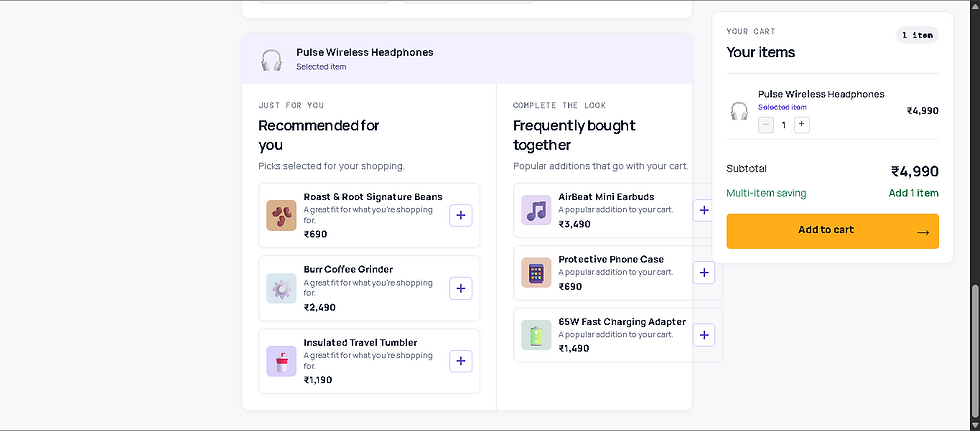
What “frequently bought together” should really mean
There is a familiar version of this idea on many retail sites: “customers also bought.” It can be useful, but only when it is anchored in a real relationship. A universally popular product may appear in a large number of carts, but that does not make it a useful companion to every purchase.
Bundlewise therefore models product pairs. In the demo data, an espresso machine has strong relationships with beans, a grinder, a frother, care tablets, and espresso cups. A pair of headphones has relationships with a charging adapter, protective case, small speaker, or earbuds. A yoga mat has meaningful links to a hydration bottle, towel, mat-cleaning spray, resistance bands, and recovery roller.
The idea is straightforward: when items repeatedly appear together in past baskets, the application can treat that association as a signal. It is not a command. A person may already own the accessory, prefer a different brand, or simply not want it. That is why suggestions are presented as optional additions, not as forced bundles.

The cart is the conversation
This is the feature that makes Bundlewise more than a static recommendation page. A shopping cart is not just a checkout container. It is the clearest statement of what the shopper is doing right now.
Imagine a customer selects an espresso machine. Initially, coffee beans, a frother, and care tablets make sense as companion products. Then the customer adds beans. The system should not keep offering the beans they have already added. It should remove that duplicate from both recommendation shelves and look for a fresh useful option, perhaps a grinder, reusable filter, mug, or kettle. If the shopper then adds a frother, the basket becomes a stronger coffee-making context, and the ranking can change again.
Bundlewise recalculates after every cart mutation. Adding an item updates the shelves. Removing an item updates them again. Increasing a quantity also contributes to the context, because a larger quantity can signal a stronger intent. The app combines relationships from all cart items rather than letting the first selected product dominate forever. That is why the section has a subtle “Updated for your cart” acknowledgement: not a disruptive pop-up, simply a quiet confirmation that the store is paying attention.
The same principle works outside coffee. If someone starts with wireless headphones and then adds a fast charger, a protective case or power bank may become more relevant. If they start with runners and add performance socks, insoles or sneaker-care products can move upward. If someone builds a yoga-and-recovery basket, a bottle, towel, roller, and mat-cleaning spray become more coherent than an unrelated bestseller.
Most importantly, the shelves exclude products already in the cart. That sounds obvious, but it is the difference between a recommendation system that notices a decision and one that merely repeats a static list.
Recommendations must remain purchasable
An intelligent suggestion is not useful if the shopper cannot complete the purchase. Bundlewise connects recommendations to inventory-aware cart behaviour. Every cart item has minus and plus quantity controls. The plus control cannot push the quantity beyond the available synthetic stock. At the maximum, the interface explains that the stock limit has been reached.
The cart updates the number of items, the subtotal, and any multi-item saving as quantity changes. Removing an optional add-on removes it from the cart and returns the recommendation engine to the new context. The primary selected item remains the starting point of the current shopping session, while related additions can be changed freely.
This is a small detail with an important lesson: shopping intelligence should respect operational reality. A recommendation engine is only one part of a retail experience. Catalogue data, stock, delivery, pricing, and checkout all need to agree with what the shopper sees.

A simple architecture behind a natural experience
The implementation can be understood without a data-science degree. Think of Bundlewise as five small decisions in sequence:
Catalogue and stock → Shopper history → Current cart → Ranking rules → Storefront shelves
The catalogue provides products, categories, prices, and available quantity. Shopper history provides a small picture of preferences. The cart tells the system what the person is interested in at this moment. The ranking rules look for unseen products that fit the shopper or commonly go with the basket. Finally, the storefront shows the best few suggestions in familiar product-card form.
For the MVP, this is intentionally deterministic and explainable. The synthetic data has deliberately created product relationships, and the rules make those relationships visible. That is a strength at this stage: stakeholders can change a shopper, choose a product, add an item, and see why the screen changes. There is no need to pretend that a prototype has a mysterious production-scale machine-learning model behind it.
In a production version, the same architecture could connect to real catalogue and inventory systems, build product-pair statistics from completed orders, respect customer consent, and be evaluated through controlled experiments. The principle would remain the same: do expensive learning offline, then make fast, useful decisions while the person shops.
Where this can go next
Bundlewise proves a practical point: a smarter commerce experience does not need to look like a laboratory. It can look like a good shop. The catalogue remains easy to browse. The cart remains the place to manage a purchase. Recommendations become more useful because they are responsive, complementary, and aware of what has already changed.
Production readiness would add real event collection, a catalogue service, near-real-time inventory, privacy controls, cold-start policies for brand-new shoppers, experimentation, and monitoring. The MVP does not claim to replace those systems. It demonstrates the shopping behaviour that those systems should ultimately support.
Want to turn a static catalogue into a smarter shopping journey? Build your next commerce experience with Codersarts.
A closer look at the shopper journeys
It is useful to slow down and see how the same storefront behaves for different people. A recommendation system should not have one idea of a “good” basket. It should be able to recognise that the customer buying an espresso machine, the customer preparing for a run, and the customer refreshing a home workspace are all asking the shop for different kinds of help.
Take the coffee journey. Priya begins with the espresso machine. Before anything else is in the cart, the frequently-bought-together shelf can reasonably lead with signature beans, a milk frother, and machine-care tablets. Those are close, practical companions to the primary purchase. Her personal shelf may include a grinder and an insulated tumbler because her profile has shown interest in premium coffee and kitchen upgrades.
When Priya adds the beans, the system has learned something new. It should not congratulate itself by displaying the same beans again. Instead, it can give more weight to products that make the combination better: a burr grinder, reusable filters, a pour kettle, or espresso cups. The cart now represents more than “coffee machine”; it represents an at-home coffee routine. That distinction is where ordinary recommendations often fail and where cart-aware ranking becomes useful.
Now imagine Arjun, whose synthetic history is oriented toward home workouts, hydration, and durable fitness gear. He may browse a yoga mat, then add a bottle and resistance bands. A helpful system can shift from showing broad wellness products toward the items that complete a workout setup: a quick-dry towel, recovery roller, mat-cleaning spray, protein blend, or shaker. There is no need to tell Arjun that a complex score changed. The evidence should be the usefulness of what appears next.
Finally, consider someone building a simple office setup. They select an ergonomic mouse, then add a compact keyboard. The cart becomes a workspace context. A laptop stand, desk lamp, cable organiser, or power bank has a much stronger case than an unrelated candle or running shoe. If they remove the keyboard, the stand may still be appropriate, but the ranking should soften. The store responds to intent as it develops, not just to a single click made several minutes ago.
These examples explain why a cart is richer than a one-time product view. Product selection says, “This caught my attention.” A cart says, “This is the problem I am trying to solve.”
How the live ranking stays sensible
There is a temptation to describe every recommendation system as if it reads minds. It does not, and it should not claim to. Bundlewise uses straightforward signals and a few sensible guardrails.
First, products already in the cart are removed from recommendation candidates. This prevents a silly but common outcome: asking somebody to add the same grinder that is already in their basket. Second, items that share a meaningful category or relationship with the basket receive more attention than generic popular products. Third, product-pair relationships are combined across the cart. If two cart items both connect to an accessory, that accessory becomes a stronger candidate than one connected to only a single product. Finally, a quantity can strengthen a signal without becoming an instruction. Two packs of protein powder might make a shaker or vitamins more relevant; they do not automatically mean the shopper wants a large unrelated fitness bundle.
The personal shelf and the companion shelf can therefore agree sometimes and disagree other times. That is healthy. A customer’s history may suggest a premium travel tumbler, while the cart relationship may suggest machine-care tablets. Both can be useful for different reasons. The layout allows the shopper to choose without making the logic feel contradictory.
When the signals are weak, the system should be humble. A new customer may have little or no history. A new product may not yet have enough co-purchase data. In those cases, category-adjacent recommendations and clearly useful accessories are safer than pretending to know too much. Production systems often call this a cold-start problem. In ordinary language, it means the store has not learned enough yet. The right response is a sensible default, not false certainty.
Why explainability still matters when the UI stays simple
The shopper-facing screen does not need a technical panel listing weights, confidence values, or association rules. Most people want to know whether an item looks useful, fits their budget, and is available. But the people building and operating the experience do need to understand why the app behaves as it does.
That is one reason this MVP uses deterministic, inspectable synthetic relationships. A designer can change a customer in the header, add an item, and observe the recommendation change. A product owner can ask why a certain product is prominent. A developer can trace the answer to a clear category, purchase-history, or co-purchase relationship. This makes the demonstration easier to trust and makes later improvement less risky.
In a production environment, explainability also supports quality control. Teams can detect when a broadly popular item overwhelms every page, when a low-margin accessory is being promoted too aggressively, or when a product relationship no longer reflects current buying patterns. “Smart” is not a permanent label attached to a model. It is a habit of measuring whether the experience continues to help.
What would change with real retail data
Synthetic data is useful for a demo because it is safe, controlled, and easy to understand. Real deployment introduces richer signals and more responsibilities. Products would come from a catalogue system rather than a hand-curated list. Prices and availability would be refreshed from inventory services. Completed orders, not assumptions, would update product-pair relationships. Search, clicks, saves, returns, and ratings could add context when used with appropriate consent and privacy safeguards.
Real data also calls for careful boundaries. A shopper should be able to understand and control personalised experiences. Teams should minimise data collection, protect sensitive information, and avoid using categories that could create unfair or uncomfortable outcomes. A recommendation is a suggestion, not a judgement about a person. The most trustworthy systems give people useful control: they allow removal, let users ignore suggestions, and do not make the checkout depend on accepting an upsell.
The operational side matters too. Recommendations should be measured against outcomes that genuinely help both the customer and the business. Add-to-cart rate is one useful measure, but it is not enough. Teams should consider conversion, return rate, repeat purchase, basket satisfaction, and whether recommendations create clutter. A higher click rate is not a win if it leads to confusing baskets or disappointed shoppers.
A practical production roadmap
The next step after an MVP like Bundlewise is not to jump immediately to the most complicated machine-learning stack. The sensible path is incremental.
Begin by connecting the real catalogue, stock, prices, and order data. Keep the existing clear rules while validating that product relationships make sense. Establish product-level quality checks and a way for merchandising teams to review relationships that affect important pages. Add privacy and consent choices before expanding behavioural inputs.
Then build a reliable offline process that refreshes co-purchase statistics on a defined schedule. This process can calculate which items occur together, reduce the influence of universally popular products, and store a compact set of related products for fast lookup. The live storefront should do only the quick part: combine the shopper context and cart context with those prepared relationships, exclude unsuitable or unavailable products, and return a short ranked list.
After that foundation is stable, controlled A/B tests can compare recommendation approaches. One version might emphasise complementary accessories; another may use more category affinity. Results should be evaluated by segment and category, not only as one global score. A coffee accessory strategy may work beautifully while the same approach is less appropriate for clothing. The point is not to chase a single magic formula. It is to learn where the experience creates value.
The takeaway
Bundlewise is deliberately modest in its promise and ambitious in its behaviour. It does not say that every shopper needs a mysterious AI assistant. It says a store should pay attention when somebody changes their mind, adds an item, removes an item, or reaches a stock limit. The best recommendation is not necessarily the most sophisticated-looking one. It is the next item that makes a purchase easier, more complete, or more satisfying.
That is the standard this application demonstrates: a normal shopping journey, made more responsive by the context a customer is already giving the store.
What a good recommendation experience does not do
It is worth being clear about the boundaries. Bundlewise does not trap a shopper in one category because they once bought something there. It does not hide the catalogue behind personalisation. It does not treat every product pair as a mandatory bundle. And it does not pretend that a low stock label is an emergency message designed to pressure somebody into buying.
Those are important design choices. A good recommendation shelf should widen a shopper’s useful options, not narrow them. A shopper can always browse another department, search directly, ignore a suggestion, remove an item, or change quantity. The cart is the shopper’s decision; the system’s role is to keep the next choice relevant as that decision evolves.
This also protects against a familiar retail failure: a page that is technically personalised but feels repetitive. If somebody has placed an espresso machine in the cart, showing five different coffee machines is not helpful. If they have selected runners, showing only more runners may be less useful than showing socks, insoles, care products, or a bottle. Complementary discovery is often more valuable than near-duplicate discovery.
Designing for confidence, not pressure
There is a difference between helping someone complete a purchase and pushing them to add more. The application uses a compact recommendation layout, clear prices, visible stock, and optional plus buttons because it should remain easy to say no. The cart shows what has changed. The shopper can remove optional additions. The added-to-cart state confirms an action without pretending that checkout has happened.
For a real business, this restraint is practical as well as ethical. Customers who understand a basket are less likely to abandon it because it has become confusing. Customers who see clear stock limits are less likely to encounter an unpleasant surprise later. Customers who receive relevant complements are more likely to feel that the store saved them another search. Trust is not a decorative value; it is what makes repeated shopping possible.
From demo to daily use
The demo is intentionally small enough to understand in one sitting. The customer switcher makes changes visible. Synthetic data keeps the story safe to demonstrate. Product groups are broad enough to show several kinds of basket: coffee setup, home workout, office desk, footwear care, or an everyday clothing purchase. That makes it a useful conversation tool for product teams, merchandisers, and business stakeholders.
In daily use, the customer selector would disappear. A signed-in customer’s consented history would provide context automatically; a guest would receive sensible category and cart-based recommendations. The same page could work on mobile, in an app, or at a kiosk. The principle does not depend on the interface size. The shopper does something, the system notices the updated context, and the next suggestion becomes more useful.
That is the lasting lesson of Bundlewise. Recommendation systems should not be treated as a feature that is finished once it appears on a page. They are a conversation with the cart. When the cart changes, the answer should change too.
Our Other Blogs
If you found this blog helpful, explore more AI resources from CodersArts AI to see how organizations are applying these systems to real world applications.
OpenAI for Agentic AI: What You Need to Know Before Building AI Agents https://www.ai.codersarts.com/post/openai-for-agentic-ai-the-essential-guide
Build a Multi-Agent AI Banking Document Processing Platform with n8n https://www.ai.codersarts.com/post/build-a-multi-agent-ai-banking-document-processing-platform-with-n8n
Production Observability for AI Agents on AWS: Traces, Latency, Tokens, and Failures https://www.ai.codersarts.com/post/production-observability-for-ai-agents-on-aws-traces-latency-tokens-and-failures
Microsoft Agent Framework for Agentic AI: Everything You Need to Know https://www.ai.codersarts.com/post/microsoft-agent-framework-for-agentic-ai-everything-you-need-to-know
References
1. Linden, G., Smith, B., and York, J. [Amazon.com Recommendations: Item-to-Item Collaborative Filtering](https://www.cs.umd.edu/~samir/498/Amazon-Recommendations.pdf). IEEE Internet Computing, 2003.
2. Agrawal, R., Imieliński, T., and Swami, A. [Mining Association Rules Between Sets of Items in Large Databases](https://dl.acm.org/doi/10.1145/170035.170072), 1993.
3. [ACM Conference on Recommender Systems](https://recsys.acm.org/).
4. Google, [Rules of Machine Learning](https://developers.google.com/machine-learning/guides/rules-of-ml).
5. National Institute of Standards and Technology, [Privacy Framework](https://www.nist.gov/privacy-framework).


Comments