

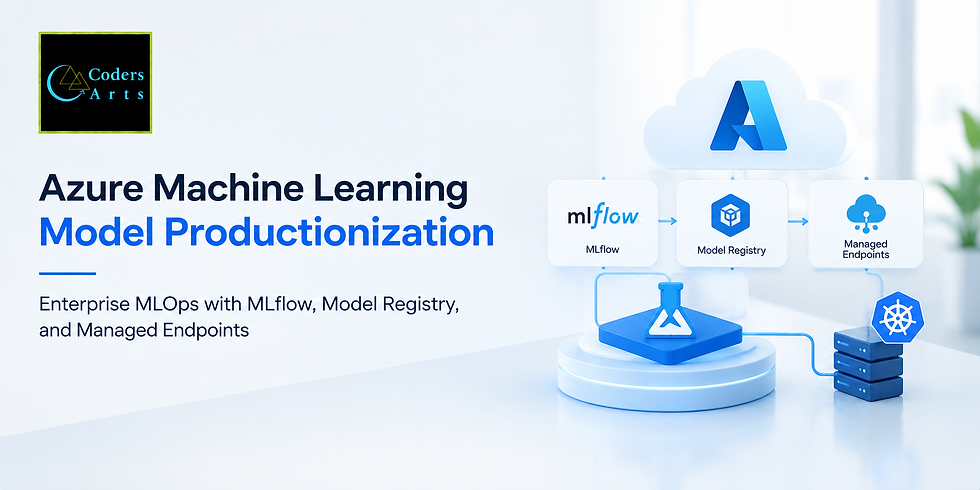
Azure Machine Learning Model Productionization: Enterprise MLOps with MLflow, Model Registry, and Managed Endpoints
.jfif/v1/fill/w_320,h_320/file.jpg)
Across the enterprise technology landscape, the primary challenge in machine learning is no longer algorithmic discovery; it is productionization. Data science teams routinely construct high-performing predictive models inside interactive Jupyter notebooks. Yet, industry studies consistently reveal that over 80% of enterprise models never reach production, and those that do often take months to deploy.
The root causes of this "notebook-to-production" chasm are well-documented:
Fragile, Unversioned Artifacts: Serialized model files (`.pkl` or `.joblib`) are stored ad-hoc in shared cloud storage with no auditable lineage connecting them back to the exact training dataset, hyperparameter set, and source code commit.
Train-Serve Skew: Feature transformations (such as scaling, imputation, and categorical encoding) executed in exploratory notebooks are omitted from the deployed binary, requiring complex and error-prone re-implementation in downstream serving applications.
Absence of Automated Quality Gates: New model candidates are promoted based on subjective evaluation rather than rigorous, automated statistical comparison against existing production champion models.
Runaway Cloud Hosting Costs: Inference models are deployed to 24/7 dedicated virtual machine endpoints for business workloads that only require periodic scoring or occasional testing, resulting in thousands of dollars in wasted compute spend.
This comprehensive guide delivers an architectural blueprint and practical execution manual for building an enterprise-grade Azure Machine Learning Model Productionization Pipeline.
Covering Azure ML v2 (SDK & CLI), MLflow, Azure ML Model Registry, Azure Blob Storage, Automated Evaluation Quality Gates, Azure ML Managed Online Endpoints and Batch Endpoints, and Azure DevOps CI/CD Pipelines, this guide demonstrates how to establish an end-to-end MLOps lifecycle that is repeatable, auditable, and cost-controlled.
The Enterprise MLOps Chasm on Microsoft Azure
Traditional software engineering relies on deterministic compilation: source code is compiled into binaries and verified through unit tests. Machine learning introduces a complex dependency: runtime behavior is a joint function of source code, statistical properties of data, and hyperparameter configurations.
Production Software = Code
Production Machine Learning = Code + Data + Hyperparameters + Environment
When organizations attempt to bridge the gap between experimental data science and production engineering through manual steps, severe operational anti-patterns emerge:
Exploratory Notebook Workflows | Enterprise Azure MLOps Pipelines |
Local execution; hardware bound | Managed Azure ML compute (Serverless/Clusters) |
Unversioned data snapshots on disk | Immutable Azure ML Data Assets (v1, v2) |
Unrecorded metrics in console logs | Centralized MLflow tracking & visualizations |
Orphaned .pkl files in blob storage | Model Registry with lineage & version aliases |
Manual "click-ops" deployments | Automated quality gates & Azure DevOps CI/CD |
24/7 idle endpoint compute costs | Zero-idle-cost Batch Endpoints & Auto-Teardown |
The Risk of Orphaned Model Artifacts
When an engineer trains a model locally and uploads a serialized `.joblib` file to an Azure Blob Storage container, the operational context is permanently lost. Months later, if the model exhibits performance drift or regulatory auditors demand documentation, the organization cannot determine which dataset version, environment dependencies, or Git commit produced that specific binary.
The Train-Serve Skew Hazard
Data scientists often perform feature transformations—such as imputing missing values with median statistics, scaling numerical columns with z-scores, and one-hot encoding categories—using exploratory pandas code outside the model object. When the raw model is deployed, incoming production requests lack these transformations, leading to silent prediction corruption or application crashes.
The Azure ML v2 Paradigm
Azure Machine Learning (v2), paired with native MLflow integration, eliminates these failure modes. Azure ML v2 provides declarative YAML specifications, a modern CLI and Python SDK, managed serverless compute, and a centralized Model Registry that enforces governance from experiment to deployment.
Architecture of an Azure ML Production Pipeline
An enterprise MLOps architecture on Microsoft Azure organizes the machine learning lifecycle into structured, automated operational layers.
Phase | Pipeline Stage | Primary Infrastructure & Tooling | Operational Mechanics & Governance Controls |
1 | Data & Storage Management | Azure Blob Storage (workspaceblobstore), Azure ML Data Asset | Ingests raw tabular data and registers immutable, versioned Data Assets (azureml:bank-churn-data:1) |
2 | Managed Cloud Training | Azure ML v2 Command Job (Serverless Compute / CPU Cluster) | Executes modular Python training within a curated Scikit-Learn container, mounting versioned Data Assets directly to compute nodes |
3 | Experiment Tracking & MLflow | MLflow Tracking Server on Azure ML | Logs hyperparameters, scalar metrics (ROC-AUC, F1, Accuracy, Precision, Recall), evaluation plots, and standard MLflow Model Artifacts (MLmodel, model.pkl) |
4 | Model Registry & Governance | Azure ML Model Registry (azureml:bank-churn-classifier) | Enforces semantic versioning, assigns dynamic aliases (@candidate, @champion), and maintains end-to-end lineage (Dataset → Job → Commit → Model) |
5 | Automated Quality Validation Gate | Evaluation Quality Gate Script | Validates candidates on holdout data against thresholds (ROC-AUC $\ge$ 0.82, F1 $\ge$ 0.70) and @champion performance; promotes passed models or marks failed ones as @rejected |
6 | Cost-Optimized Inference & Serving | Azure ML Batch Endpoint / Ephemeral Managed Online Endpoint | Deploys models to zero-idle-cost Batch Endpoints or provisions Ephemeral Online Endpoints for immediate deployment smoke testing and automated teardown |
7 | Continuous Integration & Delivery | Azure DevOps Pipelines (azure-pipelines.yml) | Automates end-to-end execution: code testing, cloud training, quality evaluation gating, model registration, and deployment validation |
Architecture Note: This workflow establishes an enterprise-grade Azure MLOps loop, ensuring all deployments pass automated quality gates with complete lineage tracking and zero idle compute waste.

Cloud Infrastructure Foundation: Resource Groups, Workspace v2 & Storage
An enterprise MLOps platform on Microsoft Azure requires configuring an integrated ecosystem of cloud resources.
Azure ML Workspace v2 Architecture
The Azure ML Workspace is the centralized hub for machine learning assets, compute, and governance. When an Azure ML Workspace is provisioned, it automatically provisions and links four essential Azure services:
1. Azure Blob Storage Account: Acts as the primary underlying datastore (`workspaceblobstore`). All training scripts, Data Assets, and exported MLflow model binaries reside in durable blob containers.
2. Azure Key Vault: Securely manages secrets, database credentials, and service principal tokens without exposing them in training scripts.
3. Azure Application Insights: Captures live telemetry, request volumes, and operational latencies from deployed Managed Online Endpoints.
4. Azure Container Registry (ACR): Stores customized Docker images used for training environments or specialized inference runtimes.
Identity and Access Management (IAM) & Least Privilege
Executing automated training jobs and CI/CD pipelines under personal user accounts is an enterprise anti-pattern. Workloads must execute under dedicated Managed Identities or Service Principals configured with least-privilege role-based access control (RBAC):
`AzureML Data Scientist`: Permits creating training jobs, reading data assets, logging metrics to MLflow, and registering models.
`Storage Blob Data Contributor`: Grants read/write access to Azure Storage containers holding training data and model artifacts.
Data Asset Versioning & Train-Serve Integrity
A primary reason machine learning models fail in production is Train-Serve Skew—a divergence between the feature transformations applied during model training and the preprocessing applied to incoming live inference requests.
Eliminating Train-Serve Skew with Unified Pipelines
Consider a standard tabular classification scenario (such as bank customer churn or credit default prediction). The raw dataset contains numerical features (e.g., credit score, balance, age) and categorical features (e.g., geography, gender, card status).
The Anti-Pattern: A data scientist cleans the data in a notebook using separate pandas commands (`df.fillna()`, `pd.get_dummies()`), saves a cleaned CSV, and fits a raw scikit-learn or XGBoost model. In production, incoming inference requests arrive as raw JSON strings. Downstream software engineers must manually re-create the data preprocessing in microservices, causing immediate mathematical discrepancies and silent prediction errors.
The Production Pattern: The feature engineering logic (imputation, standard scaling, one-hot encoding) is encapsulated directly inside a single Scikit-Learn `Pipeline` combined with a `ColumnTransformer`. The entire pipeline is fitted simultaneously and serialized as a unified object.
Step | Pipeline Stage | Technical Component | Transformations & Operational Behavior |
1 | Ingress Payload Parsing | Raw Request Payload | Ingests incoming raw JSON payload containing un-preprocessed feature columns |
2 | Feature Preprocessing | ColumnTransformer (Stage 1) | • Numerical Features: Imputes missing values (strategy='median') → Scales features via StandardScaler() • Categorical Features: Fills missing values (fill_value='missing') → Encodes via OneHotEncoder(handle_unknown='ignore') |
3 | Model Inference | RandomForestClassifier (Stage 2) | Evaluates transformed feature array using trained ensemble estimator (n_estimators=100, max_depth=8) |
4 | Egress Response Construction | Prediction API Response | Formats inference score into standard outgoing JSON output ({"predictions": [0.184]}) |
Pipeline Encapsulation: Encapsulates feature engineering and estimator logic into a single serialized MLflow artifact, eliminating training-serving data leakage and feature skew.
When serialized in this manner, the model artifact accepts raw, un-transformed JSON payloads in production, applies the exact mathematical transformations learned during training, and emits predictions without requiring auxiliary preprocessing microservices.
Immutable Azure ML Data Assets
In a production MLOps pipeline, models should never read unversioned files directly from arbitrary storage URLs. Instead, datasets are registered as Azure ML Data Assets:
Semantic Versioning: Each dataset update creates an immutable version (e.g., `azureml:bank-churn-data:1`, `azureml:bank-churn-data:2`).
Audit Lineage: Azure ML tracks which model was trained on which specific version of the Data Asset.
Storage Abstraction: Training scripts reference the Data Asset by name; Azure ML handles mounting the underlying blob storage automatically.
Managed Cloud Training with Azure ML Command Jobs & MLflow
While local model training is suitable for rapid exploratory prototyping, production model training must execute on managed cloud compute.
Local Workstation / Notebook | Azure ML Managed Command Jobs |
Compute-constrained (local CPU) | Scalable cloud compute (Serverless / Clusters) |
Job terminates if connection drops | Fully managed background cloud execution |
Environment drift & dependency hell | Ephemeral, reproducible Docker environments |
Unaudited local artifact storage | Automatic registration in Azure ML & MLflow |
Hardware costs run continuously | Billed per-second; auto-shutdown to 0 nodes |
The Azure ML v2 Command Job Lifecycle
When you submit an Azure ML Command Job, the platform executes an automated operational workflow:
1. Compute Provisioning: Azure ML allocates the requested compute target. Organizations can choose between Serverless Compute (instant provisioning without cluster management) or dedicated AmlCompute Clusters (`cpu-cluster` with auto-scaling from 0 to 4 nodes).
2. Environment Resolution: Azure ML pulls the designated container environment. Azure provides curated, pre-built environments (e.g., `AzureML-sklearn-1.5`) containing optimized Python, scikit-learn, and MLflow runtimes.
3. Data Mounting: Azure ML mounts the versioned Data Asset from Azure Blob Storage into the container filesystem at runtime.
4. Code Execution: The designated Python training module is executed with hyperparameter arguments.
5. Telemetry & Log Streaming: All `stdout` and `stderr` logs are streamed in real time to the Azure ML Studio console and Azure Application Insights.
6. Compute Deprovisioning: When the training script exits, Serverless compute terminates immediately, or compute cluster nodes scale down to 0, ensuring zero ongoing idle costs.
Deep MLflow Tracking Integration
Azure ML features native, managed integration with MLflow. Without configuring external servers or database backends, training scripts utilize standard MLflow APIs that automatically log to the Azure ML workspace:
Hyperparameter Tracking: `mlflow.log_params()` records tree depth, estimators, and learning rates.
Performance Metrics: `mlflow.log_metrics()` records Accuracy, Precision, Recall, F1-Score, and ROC-AUC.
Evaluation Artifacts: `mlflow.log_artifact()` records confusion matrix heatmaps and ROC curve charts.
Standardized Model Packaging: `mlflow.sklearn.log_model()` packages the model with an inferred Model Signature (strict input/output schema contract) and a `conda.yaml` environment definition.
Azure ML Model Registry: Governance, Lineage & Version Aliases
The Azure ML Model Registry serves as the centralized catalog and governance authority for all machine learning models across an enterprise.
Version | Model Resource URI | Tags & Metadata | Assigned Alias | Operational Status |
v1 | azureml://registries/.../models/bank-churn-classifier/versions/1 | framework=sklearn author=ci-runner | @archived | Retired / Legacy model version |
v2 | azureml://registries/.../models/bank-churn-classifier/versions/2 | framework=sklearn author=ci-runner | @champion | Active production model serving live traffic |
v3 | azureml://registries/.../models/bank-churn-classifier/versions/3 | framework=sklearn author=ci-runner | @candidate | Currently undergoing automated quality validation |
Registry Governance: Target Model bank-churn-classifier. Production deployment pipelines and endpoint configurations consume dynamic aliases (@champion, @candidate) rather than hardcoded version integers to enable seamless, zero-downtime model promotion.
Registering Models Directly from MLflow Runs
Rather than downloading model binaries locally and re-uploading them, Azure ML permits direct registration from the completed training run:
az ml model create --name bank-churn-classifier --version 1 --type mlflow_model --path "runs:/<RUN_ID>/model"
This ensures complete cryptographic and operational lineage:
The registered model retains an immutable backlink to the exact Azure ML Command Job that generated it.
Anyone inspecting the model can view the training dataset version, code commit, and environment configuration.
Managing Lifecycles with Model Version Aliases
Enterprise MLOps avoids hardcoding specific version numbers in downstream deployment scripts. Instead, Azure ML utilizes Mutable Version Aliases:
`@candidate`: A newly registered model version undergoing automated quality gate validation.
`@champion`: The currently validated, active production model authorized to serve traffic.
`@archived`: Deprecated historical versions maintained strictly for compliance and auditing.
Downstream deployment systems simply request `azureml:bank-churn-classifier@champion`. When a new candidate passes validation, updating the alias instantly directs downstream systems to the new model version without modifying client code.

Automated Model Evaluation & Quality Validation Gates
In a mature enterprise MLOps pipeline, model registration does not equal model release. A newly registered model version tagged as `@candidate` must satisfy automated Quality Gates before it can be certified for production deployment.
Step | Pipeline Stage | Technical Action & Evaluation Criteria | Outcome & Operational Impact |
1 | Dataset & Model Loading | Ingests the trained candidate model artifact (@candidate) and holdout test split | Prepares isolated, unseen dataset for evaluation |
2 | Quantitative Metric Computation | Computes core classification metrics: ROC-AUC, F1-Score, Accuracy, and Precision | Generates standardized evaluation metrics for threshold comparison |
3 | Gate Threshold Validation | Evaluates candidate metrics against defined deployment gates: • ROC-AUC >= 0.82 • F1-Score >= 0.70 • Performance >= current @champion | Determines whether candidate model meets production deployment criteria |
4a | Model Promotion (PASSED) | Triggered when all absolute and relative thresholds are satisfied | • Promotes model alias: @candidate → @champion • Authorizes downstream deployment pipelines |
4b | Pipeline Halt & Alert (FAILED) | Triggered when candidate fails any quality threshold | • Marks model version as @rejected • Halts CI/CD pipeline and sends automated alerts via Slack/Teams |
Automated Governance: Quality gates act as an automated circuit breaker in CI/CD pipelines, preventing model regression by ensuring only validated models reach production endpoints.
Quantitative Validation Thresholds
Validation gates evaluate performance metrics computed strictly on the unseen holdout test dataset:
1. Absolute Performance Floor: The model must exceed predefined business-level minimums:
Quality Gate Thresholds:
ROC-AUC >= 0.82 AND F1-Score >= 0.70
Validation Requirement:
A candidate model must satisfy both metric criteria simultaneously (ROC-AUC >= 0.82 and F1-Score >= 0.70) to successfully pass automated quality evaluation and qualify for production promotion.
2. Relative Performance Benchmark: The candidate model must demonstrate statistical parity or superiority when compared against the currently active `@champion` version on identical test data slices.
3. Inference Contract & Schema Verification: The candidate artifact is loaded in an isolated test harness to confirm that it correctly processes standard JSON payloads matching the registered MLflow signature.
If all validation criteria are satisfied, an automated script updates the version alias in Model Registry, promoting the candidate to `@champion`. If validation fails, the pipeline halts immediately, preserving the existing champion without operational disruption.
Serving Strategies & Cost Optimization: Batch vs. Online Endpoints
A frequent mistake in cloud machine learning is deploying 24/7 dedicated online endpoints for workloads that do not require real-time, millisecond-level responses.
Organizations must balance their serving requirements against the Serving Cost-Latency Matrix:
Architectural Dimension | Azure ML Batch Endpoints | Azure ML Managed Online Endpoints |
Latency Profile | Minutes to Hours (Asynchronous) | Sub-second (10ms – 100ms Synchronous HTTP) |
Compute Lifecycle | Ephemeral: Cluster spins up, scores, and tears down on completion | Persistent: Compute instances run continuously to serve live requests |
Idle Infrastructure Cost | EXACTLY $0.00 / hour | ~$50 – $200+ / month per node |
Data Ingestion Format | CSV, Parquet, or JSON in Azure Blob Storage | REST JSON payloads |
Primary Enterprise Use Cases | Daily churn scoring, risk assessment, offline ETL pipelines | Real-time checkout fraud detection, live interactive apps |
Trade-off Analysis: Batch Endpoints optimize for total cost efficiency by eliminating idle compute costs for non-time-sensitive workloads, whereas Managed Online Endpoints trade higher baseline operational costs for low-latency synchronous REST serving.
Strategy A: Azure ML Batch Endpoints (The Zero-Idle-Cost Champion)
For tabular scoring workloads (such as generating customer churn risk scores every night or updating credit limits weekly), Azure ML Batch Endpoints are the enterprise standard.
How Batch Endpoints Work:
1. Input data containing thousands or millions of un-scored records is uploaded to Azure Blob Storage.
2. A Batch scoring job is submitted referencing the model version from Model Registry:
az ml batch-endpoint invoke --name bank-churn-batch-ep --input azureml://datastores/workspaceblobstore/paths/unscored_data.csv3. Azure ML dynamically provisions compute cluster nodes, pulls the serving container, parallelizes the scoring workload across workers, and writes the output predictions directly back to Azure Storage.
4. The moment scoring completes, the compute nodes are de-allocated. Compute billing stops immediately upon job completion. Idle compute cost: Exactly $0.00.
Strategy B: Ephemeral Managed Online Endpoints (Controlled Smoke Testing)
When real-time HTTP prediction is required, Azure ML provides Managed Online Endpoints. Because our model was packaged as a standard MLflow model, Azure ML automatically provisions the production serving container runtime with zero custom scoring scripts or Flask/FastAPI wrappers required.
To verify deployment readiness without incurring runaway 24/7 cloud costs, enterprise teams utilize an Ephemeral Verification Workflow:
[Deploy Candidate to Managed Online Endpoint]
↓
[Dispatch Live Test Payload via az ml online-endpoint invoke]
↓
[Capture Screenshots & Validate HTTP 200 Response]
↓
[Execute Automated Teardown Script: az ml online-endpoint delete]
↓
[Ongoing Compute Charges: Exactly $0.00]
1. Deploy: The model is deployed to an online endpoint with instance count 1 (`Standard_DS2_v2` or `Standard_D2s_v5`).
2. Verify: A synthetic client payload is dispatched, validating response schema, latency, and prediction confidence.
3. Teardown: Immediately upon verification, the automated pipeline deletes the endpoint, ensuring that compute charges are limited strictly to the few minutes required for testing.
CI/CD Pipeline Automation with Azure DevOps Pipelines
True organizational agility is achieved when the entire machine learning lifecycle—from code commit to model registration and deployment verification—is codified into an auditable, version-controlled Azure DevOps Pipeline.
The Five Sequential Pipeline Stages in `azure-pipelines.yml`
Stage | Pipeline Phase | Technical Tool / Mechanism | Operational Action & Governance Validation |
1 | Code Quality & Unit Tests | flake8, pytest tests/ | Enforces Python PEP8 code style standards and validates data pipeline integrity and MLflow prediction signatures |
2 | Cloud Training Job Submission | Workload Identity Federation, az ml job create | Authenticates via Azure Service Connection, submits v2 Command Job (jobs/train_job.yaml), and streams logs to MLflow |
3 | Automated Quality Gate | src/evaluation/evaluate.py | Evaluates candidate model against holdout test data, asserting required thresholds (ROC-AUC >= 0.82 and F1 >= 0.70) |
4 | Model Registry & Promotion | Azure ML Model Registry | Registers approved MLflow model artifact and updates version alias to @champion |
5 | Ephemeral Smoke Test | Ephemeral Online Endpoint / Batch Job | Deploys temporary infrastructure, verifies HTTP 200 OK inference response, and executes automated teardown to preserve $0.00 idle cost |
CI/CD Pipeline Integrity: Initiated via Git push or pull request merge, this Azure DevOps pipeline enforces end-to-end quality gates, zero-idle-cost smoke testing, and continuous model promotion for enterprise releases.
Key Advantages of Azure DevOps for MLOps
Passwordless Authentication: Uses Azure Resource Manager (ARM) Service Connections with Workload Identity Federation, eliminating the security vulnerability of managing long-lived client secrets.
Complete Regulatory Traceability: Every production model version in the Model Registry retains a direct backlink to the exact Azure DevOps build run and Git commit SHA that authorized its release.
Automated Rollback Triggers: If an evaluation gate fails, the pipeline halts immediately, leaving the existing `@champion` model active in production with zero downtime.
FinOps & Cost Optimization for Azure ML Workloads
Operating machine learning pipelines at enterprise scale requires rigorous financial operations (FinOps) controls to prevent unexpected cloud billing.
Eliminating Idle Compute Costs
1. Serverless Training Compute: Prefer Serverless Compute for custom training jobs. Azure provisions the virtual machine only for the exact duration of the training script and deprovisions it immediately upon completion.
2. Scale-to-Zero Compute Clusters: When using dedicated compute clusters (`AmlCompute`), always set `min_instances: 0` and configure an aggressive idle timeout (e.g., 120 seconds).
3. Default to Batch Endpoints: Unless an application strictly requires synchronous sub-second API responses, utilize Batch Endpoints to maintain a baseline idle compute cost of $0.00 / month.
4. Automated Teardown for Test Endpoints: In non-production testing pipelines, never leave online endpoints running. Enforce automated deletion scripts in CI/CD.
Azure Budget Alerts
Configure explicit Azure Cost Management Budget Alerts at $10, $50, and $100 thresholds with automated email notifications to engineering leads, guaranteeing immediate awareness of unexpected resource consumption.
Conclusion: Transforming Machine Learning into an Enterprise Asset
The maturation of enterprise artificial intelligence requires engineering organizations to bridge the divide between experimental data science and production engineering.
Training a machine learning model inside an isolated Jupyter notebook is an exploratory achievement of limited business value. Building an automated, auditable engineering pipeline that:
Versions datasets as immutable cloud assets,
Executes training within managed serverless cloud environments,
Tracks all hyperparameters, scalar metrics, and visual artifacts in MLflow,
Governs models within a centralized Model Registry with version aliases,
Enforces statistical quality gates before deployment approval,
Implements zero-idle-cost batch inference and ephemeral online verification, and
Automates the entire journey from code commit to release via Azure DevOps CI/CD...
...is what transforms experimental machine learning into an enduring enterprise competitive advantage.
By anchoring your MLOps practices in the unified platform capabilities of Azure Machine Learning v2, MLflow, and Azure DevOps, your organization eliminates deployment bottlenecks, ensures regulatory auditability, and delivers reliable AI solutions with optimized cloud economics.
About Codersarts & Enterprise Consulting Services
Building enterprise-grade MLOps pipelines, serverless cloud architectures, and resilient AI platforms requires cross-disciplinary expertise spanning cloud infrastructure, distributed data systems, and machine learning engineering.
Codersarts is an industry-recognized technology consulting and engineering firm specializing in Enterprise MLOps & LLMOps Architecture, Microsoft Azure Cloud Engineering, Kubernetes Platform Modernization, and End-to-End AI Product Development.
Service Area | Description & Scope |
Azure MLOps Architecture & Migration | We transition fragile Jupyter notebooks and legacy ML scripts into automated, reproducible production pipelines on Azure Machine Learning v2 and MLflow. |
Azure FinOps & Cloud Cost Optimization | Our certified cloud architects audit and refactor your ML compute to eliminate runaway bills, implementing serverless architectures and zero-idle-cost batch. |
Enterprise Model Governance & CI/CD | We design automated evaluation gates, model registries, and Azure DevOps GitOps pipelines tailored to strict enterprise compliance and security. |
Custom Enterprise AI/ML Development | From predictive analytics and tabular classifiers to generative AI and LLM agents, our engineering teams build scalable AI systems that deliver results. |
Partner with Our Principal Azure MLOps Architects
Whether you are designing a new MLOps platform from scratch on Microsoft Azure, refactoring existing machine learning workflows for automated CI/CD, or seeking expert engineering leadership:
Website: www.ai.codersarts.com
Email: contact@codersarts.com
Architecture Consultation: Contact us today to discuss your Azure ML, MLOps, and cloud infrastructure roadmap.
© 2026 Codersarts. All rights reserved. Microsoft, Azure, Azure Machine Learning, and Azure DevOps are trademarks of Microsoft Corporation.


Comments