

AI Operations & Infrastructure
MLOps & LLMOps Infrastructure Services
Build scalable infrastructure to develop, deploy, monitor, and govern machine learning models and large language models. We implement end-to-end MLOps and LLMOps pipelines that enable reliable, secure, and production-ready AI systems.
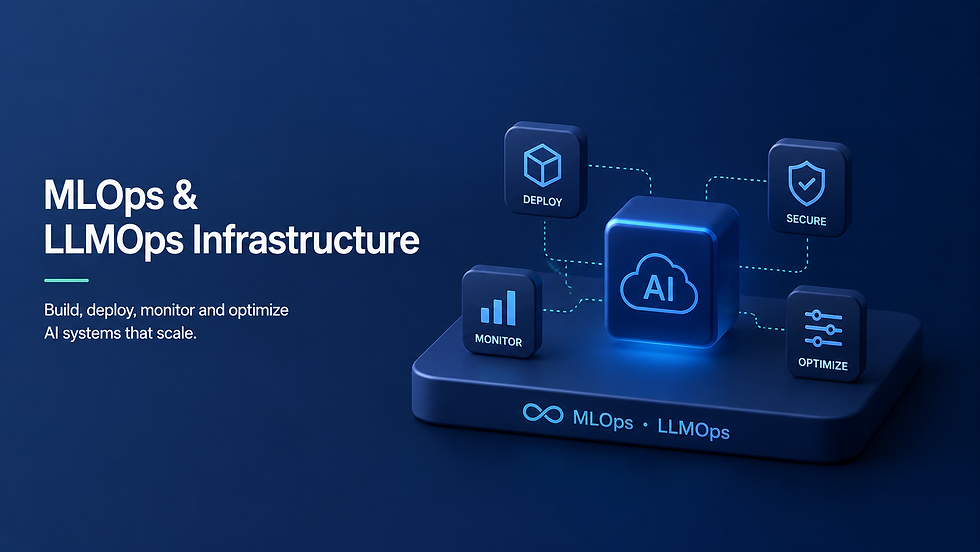
Build reliable infrastructure for deploying and managing AI at scale.
Growing AI Teams, Enterprises, AI Product Companies
MLOps / LLMOps Infrastructure
LLMOps Infrastructure Services to Enhance Your Applications with Powerful AI Capabilities
Our LLMOps infrastructure services give teams running LLMs in production the same engineering discipline they apply to the rest of their stack — model CI/CD, monitoring, cost visibility, and eval-in-prod — so AI features stay reliable as they scale, not just on launch day.
Book a Free Architecture Audit →
The Problem With "We Shipped It, Now What?"
Shipping an LLM feature is the start, not the finish. Most teams deploy a model or prompt, call it done, and then discover the problems later: response quality drifts as the model provider pushes an update, costs spike unexpectedly when a new use pattern emerges, and the only monitoring in place is an angry user email. Without the same infrastructure discipline applied to AI features that you'd apply to any other production service, LLM features degrade silently and expensively.
Ad-Hoc LLM Operations vs. LLMOps Infrastructure
Ad-Hoc Operations
Deployment: Manual, undocumented, no rollback path
Monitoring: None until something breaks and a user reports it
Cost visibility: Single monthly API bill with no per-feature breakdown
Model/prompt updates: Tested manually on a few examples, shipped on hope
Incident response: Reactive — team investigates after the fact
LLMOps Infrastructure
Deployment: Automated CI/CD with rollback on eval regression
Monitoring: Real-time latency, error rate, and output quality dashboards
Cost visibility: Per-feature, per-model cost tracking with anomaly alerts
Model/prompt updates: Automated eval suite runs before any change goes live
Incident response: Proactive — alerts fire before users are affected
What We Build
Model CI/CD pipeline — automated testing and deployment so every prompt or model change runs through your eval suite before it reaches production
Production monitoring dashboards — real-time visibility into latency, error rates, token usage, and output quality across every AI feature
Cost optimization layer — per-feature cost attribution, model-tier routing, and caching to eliminate waste without degrading quality
Eval-in-production — continuous sampling and scoring of live traffic to catch output drift weeks or months after launch, not just at release time
Alerting and incident playbooks — automated alerts when quality metrics drop below threshold, with documented runbooks so the on-call engineer knows what to do
Model versioning and rollback — clean versioning of models, prompts, and configs so reverting a bad update takes minutes, not an emergency all-hands
Who This Is For
Teams whose LLM features are in production but running without monitoring, cost attribution, or a safe deployment process
AI product companies scaling past early growth and seeing costs and reliability become real engineering concerns
Platform teams who need to support multiple LLM-powered features across different product areas and need a shared infrastructure layer
Regulated industries that need audit trails, access logs, and documented incident response for any AI system in production
Trusted Across 50+ Countries
Codersarts maintains a 4.9/5 client satisfaction rating across hundreds of engagements. Clients consistently note the team's reliability on technically complex engagements — Li (China) described the team as patient and thorough on a multi-part project, while Vivek (India) highlighted how the team broke down complex infrastructure work into something his team could own and maintain after handover.
Results
A consumer AI startup went from a single monthly API bill with no visibility to per-feature cost dashboards within three weeks, immediately identifying one low-priority feature consuming 40% of their LLM budget.
A B2B SaaS platform reduced mean time to detect production quality issues from days (when a user reports it) to under 15 minutes (automated eval-in-prod alert) after we deployed continuous output scoring on live traffic.
An enterprise software company cut LLM infrastructure costs by roughly 28% through model-tier routing and response caching, without any measurable change in output quality for end users.
(Client names withheld under NDA; case studies available on request.)
Pricing
Starter
Scope: Basic monitoring dashboard, cost attribution, alerting setup
Price: $10,000–$15,000 + $1,000/mo retainer
Production
Scope: Model CI/CD pipeline, eval-in-prod, cost optimization layer, incident runbooks
Price: $15,000–$25,000 + $2,000/mo retainer
Enterprise
Scope: Full LLMOps platform — multi-team, multi-feature, model versioning, audit trail, compliance logging
Price: $25,000–$30,000+ + $3,000/mo retainer
For context: MLOps platform builds and managed services in the US market typically run $50,000–$200,000+ for initial setup, with ongoing managed costs on top. Our pricing reflects high-quality offshore delivery and ongoing retainer support at a fraction of those rates.
How We Work
Infrastructure audit (Week 1) — map current deployment process, monitoring gaps, and cost structure
Build (Weeks 2–4) — CI/CD pipeline, monitoring stack, cost attribution
Eval-in-prod setup (Week 5) — configure continuous scoring against your eval criteria on live traffic samples
Handover + retainer — team trained on dashboards and runbooks; monthly retainer for ongoing tuning and incident support
Why Codersarts
As an MLOps consulting company focused on LLM systems, we build infrastructure that your engineering team can actually own after handover — not a bespoke internal platform that only we understand. Every engagement includes documented runbooks, a training session for your team, and a retainer structure designed to transfer knowledge over time rather than create a dependency.
Related Services
LLM Evaluation & Benchmark Engineering — the eval foundation that makes CI/CD gating and eval-in-prod possible
LLM Integration & API Orchestration — for teams that need provider-level reliability and cost routing built in before adding the ops layer
AI Agent Development — agentic systems have their own observability requirements beyond standard LLM monitoring
Private / On-Prem LLM Deployment — for teams self-hosting models who need infrastructure for those systems specifically
Get Started
Book a Free Architecture Audit →
FAQ
Do we need LLMOps infrastructure if we're using a managed provider like OpenAI?
Yes — a managed provider gives you uptime for their API, not visibility into your own AI feature quality, cost, or regression risk. Your eval suite, cost attribution, and deployment process are your responsibility regardless of which provider you use.
What monitoring stack do you build on?
We work with your existing observability stack where possible (Datadog, Grafana, CloudWatch) and add LLM-specific layers on top. We don't require replacing your current tooling.
How does eval-in-production work in practice?
A configurable percentage of live traffic is sampled and scored automatically using the same eval criteria as your CI pipeline. Results feed into a dashboard with trend lines and threshold alerts — you see quality drift emerging over weeks, not after a user complaint.
What's included in the monthly retainer?
Ongoing monitoring, alert triage, cost optimization tuning as your usage patterns evolve, and a monthly review of eval-in-prod trends. The retainer also covers updates needed when model provider APIs change.
Can you build on top of an existing LLM system or do you need to start fresh?
We build on top of existing systems in most cases. The audit in week one assesses what's already in place and identifies the highest-leverage gaps to close first.


Build Enterprise AI That Delivers Business Value
Whether you're deploying AI agents, building RAG systems, fine-tuning LLMs, or creating a complete AI Foundry, our team helps you design, build, deploy, and scale production-ready AI solutions tailored to your business.
From strategy and architecture to implementation and ongoing optimization, we work alongside your team to turn AI initiatives into measurable outcomes.
-
💬 WhatsApp available
-
🌍 Serving US · UK · Canada · Australia · UAE
We typically respond within 2–4 business hours.